Should You Sell Your Solana?
$SOL Price Prediction & Bull Market Strategy
April 20, 2024

GM! This is Milk Road PRO, lighting up your email inbox each Saturday with a report that helps you invest successfully in crypto. 💰
Today, we're diving into Solana—yup, the blockchain that's been declared more finished than a Thanksgiving turkey. 💀
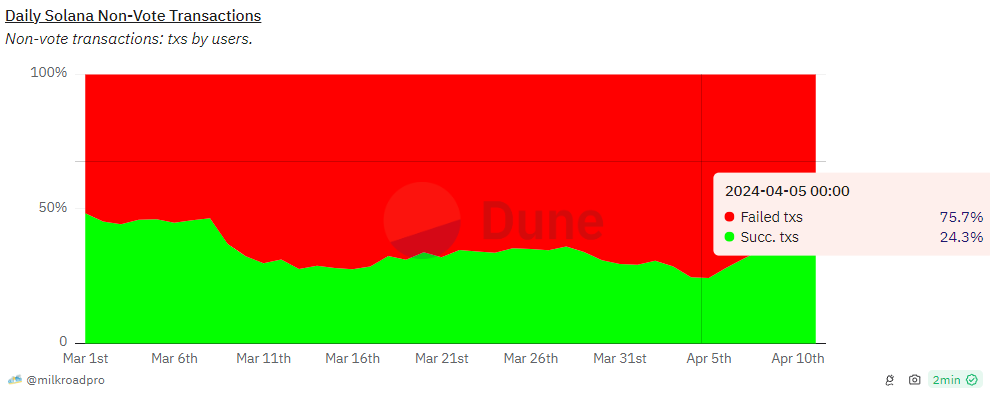
Maybe you’ve seen those viral charts on X suggesting that 75% of transactions on Solana fail?
Source: Dune
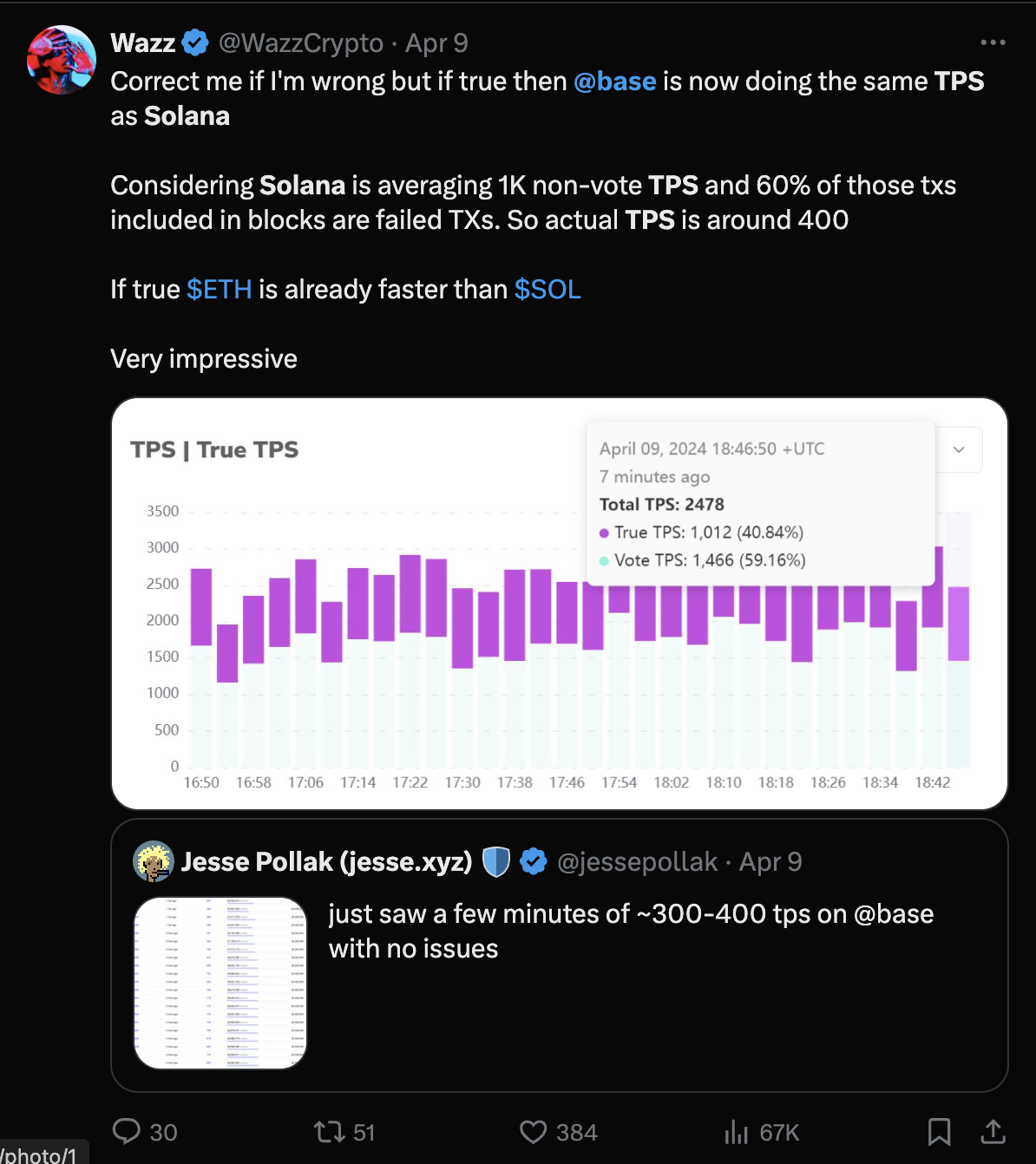
Or that Base is now doing more TPS (transactions per second) than Solana? ⚡
Source: WazzCrypto
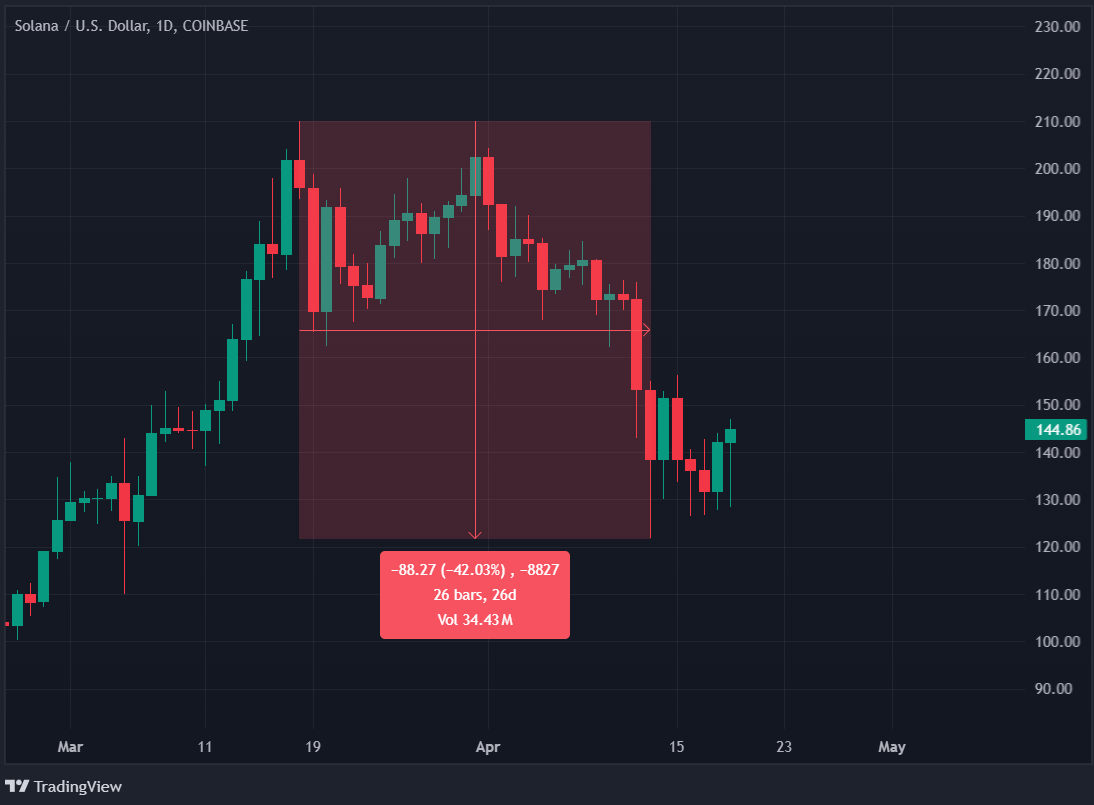
Not to mention, $SOL took a 42% nosedive from its local top on March 18th. 📉
Source: TradingView
Because of the continuous issues that Solana has faced over the years, many are starting to ask themselves:
-
Is Solana's time over?
-
Is it time to get out of $SOL?
-
Should we all give up on the promise of Solana?
Interestingly, one of the first ever PRO reports we wrote was called “Is Solana Dead?” from back in January 2023, where we made the case for its comeback, when $SOL was sitting around $8. 👀
We’ve written numerous times about Solana since then and even put a call out to our community to buy $SOL in October of last year when $SOL was around $30.
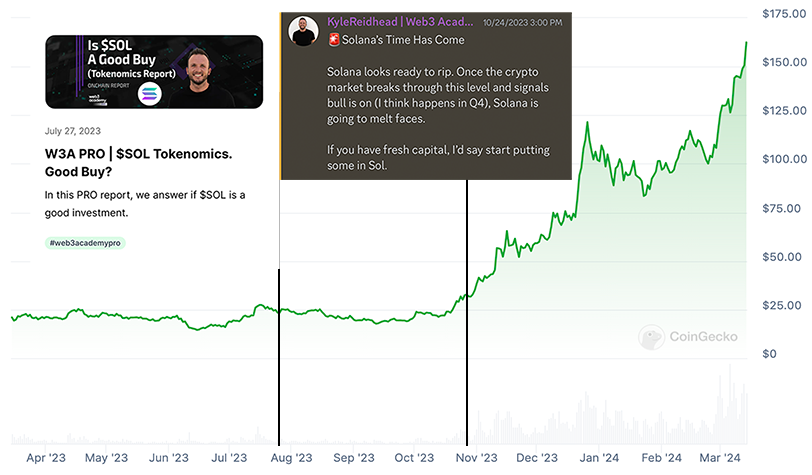
Going against the negative narrative on Solana has proven time and time again to be the right move. We think no differently this time around either.
In fact, we think Crypto Twitter couldn’t have this more wrong and are only hoping that $SOL will have a bigger pullback to create a better buying opportunity.
It appears many have forgotten or missed the fact that Solana is processing more transactions than the top 15 chains… combined! 🤯
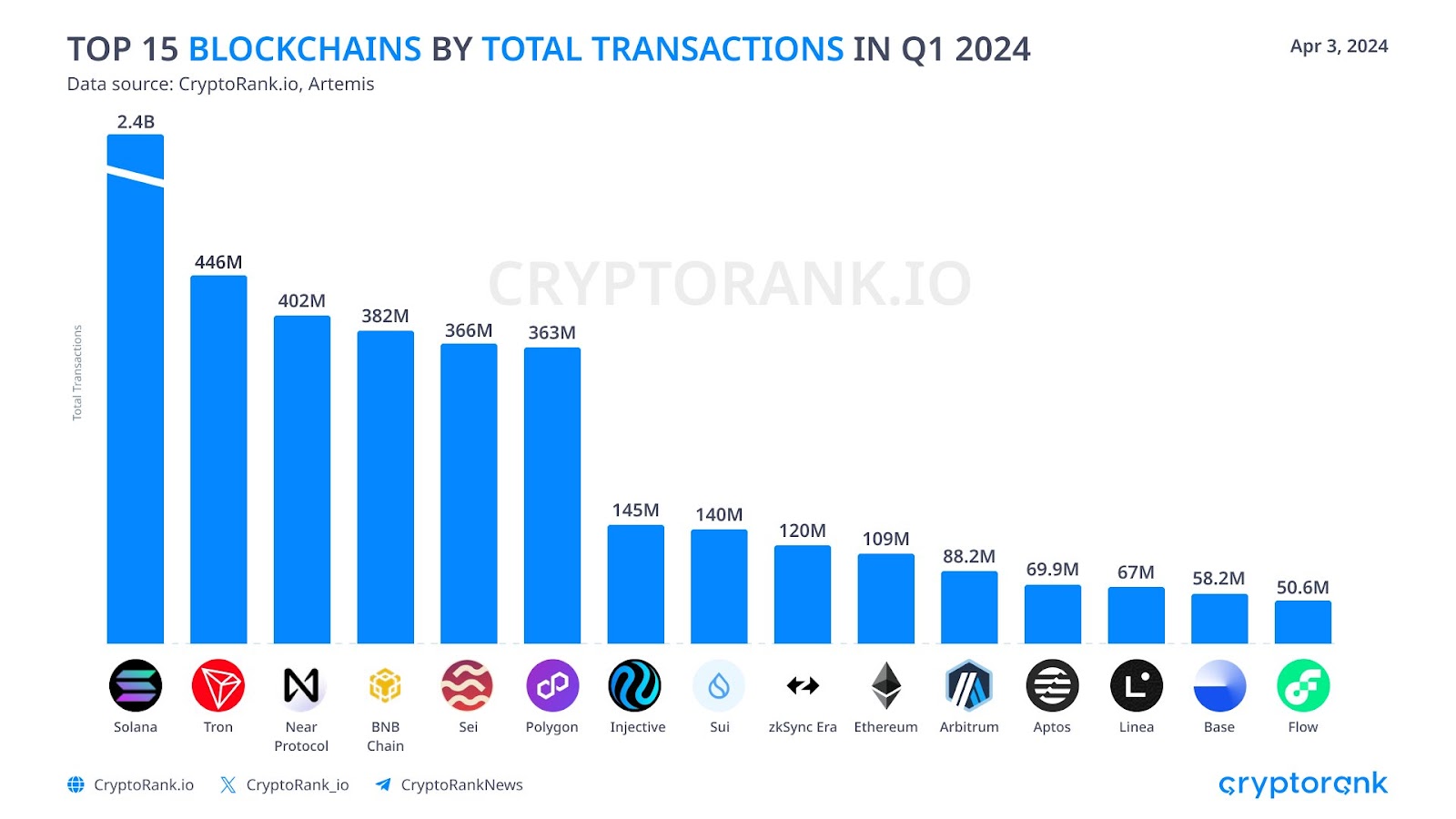
Source: CryptoRank
This chart may appear misleading because it's not showing the scale. But if you look at the numbers, Solana processed over 2.4 billion transactions in Q1 2024, far outpacing Tron, which handled 446 million.
In today’s PRO report we are going to cover:
-
Why Crypto Twitter has gotten the narrative wrong on Solana (...once again) 🤦
-
Where we think the price will go for $SOL this cycle 🤔
-
When to sell your $SOL 👀
-
What to do with your $SOL now to make more bang for your buck 💸
Let’s get after it! 👇
P.S. - We’re hosting an AMA next week — scroll to the bottom for more info. 👀
WHY SOLANA’S ISSUES AREN’T AS BAD AS THEY APPEAR 👍
Solana has experienced several significant outages.
The network suffered multiple major disruptions throughout 2022, particularly in January, April, May, June, September, and October.
More recently, there were disruptions in February 2023 and again in February 2024, almost exactly a year later.
Major outages on a live blockchain with millions of users and billions of capital is completely unacceptable.
The Solana team knows that and has been working tirelessly to fix those problems. Progress is happening very quickly on these issues.
However, Solana is struggling with an issue that no other blockchain has… processing BILLIONS of transactions per month!
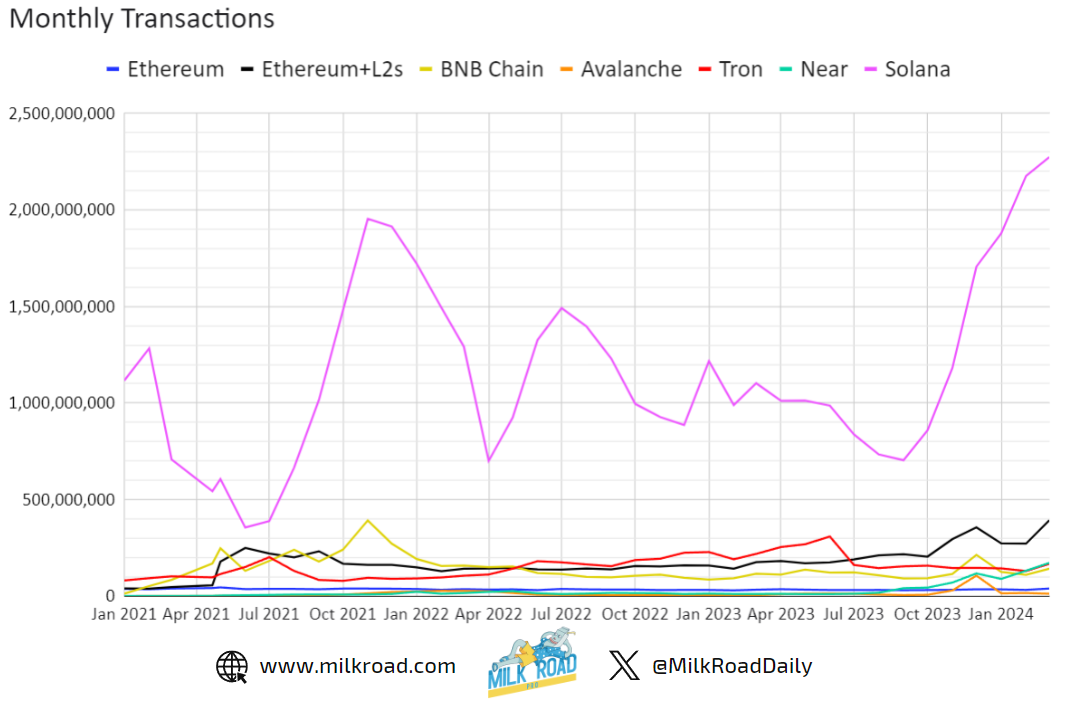
Solana is in a league of its own when it comes to transaction volume; no other chain comes close.
Even if you add up Ethereum and all its L2s—represented by the black line—you'll see they total around 400 million transactions per month.
While Ethereum and its ecosystem are performing remarkably well, Solana's numbers are simply on another level.
If we look at the TPS—a common way to measure the performance of a blockchain—Solana is processing more than 850 TPS, far outstripping Ethereum and all its L2s combined, which manage just over 150 TPS.
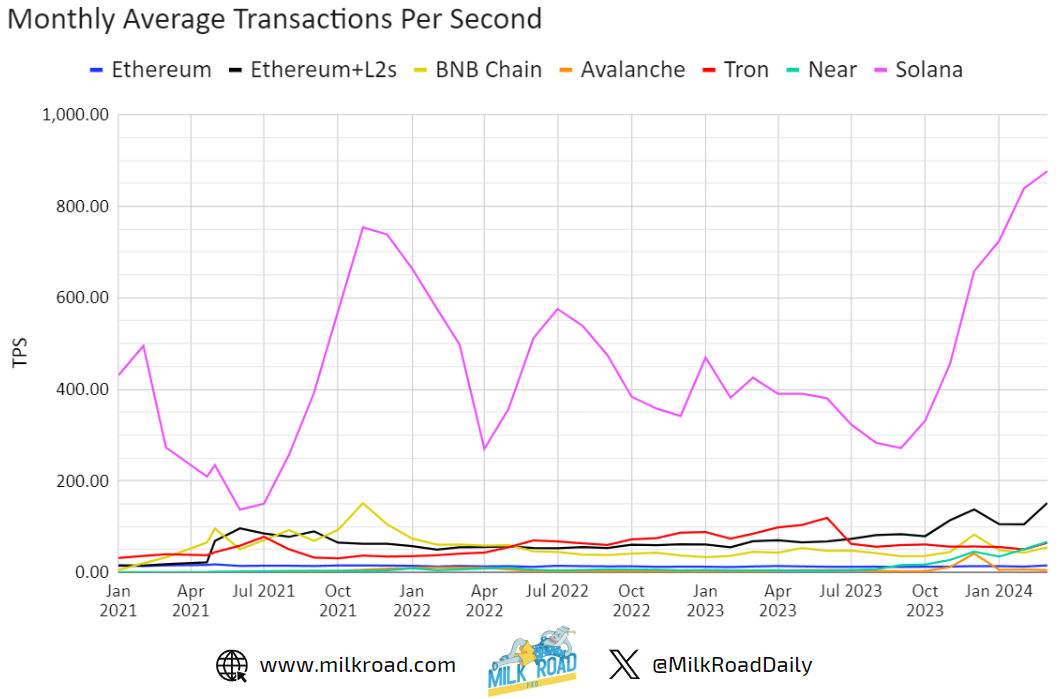
Ok, but 75% of these transactions fail, so who cares, right? 🤷
Let’s talk about this situation for a second. Without getting too technical, we’re going to give a simplified explanation as to what’s going on with these failed transactions, just so you have some context around this issue.
From a user perspective, when they make a transaction on Solana, there are 3 outcomes that can occur:
1/ Transaction is executed successfully.
2/ Transaction is executed but fails—gas is paid, but nothing else happens.
3/ Dropped transaction—the txn never appears on the chain, and no gas is paid.
#1 is straightforward.
#2 occurs when transaction conditions aren't met, such as when a mint is sold out or price slippage exceeds set limits. This isn't a blockchain failure, just an invalid transaction.
This is where the 75% of failed transactions chart above comes from, but it's not why most users complain about failed transactions (more on that in a second).
In this scenario, only about 8% of these 75% failed transactions are by actual users—the rest are failed transactions from arbitrage bots.
You see, Solana has such cheap fees that it’s a profitable business model for bots to spam the chain with thousands of transactions per day, in an attempt to earn profit for an arbitrage.
What may cost these bots hundreds of dollars a day in failed transaction fees, could earn them hundreds of thousands of dollars if one trade goes through.
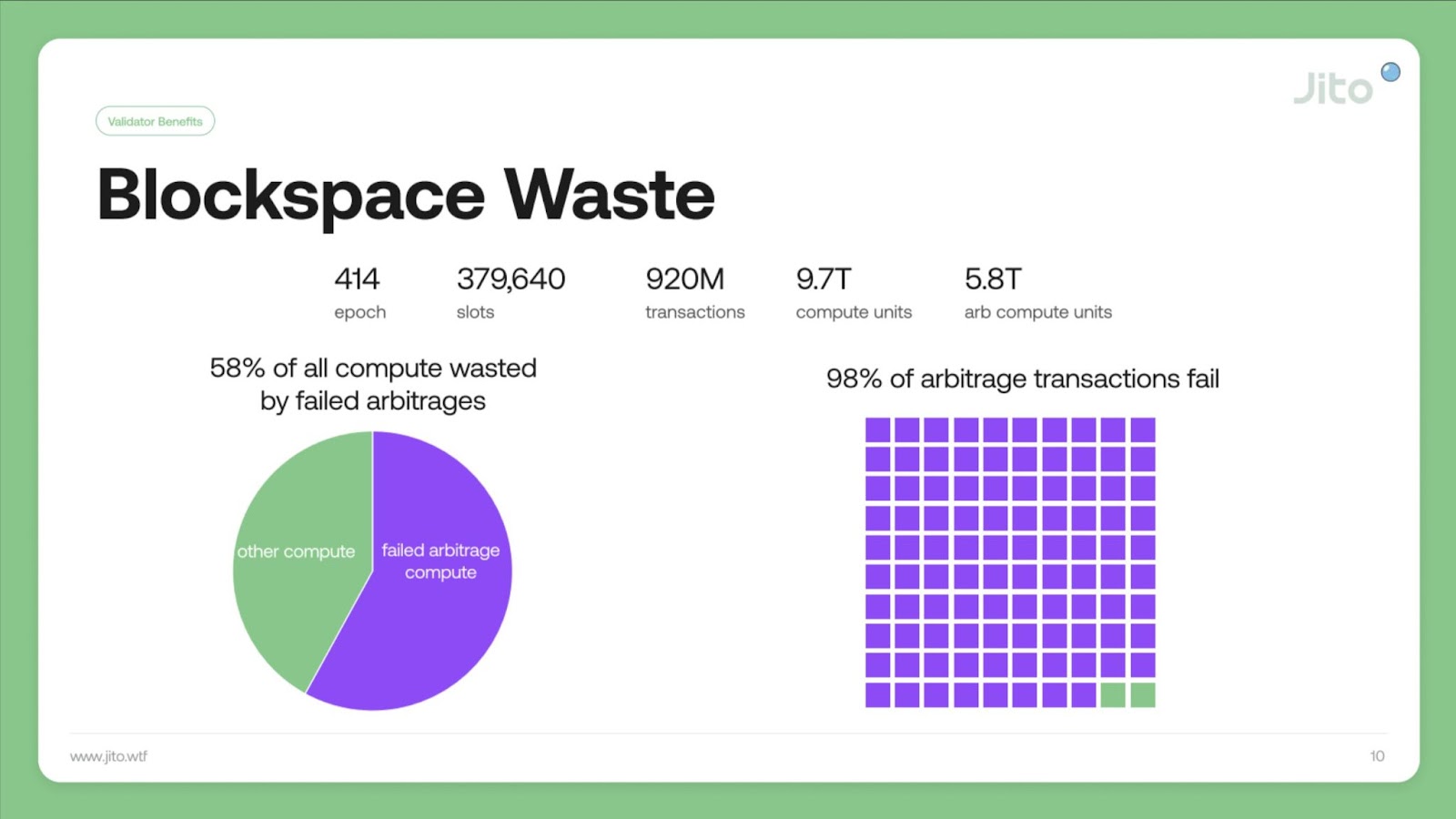
Source: Jito Blog
In this case, Solana operates exactly as intended at the execution or consensus levels of the blockchain, and the 75% failure rate shown in the chart is actually misleading.
Of course, improvements in the fee structure can be made here to prevent this, but that’s for another discussion.
#3, where transactions are dropped and never even reach the chain, is the real issue troubling users today, and it's not included in that 75% of failed transactions.
What’s happening here is that Solana recently upgraded to QUIC as its network layer (the messaging layer that connects the user transactions to the blockchain).
This new architecture was upgraded to help prevent Solana from halting when it’s congested (the problem mentioned above).
The issue is that this upgrade is still buggy and was poorly implemented, which happens when you need to make big technological changes at lightning speed to keep a blockchain running.
Don’t forget, Solana is technically still in beta!
As a result, the chain is working as usual but the bugs are causing issues in sending the transaction message to the blockchain to execute it.
These transactions fail not because of a Solana issue (they never actually reach the Solana blockchain), but because of an issue in the messaging layer, QUIC (a technology designed by Google, interestingly enough).
The good news is that Solana developers are and have been well aware of these issues and deployed a patch just a few days ago.
Looking at the long-term, teams such as Firedancer (by Jump) are overhauling much of the Solana codebase, aiming to fundamentally resolve these issues.
Don’t get this wrong, there is plenty of work to be done to improve the Solana blockchain, but these issues are nowhere near the level that influencers are telling you on Crypto Twitter and Youtube.
Solana is by far the most highly performant blockchain right now, with plenty of upgrades on the way to take it to another level.
THE BULL CASE FOR SOLANA 🐂
As Solana continues to work through its congestion issues, there are various client teams working in the background to make Solana even more performant than it is today.
The most exciting of these is Firedancer, who has built a 2nd client on Solana which has shown to have the ability to take Solana’s throughput from its theoretical 60,000+ TPS to more than 1 million. 🚀
Firedancer is already on testnet and is supposed to go live on mainnet at some point in Q3 or Q4 of 2024.
If Firedancer succeeds in their endeavours, it will undoubtedly put Solana so far ahead of every other blockchain in terms of performance, it wouldn't even be close.
Of course, L2s and other blockchains are scaling quickly as well, and it’s not all about speed and cheap transactions.
Ethereum’s L2 ecosystem has solved the scaling issue in its own way and will do very well as a result, as it has its own advantages to its solution.
What’s different about Solana however is that its scale is so large and so performant, that it can enable use cases that simply are not possible anywhere else.
Compression NFTs are one of those use cases. There is no other chain that enables the ability to mint more than 1 million NFTs for < $100.

Source: Solana Blog
This opens the door for use cases like Helium, creating millions of WiFi hotspots around the world using NFT infrastructure.
Entire sectors like DePin or AI will be built on Solana because they simply can’t function anywhere else (at least not right now).
More than 100 million NFTs were minted on Solana in the month of February alone via compression NFTs.
These numbers are absolutely ludicrous, and simply not possible anywhere else. 🤯

Source: Dune
Most people are bullish on Solana because that’s where all the memecoins are. Most believe it's “the chain for retail”.
But memecoins can be traded anywhere with relatively cheap transactions. We’re already seeing memecoins proliferate across Base, which arguably could also end up becoming the main retail chain, considering how easy the UX is to move from Coinbase to Base.
Regardless, no chain has a moat around memecoin trading.
But DePIN for example is a sector with incredible projects, building real solutions at scale (see PRO reports on Hivemapper and DePin) and they can only be built on Solana.
That is a real competitive moat and is the real bull case for Solana, though of course the memecoin mania on Solana right now doesn’t hurt either!
To be clear, Solana still has issues around its economics, as it’s extremely unprofitable and thus subsidising its chain via inflation.
However, in a bull market, these sorts of things matter much less. This is a problem for another day (...keep reading to learn about when that time is and what you should do about it).
$SOL PRICE PREDICTIONS 👀
Predicting the price of $SOL is extremely difficult, considering it's such a new asset and ecosystem.
The analysis below should not be taken as an exact prediction, but instead as a guide, to help build a thesis around $SOL throughout the cycle.
Although $SOL is new, it’s an asset very similar to $ETH, in the sense that it’s the native currency for a vibrant and growing ecosystem.
Regardless of what use cases take off, whether it’s memecoins, NFTs or something else, you need the native currency to interact and transact.
What this means is that so long as the Solana ecosystem grows in users and activity, the price of $SOL should grow along with it, just like this is true with $ETH.
If we compare the $SOL price in its first cycle (2021-2023), it performed almost identical to $ETH in its first cycle (2017-2020) in terms of price action and structure…

Source: Dune
If we now add Ethereum's second cycle to the chart, we can see what Solana could be in store for, if it follows the $ETH price structure for another cycle…

Source: CoinGecko
Should Solana follow Ethereum’s last cycle, then $SOL would top out around $900 this cycle.
Comparing market structure and price is one thing, but this doesn’t tell enough of the story.
What’s also important when comparing cycles is looking at the market caps (aka the valuations) as it really helps to put things into perspective.
Solana reached a $74.5 billion market cap in its first cycle—equating to only 53% of Ethereum’s market cap in its first cycle.

Source: CoinGecko
It's important to note that Solana's fully diluted market cap hit $200 billion—considering locked-up tokens not in circulation.
However, this metric is less indicative as these tokens couldn't be sold, unlike Ethereum, which never had locked tokens.
That said, if in this cycle, Solana again achieves 53% of the market cap of Ethereum in its last cycle, that would give Solana a top market cap of $302 billion and a price of $714.
Of course, there is potential that Solana could gain market share and relevance over Ethereum during this cycle (it undoubtedly already has), so let’s look at its price if Solana matched the market cap of Ethereum from last cycle.
If Solana reached a $571 billion market cap, that would put $SOL at $1,351 at the top of this cycle.
Based on the above analysis comparing $SOL to $ETH, if this crypto cycle plays out similar to the last 2 cycles, then Solana could top out somewhere between $750 and $1,450.
That's a 5 to 10x increase from Solana’s current prices of $145.
Remember, even $SOL hits these peak numbers, timing the top precisely is incredibly tough.
For context, $ETH reached its own market highs for only a few minutes—these weren't sustained prices but rather brief, volatile spikes during a bull cycle, quickly followed by sharp declines.
So, plan your profit-taking strategy wisely!
WHEN TO TAKE PROFITS ON $SOL 🤑
In our opinion, $SOL may not be a token you want to be holding throughout the bear market.
Don’t get us wrong, we believe Solana is here for the long term and will be an integral part of the crypto ecosystem for the foreseeable future. If you have a long enough time-horizon and are ok with holding through 80%+ dips, then this is not relevant.
But if you’re aiming to get the most out of this cycle, then below we’re going to explain why you might not want to hold $SOL during the inevitable bear market.
Although we classify Solana as one of the major players in crypto, it faces two issues compared to $ETH or $BTC that make it less appealing to hold post-bull cycle.
1/ Inflation
Solana has an inflation rate of 6.14% currently and while there is a plan for that to be lowered, it’s going to take years for this to play out.

Source: StakingRewards
Solana does have a burn mechanism, but it’s nowhere near enough to be relevant for this high of inflation. In a bull market, this isn’t an issue, but during a bear market, where there is less demand, this will without a doubt impact the $SOL price.
2/ Token Unlocks
$BTC and $ETH never had tokens that were vested over time for the team or VCs and they still managed to go down 70-80% during a bear market.
The dynamics for both of these assets are improving and we believe their dips will continue to be less and less through each cycle.
$SOL on the other hand doesn't fit into this category, yet. It still has plenty of token unlocks left for the team and investors (like FTX) which will occur throughout 2025 and 2026, right in the middle of the estimated next bear market.

Source: Solana Compass
During a bear market when there is much less demand for a token, unlocks can be very painful.
Adding more supply when there is lessening demand is a recipe for a 90%+ drop from all-time highs.
We believe it's very likely that Solana sees another very large drop once this bull cycle is over.
To be clear, we believe $SOL will do well long term, so again, you can simply hold through this, but we believe it would be wise to have a selling plan for $SOL throughout this cycle.
You can learn more about how we think about selling here, but in summary:
After $SOL reaches around $500 this cycle, it might be prudent to start dollar-cost averaging out of $SOL, hopefully consistently taking profits while $SOL climbs to new highs.
However, holding a certain % of $SOL for the long-term is always wise, in case the bear market never comes or we are wrong in our thesis.
But, you’ll want to ensure that you lock in profits on your $SOL, especially if you’ve been holding since <$20.
Of course, things can always change and our thesis or strategies can/should be updated with new information, but based on what we are seeing in markets so far, this seems like the best idea.
WHAT TO DO WITH YOUR $SOL NOW 🔥
There are endless opportunities to put your $SOL to work in. Whether that be for farming airdrops or generating yield.
We won’t be providing an exhaustive list here, but instead a way to think about your strategy by making the most while managing your risk.
To start, you shouldn’t hold any $SOL. You can earn 8%+ APY by staking your $SOL with minimal additional risk to your assets.
It is crazy to not be taking advantage of this right now.
You can delegate your $SOL to validators directly in your Phantom wallet, however, our recommendation is to swap your $SOL into $jitoSOL because this allows you to generate yield from both inflation as well as MEV rewards.
Jito is a well established protocol in the Solana ecosystem and while it too has additional risks, we believe they are very minimal at this point.
If you want to take things a step further, we recommend taking <20% of your $SOL and using it to farm future airdrops.
The 2 most well established airdrop farming opportunities are MarginFI (...if it ever comes!) and Kamino Finance (onto season 2 now).
You can deposit in MarginFI here.
You can deposit in Kamino Finance here.
For more ways to earn airdrops with your assets, check out the new Top Crypto Airdrops Guides with recommendations from Milk Road.
But be careful of two things:
1/ Fake links and scams. Always review URLs or click from trusted sources like Milk Road and our guide or directly from the source.
2. Avoid overleveraging when you supply and borrow. We suggest pairing similar assets, like jitoSOL and mSOL, whose prices tend to move together, minimizing your risk of liquidation.
The most important thing in investing is not to lose your assets!
There’s no need to go farther down the risk curve for a few extra %. It’s not worth it.
Greed is an investor’s worst enemy.
Stay safe and good luck out there! ✌️

GET YOUR MILK READY - WE’RE HOSTING AN AMA 🥛

You’ve got questions, we’ve got the answers (hopefully)…
Next Wednesday (April 24th) at 12PM EST, we’re hosting a PRO-only AMA in Discord — this is your chance to hang out with the Milk Road crew and get any questions answered!
IMPORTANT: Click here to submit your burning question(s) ahead of time — if you don’t, we might not tackle yours!
And, if you’re not already part of the Milk Road PRO Community, then use this button to join thousands of fellow PROs like 🫵