How to check your portfolio’s pulse 🫀
Key metrics we're using to track the health of our investments... 🔑
September 28, 2024

GM! Welcome to Milk Road PRO – the newsletter designed to sooth the pain of a declining portfolio, with a dose of insight-driven dopamine!
Today, we're diving back into our portfolio to reassess whether our positions still have that bullish potential.
Because so far, the market doesn't seem to be sharing our optimism…
Just take a look at the performance of the positions we skipped in part one of our portfolio review:

[
Source: TradingView
Only $SOL is holding steady around 15%, while the rest of our portfolio has suffered double-digit losses since inception. 🤕
To be fair, even Bitcoin has remained roughly flat for the selected time period.
However, when we look at the broader stock market, both the S&P 500 and Nasdaq have gained around 12%.
Yes, crypto has been underperforming so far, but we're only looking at a 5-month period.
This isn't a long enough timeframe for investors to determine whether an investment is definitively ‘good’ or ‘bad.’
Instead, let's dive into each of our positions to assess whether we're still bullish or if any concerns have emerged.
Reminder: This is part 2 of our portfolio update series. If you haven’t read part 1 yet, feel free to check it out here – and/or view our complete portfolio here.
Here’s the agenda for each of our positions in today’s report:
-
KPIs: A quick snapshot of key performance metrics.
-
Recent developments: An overview of the latest strategic moves, new integrations, and any game-changing announcements.
-
Price movements: An analysis of recent price trends and how these projects are navigating the volatile market.
-
Conclusions: Insights on whether our investment thesis for that position remains strong.
Before we jump in, there's something spicy we need to talk about—the buzz around Ethereum and its rapidly dropping fees, especially after the fee-reducing Dencun upgrade.
See below:

[
Source: TokenTerminal
Back in March, Ethereum’s weekly fees were soaring at $150M, but now they've plunged to just $10M—a jaw-dropping 90% drop. That’s huge, right?
For cash-flow-driven investors, this can change things.
With such a dramatic shift, the way we value Ethereum based on its cash flows has completely transformed.
Let’s look at the Price-to-Sales (PS) ratio, a crucial metric for evaluating its true value for these types of investors.

[
Source: TokenTerminal
Right now, Ethereum is sitting at an eye-popping 1,200x Price-to-Sales (PS) ratio.
To put that in context, traditional markets typically see Price-to-Earnings (PE) ratios around 30x, which is similar to PS.
That said, all Layer 1 blockchains are currently trading at significant premiums.
Why is that happening? Simply put, we’re still figuring out how to properly value these assets.
The market is evolving so quickly that traditional valuation methods don’t fully apply—leaving plenty of room for speculation and high premiums.
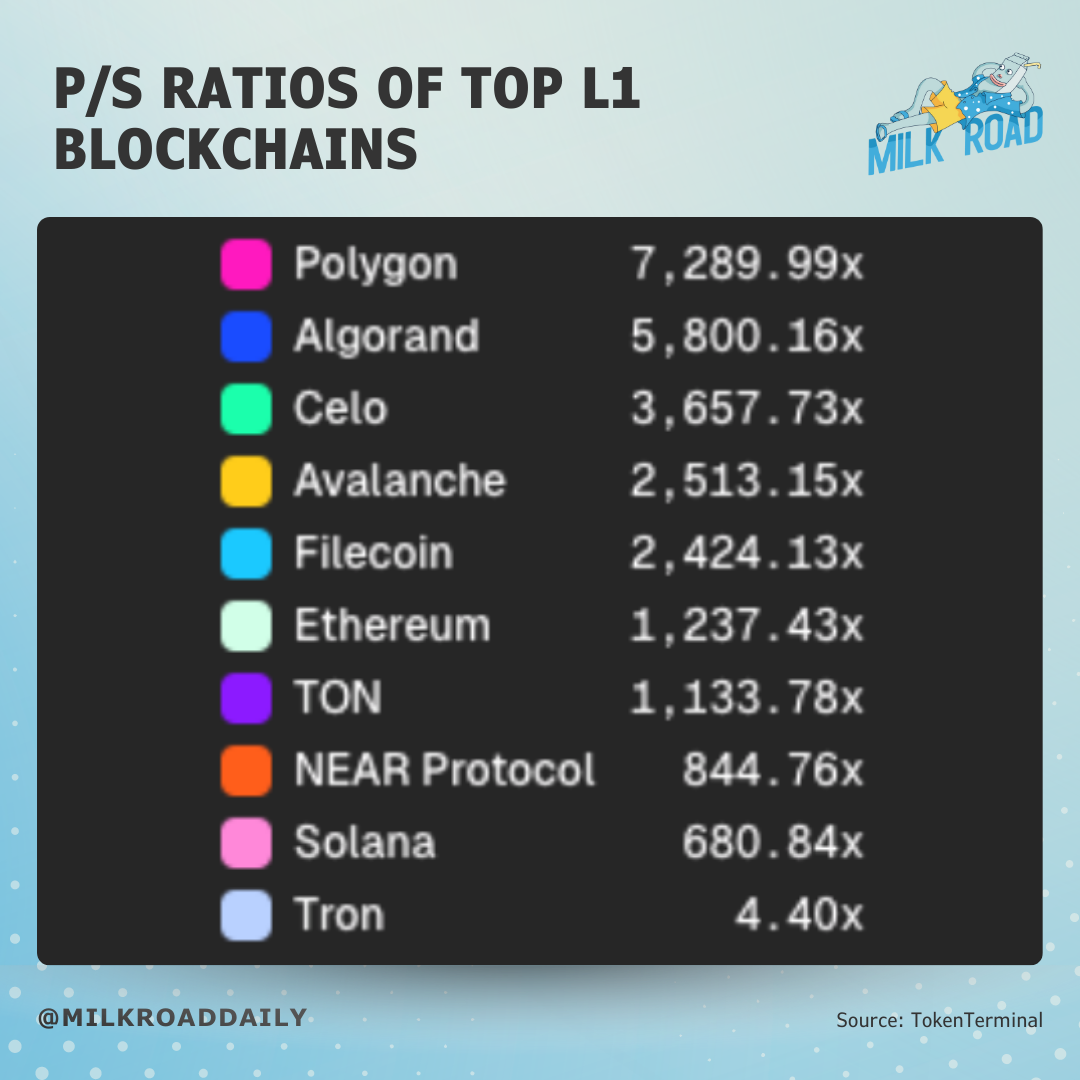
Take a look at the table below for the PS numbers for top L1s. 👀
[
Source: TokenTerminal
So, there’s likely something beyond cash flows driving these massive valuations.
The most probable explanation? It’s the monetary premium that people are assigning to these assets.
But, shoot, we're getting a bit ahead of ourselves.
We wanted to give you some context and highlight the challenging situation surrounding Ethereum right now.
Let’s dive in…
ETHEREUM ($ETH)
Ethereum is the undisputed pioneer and market leader among smart contract blockchains (by a long shot).
Ethereum's scaling roadmap through Layer 2 solutions is working exceptionally well.
And since July 23 of this year, Ethereum became the only asset besides Bitcoin with a live ETF, further solidifying its position in the market.

Ethereum is our largest position, making up 41.11% of our portfolio.
Our current Ethereum position is sitting at a -12.27% open loss since we made the purchase. 👎️
What you need to remember is, L1 blockchains are about more than just the fees they generate.
While we're confident that fees will surge again with more positive market sentiment, Ethereum’s $300 billion market cap means it will require significant demand to move the needle on its price.
Traditional cash-flow investors might not find these prices appealing, but we believe a new valuation approach is needed for L1 blockchains.
The real challenge is that no one has figured out the best way to value these assets yet (which remains a dilemma for all L1s).
Choosing just one KPI for Ethereum is tough, so we’ll highlight a few key metrics:
1/ L2s solutions are Ethereum's answer to scaling and delivering the quick, fast transactions that users demand.
They’re hitting all-time highs in users, TVL, and volumes—an incredibly positive sign for the entire Ethereum ecosystem.
For more details, check out this comprehensive report on L2s.
2/ Once the sentiment shifts and crypto starts growing again, we’ll be watching for inflows into Ethereum ETFs as a key indicator of demand from Wall Street.
3/ We should also evaluate whether Ethereum still holds its status as the "money of the internet" or if other assets are starting to erode its market share.
Since we believe much of the demand for Ethereum comes from this status, it’s crucial to stay on top of any shifts in this area.
It might sound like an easy task, but it’s not—finding all the data needed to assess this is challenging since it's not readily available today.
Here are the key areas we want to examine:
-
How much $ETH is used in lending protocols?
-
How much $ETH is being used as the second asset in liquidity pairs?
-
Are people still valuing NFTs in $ETH?
-
Is $ETH still being used as the gas token on L2s?
-
Are new protocols still launching and accepting $ETH?
-
Are treasuries still primarily holding $ETH?
4/ And finally, we’re focused on a blockchain's "GDP"—the value created on top of the blockchain, calculated by the total app fees generated across its ecosystem.
This gives a clear picture of the real economic activity happening within that network.
Here’s an example of the ecosystem fees (or "GDP") over the last 30 days for the top 10 blockchains listed on TokenTerminal.

[
Source: TokenTerminal
If we combine Ethereum with its Layer 2s, users are spending around $235 million per month within the Ethereum ecosystem.
Using this expenditure approach to measure GDP, we can estimate that the annual GDP generated on Ethereum is unparalleled, coming in at approximately $2.8 billion (12 * $235M). 🌐
This showcases Ethereum's dominance in terms of value creation across its ecosystem.
PS: Ecosystem fees aren't available for all chains (Solana, Ton, Sui and more).
Point is: There isn’t just one chart or number that can give us the full picture. Instead, we need to piece together multiple data points to gain valuable insights on this topic.
But don’t worry—so far, $ETH is still holding strong and maintaining its dominance in this area.
Now that we've shared some of the key KPIs we're tracking, let’s dive into the recent developments surrounding Ethereum.
🟢 Let’s start with the big news: The approval and launch of the Ethereum ETF on July 23.
This move caught the market by surprise, especially since the SEC hasn't been very crypto-friendly, to date. ⚔️
But out of nowhere, it happened!
And Ethereum surged by 20%. Still, we’re eager to see how inflows respond during a bull market, as they could become a strong driver of demand.
🟢 The Dencun upgrade, implemented in March 2024, reduced fees on Ethereum Layer 2 networks by 90%.
For example, the average transaction fee on Base is now just $0.01.
With this upgrade, the Ethereum ecosystem is now able to offer fast and cheap transactions, positioning itself to compete more effectively against other L1s like Solana.
🟢 The upcoming Pectra upgrade for Ethereum, featuring these three key components, could serve as a significant catalyst:
-
EIP-3074: This allows users to batch multiple transactions into a single transaction, reducing gas fees and making operations more streamlined.
-
Peer data availability sampling (PeerDAS): Enhances how Layer 2 solutions store and access data on the Ethereum mainnet, improving scalability and lowering costs by reducing the burden on the network.
-
Increased staking limit: Raises the validator staking limit from 32 ETH to 2,048 ETH, which helps reduce network congestion and improves the efficiency of staking operations.
🟢 A new and emerging narrative called "restaking" has taken off on Ethereum, offering stakers additional yield opportunities.
While restaking isn't exclusive to Ethereum—these projects will eventually launch and accept various assets—Ethereum still has the most diversified set of validators, giving it a significant advantage.
🟢 Several major companies, including Coinbase, Sony, and Kraken, have either launched or are planning to launch their own L2s.
These giants will leverage Ethereum's L1 security while driving their massive user bases to their own L2s, built on top of Ethereum.
They specifically chose Ethereum for this, bypassing other L1s or L2s built on different blockchains.
These companies recognize Ethereum's dominant position, with the most users, liquidity, apps, developers, and developer tools in the ecosystem.
🔴 The real challenge with Ethereum is its selling proposition.
Unlike Bitcoin or revenue-generating DeFi tokens, which are straightforward to explain, Ethereum's value can be more complex and harder to convey, especially to those outside the crypto space.
📈 $ETH experienced a solid uptrend in Q1 this year, but since March—aside from the brief surge from the ETH ETF surprise—it has mostly been trading downward.

[
Source: TradingView
Currently, $ETH is priced at $2,600, and we’re seeing signs that another higher low might be forming, which would definitely be a bullish signal.
However, the entire crypto market has been in a quiet phase, largely ignored by most market participants.
Despite this, we believe we’re on the verge of a narrative shift, and crypto is poised for explosive growth, similar to previous cycles.
Our conclusion: Our target for $ETH is around $10K.
The fact that $ETH is trading just 50% above its 2022 and 2023 levels suggests that the market still hasn't fully priced in all the positive developments we've seen with Ethereum in recent months.
It’s worth noting that Ethereum and its ecosystem continue to lead across all key metrics.
✅ We remain positive on Ethereum, but we'll be closely monitoring all the KPIs we mentioned earlier to stay informed and adjust our strategy as needed.
SOLANA ($SOL)
Solana stands out as the most performant L1 so far, delivering both cheap and fast transactions.
The market's response has been overwhelmingly positive, with Solana showing impressive growth across all metrics and capturing a notable share of the smart contract blockchain market.

$SOL is our second-largest position, making up 32.34% of our portfolio. We’re currently seeing a moderate open profit of 15.57%****.
Solana takes a different approach to Ethereum, aiming to scale its mainnet directly to attract the masses, rather than relying on Layer 2 solutions.
We’re not saying Solana will never have any Layer 2s—it’s a permissionless network, after all.
But right now, Solana's TPS is around 800, which is higher than Ethereum’s mainnet and all its L2s combined.
Earlier, we mentioned that no L1 blockchain can justify its valuation based solely on fees, and we stand by that.
This is especially true for Ethereum, where most fees—such as execution fees—are captured by L2s rather than the mainnet.
In contrast, with Solana, everything—execution fees, tips, and MEV—is captured directly by the mainnet.
So while we know that fees aren't the ideal indicator, it’s the best we have at the moment.
But rest assured, we're working on finding better ways to evaluate these blockchains.😉
Let's look at the fees.

[
Source: TokenTerminal
Currently, daily transaction fees on Solana hover around $700k, while Ethereum’s fees are closer to $1.2M per day.
There’s a growing consensus among investors that smart contract blockchains hold massive potential.
However, many are specifically looking for blockchains that offer fast, low-cost transactions and, most importantly, high throughput—meaning the ability to handle as many transactions per second (TPS) as possible. ⏩️
And who’s leading the pack? Solana, with over 800 TPS, an average transaction cost of just $0.002, and a block time of about 0.4 seconds.
These features are crucial for developers, who need to deliver seamless products and user experiences.
Without this level of speed, affordability, and scalability, it’s hard to build something truly great.
Solana delivers where it matters most.
So, perhaps instead of focusing on total fees today, we should consider using TPS (transactions per second) and average transaction costs as key performance indicators (KPIs) for evaluating blockchains like Solana.
Here’s why: Solana currently processes 800 TPS, with an average cost of $0.002 per transaction, translating to $50M in annualized transaction fees.
Impressive, but not quite enough to justify a $70 billion valuation, right?
The real potential lies in Solana's ability to attract more apps and institutions as the most performant blockchain, with a clear roadmap to potentially reach 1 million TPS.
At that point, with a $0.002 median fee, annual transaction fees would hit a staggering $63 billion.
BUT Solana isn't there yet, and neither is the demand—but it’s incredibly promising all the same.
If Solana can scale TPS growth while keeping fees low and maintaining a decent number of validators, those could be the key metrics to watch. 👀
👉 That’s why we believe blockchains like Solana are at a stage where metrics like TPS, median transaction costs, and the number of validators are far more important to monitor than just transaction fees.
These factors give a better sense of the network’s scalability and future potential.
Let’s take a look at some of the recent developments and updates on Solana.
Since we covered Solana’s fundamentals in depth a few weeks ago, we won’t rehash it all here (if you haven’t had a chance to read it yet, feel free to check it out!)
Instead, we’ll focus on the newest developments that weren’t covered in our previous report.
🟢 PayPal, US fintech giant, launched its stablecoin, $PYUSD, on Solana in late June 2024, and it quickly gained traction.
In a short time, it reached 400M tokens in circulation on Solana, surpassing its supply on Ethereum, where it’s been available since September 2023.
🟢 Solana’s Breakpoint conference took place on September 20-21, 2024, in Singapore.
Last year, $SOL’s price surged following the conference, signaling the growth of the community and excitement around key developments, like the introduction of Firedancer, Solana’s new client.
Given the new announcements and positive energy surrounding this year’s event, we anticipate a similar reaction in $SOL prices as the market responds to these innovations and the momentum of the community.
Small update: Solana Breakpoint just wrapped up, and a flood of new launches and announcements were made.
We’re considering putting together a dedicated report to cover all the exciting developments from the conference. In short? Bullish as ever!
🟢 ZK compression officially went live on the Solana mainnet — 1000x cost savings for Solana developers.
📈 As we mentioned, $SOL has seen massive growth over the past 12 months, with a year-to-date (YTD) performance of +561%.
It’s hard to find many assets with better performance over the same period, making Solana one of the top performers in the market right now.

[
Source: TradingView
In the shorter term, $SOL has been trading sideways, indicating the market is waiting for a major breakout.
We’re optimistic that this breakout will be to the upside, with our target set around $700.
And if we zoom in…

[
Source: TradingView
$SOL has shown strength during recent market pullbacks, and over the past two weeks, it’s been pushing against resistance, trying to break out of a wedge pattern.
If $SOL successfully breaks out, the typical move would be the length from the bottom to the top of the wedge—potentially pushing $SOL back to its all-time highs.
Our conclusion: We believe Solana is delivering exactly what the market needs, positioning itself far ahead of its competitors. 🐎
It doesn’t just boast the most performant blockchain but also a rapidly growing ecosystem and community—an advantage that will be hard for others to match.
✅ Solana remains one of our highest-conviction plays for this cycle.
COINBASE ($COIN)
(Btw, this refers to the stock, not any token of the same name).
Coinbase, the largest US crypto exchange, is listed and traded on Nasdaq.
Beyond traditional exchange services like trading, on-ramps, and off-ramps, Coinbase also offers a variety of additional products.
These include Ethereum staking solutions, serving as a custodian for nearly all of the US crypto ETFs – and even developing their own Layer 2 solution (Base).

Coinbase is our third-largest position, making up 9.50% of our portfolio. Currently, we’re facing an open loss of 11.77% on this investment.
We’re not diving deep into stock analysis since that’s typically the realm of traditional analysts.
However, if we had to focus on one key metric, we’d look at the commonly used and well-known PE (Price-to-Earnings) ratio for relevant insights.

[
Source: Ycharts
The current PE ratio for Coinbase is 30, just slightly lower than the Nasdaq’s PE of 32. This suggests that Coinbase is valued around the average range.
However, we see a bright future for Coinbase as they expand into various verticals and stand to gain significantly from broader crypto adoption—something that isn't fully reflected in its current price.
🟢 Coinbase recently introduced cbBTC, a liquid version of Bitcoin compatible with non-Bitcoin blockchains, like Base.
Within a few days, it accumulated over $100 million, demonstrating significant demand for a liquid Bitcoin option on Base.
🟢 Coinbase scored a big win in its battle with the SEC! The court ordered the SEC to hand over key documents, which could help Coinbase fight the claim that it’s running an unregistered exchange.
This legal victory is a step forward for both Coinbase and the crypto world, as it might change how crypto is regulated.
🟢 Coinbase's "Onchain Summer" is making waves, fueling innovation on the Base network.
With $2M in rewards for developers, the campaign has already delivered big wins: 4M active addresses and daily engagement from thousands of users.
It’s not just a vision—it’s happening now, bringing fresh projects and major brand collaborations to Base. 🧢
This ongoing program is sparking excitement, creativity, and long-term growth on the platform, positioning Base as the go-to destination for blockchain innovation.
Our conclusion: Coinbase is a well-managed company with a constantly evolving range of products and steadily increasing revenues, which fuels our bullish outlook on its future.
✅ We don’t have a specific price target at the moment, but we remain confident in Coinbase’s future performance.
OPTIMISM ($OP)
Optimism, now the third-largest Layer 2 by TVL after Arbitrum and Base, delivers lightning-fast, low-cost transactions compared to Ethereum’s mainnet.
Optimism has an ambitious vision to create a "Superchain"—a network of interconnected L2s built on the OP Stack, designed to revolutionize scalability and push the boundaries of blockchain innovation.

$OP is our sole position in the general Layer 2 sector, with a 0.99% allocation. Currently, we're sitting on an open loss of 38.43%.
Optimism realized that their expertise and "know-how" could be shared with others. By offering their code to new projects, they encourage them to join the Superchain movement.
This Superchain will aggregate multiple L2s built on the OP Stack, giving participants a share in the network and a voice in shaping its future direction.
This has proven to be a successful strategy for Optimism. So for $OP, we’re eager to see more projects launch on the OP Stack and join the Superchain, which will further strengthen the network and drive future growth.

[
Source: L2beat
Big industry players are joining the Superchain, namely Base (backed by Coinbase), Mode or Frax among others.
And on top of that, the OP Stack—the tech behind Base and other Layer 2 chains—now holds around 47% of the Layer 2 market share, a significant figure that's steadily growing.
This highlights the increasing dominance of OP-based solutions as more projects and developers opt into this ecosystem for scalability and security.
🟢 Major players like Synthetix, a DeFi OG, and consumer electronics giant Sony are planning to launch their own Layer 2s using the OP Stack and join the Superchain.
This strategy helps Optimism expand its market share and grow its interconnected ecosystem.
Eventually, users will be able to trade assets across different Layer 2s—like trading Base assets on Mode—seamlessly within the Superchain.
🟢 Optimism has reached Stage 1 of its decentralization process by introducing permissionless fault proofs, a key feature for securing the network.
These fault proofs allow anyone to challenge suspicious transactions, strengthening the integrity of the Layer 2 network.
This milestone is a major step toward making Optimism more decentralized and secure as it continues to build its interconnected Superchain.
📈 We don’t have a specific price target for this position, but we believe it will outperform $ETH.
If $ETH can potentially do a 4x from current levels, we expect OP to at least match that, ideally pushing higher into the $7–$8 range or beyond.

[
Source: TradingView
Since March, the price action has been on a consistent downward trend, with a noticeable decline.
This strong dip highlights some market challenges, but we remain optimistic about future recovery potential.
Our conclusion: If Layer 2 solutions are here to stay (and we believe they are), Optimism is poised to benefit the most.
Its ecosystem continues to expand, drawing in big names to launch on their stack and join the growing Superchain.
✅ We’re still bullish on Optimism despite the recent price decline, considering the growing market dominance its Superchain is building.
The expansion of its ecosystem and strong integration with multiple Layer 2s keep us confident in its long-term potential.
IMMUTABLE ($IMX)
Immutable is a Layer-2 solution for Ethereum, supercharging NFTs and gaming.
They aim to be the go-to platform for Web3 games by offering fast, secure, and gas-free transactions for NFTs.

$IMX is our play on the gaming industry, with a 1.60% allocation and an open loss of -12.60%.
Now, let’s dive into the key performance indicator (KPI) for this gaming platform. Just like with Steam or Epic Games Store, the top metric to watch is active users.
So we've chosen monthly active users (MAU) as the key performance indicator (KPI) for our position in $IMX.

[
Source: TokenTerminal
Immutable experienced massive growth in monthly active users (MAU), skyrocketing from late April to reach an all-time high of 2.7M MAU in August.
For Immutable, we could also track Passports as a KPI.
‘Passport’ is Immutable's wallet solution that bridges the gap between web3 complexity and web2 simplicity, making it easier for users to engage with the platform. 🛂
Think of Passports as your gaming profile with blockchain interoperability, seamlessly connecting traditional gaming experiences with the power of blockchain.
The formula is simple: The more great games, the more active users. That’s exactly what we’re looking for with Immutable.
And let’s not forget the latest announcements and developments—there’s a lot happening right now.
🟢 Over 220 well-funded games on Immutable are set to launch this year, while more than 400 games in total are currently being built on the platform.
Immutable's ecosystem is rapidly expanding, with a significant number of these games preparing to go live soon!
🟢 At Gamescom, the world’s largest video game event, Immutable introduced "The Age of Abstraction,"a future where blockchain technology seamlessly integrates into gaming experiences.
Instead of focusing on web3 features, they let their games showcase the power of digital ownership and in-game assets.
Gamers responded enthusiastically, with hundreds lining up to try out their AAA titles, proving that blockchain can truly enhance gaming in a player-first way.
🟢 Over 400K players have already pre-registered for Immortal Rising 2, launching in just a few weeks!
The game features stylish combat, stunning 3D graphics, immersive progression, and intense competitive guild wars. It's shaping up to be a must-play experience!
🟢 Immutable’s partnership with MARBLEX grants it access to South Korea's massive gaming market, where gaming is deeply ingrained in the culture.
By integrating MARBLEX’s core games and tokens onto Immutable’s zkEVM, this collaboration strengthens Immutable’s ecosystem with high-quality, high-traffic titles.
The result? More user engagement, a broader reach, and a solid foothold in one of the world’s most active gaming communities.
📈 IMX had a strong Q4 last year and Q1 this year, with its price seeing an impressive 8x increase during that period.

[
Source: TradingView
IMX is currently priced at $1.77 but has been one of the top performers over the past week, posting a strong 43.4% gain.
Our conclusion: We don’t have specific data to support a price target for $IMX.
However, we believe Immutable could benefit from the growing gaming narrative, which might finally take off this cycle.
With many games set to launch this year, there’s potential for IMX to ride that momentum and see significant upside.
✅ It's not just the price gaining momentum; the entire Immutable ecosystem is picking up steam.
We're optimistic about this as our only gaming play and believe it’s well-positioned to benefit from the growing web3 gaming landscape.
FINAL THOUGHTS 📝
This second part of our portfolio update highlights our non-DeFi positions, which differ from DeFi in that they aren’t yet generating substantial revenues, and their valuations remain more speculative (except for Coinbase).
Coinbase, our only stock, holds massive potential.
It not only offers a diversified product portfolio but also gives traditional investors direct access to crypto through a stock, making it a unique, strategic play in today's market.
When it comes to smart contract platforms, we’re thrilled to hold the two biggest—Ethereum and Solana.
The debate over which model is better—modular (Ethereum) or integrated (Solana)—is ongoing.
Ethereum excels in security and scalability through Layer 2s, while Solana leads with high-speed transactions and low fees.
We don't know which will dominate, but being part of the conversation allows us to adjust our strategies as the space evolves.
Our positions in Optimism (L2) and IMX (gaming) act as market indexes for their sectors.
They give us exposure to the expanding Layer 2 ecosystem and the booming web3 gaming space, positioning us to benefit from future growth in these industries.
Summing up our overall strategy, we’re pleased with our exposure to smart contract blockchains, DeFi, L2s, and gaming.
Looking forward, we’re exploring other emerging sectors like AI and DePin.
By adding $TAO for AI and $HNT for DePin, we could broaden our exposure to these exciting, growing sectors, much like Optimism and Immutable do for L2s and gaming.
However, we haven't made any decisions yet.
We'd like to see a confirmed "altcoin season" take shape over a longer time frame before increasing our exposure to altcoins beyond the major tokens.
And that's it for today! The goal was to update you on the remaining positions not covered in part 1 and to share some of our updated views and potential moves we're considering.
PS: As mentioned, we're working on new solutions to better navigate and gather more data points for evaluating smart contract blockchains.
This exciting project is in progress, and we hope to share more details with you soon.
Until then, stay safe, manage your risk wisely, and good luck!
ACTION STEPS FOR PRO MEMBERS 🥛
Join the private PRO community now!
This is your all-access hub for engaging directly with the Milk Road PRO research crew and fellow PRO members, diving into live AMA sessions, digital events, and daily robust discussions on market trends, fundamentals, and industry insights.
🚨 Important: Upon joining the Discord, you’ll be asked to fill out a form. Please, please pay attention to 2 things:
-
Enter the exact email address you used to sign up to PRO with.
-
Enter your exact Discord username. To find your Discord username, click on your profile picture in Discord. Your username is the smaller text name under your profile picture.
Do this with bomb-defusing precision—a single typo might lock you out! 😬
Join the PRO Discord Community Here
See you on the inside! 🥛
Start the Crypto Investing Masterclass (50% off just for you)
If you want to supercharge your portfolio and capture a piece of crypto's growth to a $100T market cap, then you need to understand these 4 basic concepts:
-
The fundamentals of crypto cycles
-
Liquidity flow in crypto
-
How to pick the right coins for your strategy
-
Building a portfolio that outsmarts 99% of crypto investors
You can learn all of the above (and more) inside the Milk Man’s Crypto Investing Masterclass — your ultimate cheat code to become a successful crypto investor.
This masterclass lays the foundation of investing in crypto, so you can maximize the value of the Milk Road PRO reports and build a portfolio that brings you generational wealth by the end of the next bull cycle.
The best part? Milk Road PRO members like you 🫵 get a 50% discount for lifetime. 🥳