Ethereum is dead...again. 💀
Why should anyone buy Ethereum right now? 📊
December 14, 2024

GM, this is Milk Road PRO, the newsletter that’s designed to be the ‘Robin’ to your portfolio’s ‘Batman’.
(We’re here to help and make quips).
The banana zone is finally here—hooray!
Everything seems to be skyrocketing...except Ethereum.
Bitcoin is well past previous cycles all time highs. Solana managed to reach previous ATHs too.
Yet, Ethereum remains 20% from last cycle's ATH of $4800.
To be fair, it looks like Ethereum has recently started to catch up. But maybe not as much as we would expect/hope. 🤔
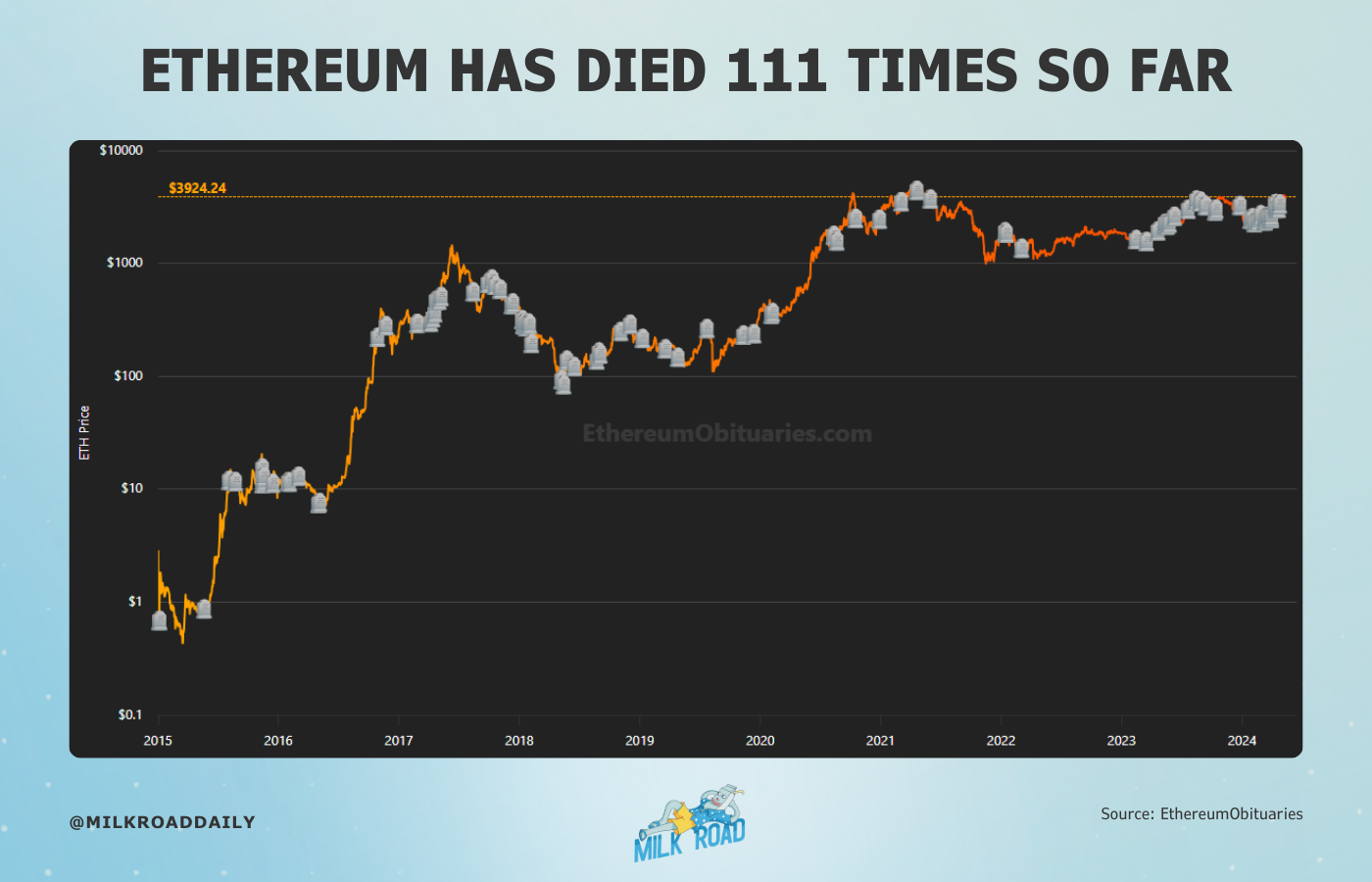
And in the meantime people keep asking: Is Ethereum dead?
[
Source: EthereumObituaries
Ethereum has been declared "dead" 111 times throughout its history—31 of those times just in 2024 alone.
So, being called dead? That’s nothing new for Ethereum.
Sure, it feels more dramatic now when other Layer 1s like Solana already hit ATHs and Sui is pumping hard every day, but it’s just another chapter in Ethereum’s rollercoaster journey.
But…what if this time is different? 🤔
-
Bitcoin is considered better money than Ethereum.
-
Solana is seen as faster and cheaper than Ethereum.
-
And even if Ethereum L2s do well, $ETH doesn’t seem to accrue much of that value anyway.
After looking at the year-to-date performance of these three major crypto assets – why should anyone stay bullish on $ETH?

[
Source: Tradingview
Ethereum is lagging far behind. Bitcoin and Solana have seen 2x the gains of Ethereum.
Which makes this the perfect moment to take a step back and revisit our thesis for Ethereum.
So we’re breaking it down for you:
-
Why has Ethereum been lagging so much?
-
Why should anyone buy Ethereum today?
-
Is there still a bright future for Ethereum?
And don’t expect us to go easy on Ethereum.
P.S. - We’re hosting a PRO AMA next week — scroll to the bottom for more info. 👀
It’s our largest position in our Milk Road PRO Portfolio, so you can bet we’re fully motivated to take off the rose-colored glasses and give it a raw, honest review.
Before we dive in, here’s a quick disclaimer—not the kind you’re used to, but an important one. 😉
By the end of this report, we’ll give you a clear vision of where Ethereum is heading, based on what we’ve learned and understood from the Ethereum community, developers, and researchers.
However, we won’t be focusing on the nitty-gritty details of specific implementations or the technical feasibility of proposed solutions—that’s way above our pay grade.
And let’s be honest, that kind of stuff can get pretty boring, and most of us get lost pretty quickly.
So, keep all of that in mind as we move forward!
But now let’s dive in and get real—starting with the things we don’t like about Ethereum.
…perhaps some of these factors have contributed to ETH’s underperformance so far.
THE THINGS WE DON'T LIKE
We’ve pinpointed 4 things about Ethereum that we’re not too thrilled about, and we’re going to break them down for you one by one.
1/ Missing the north star
A clear and focused goal isn’t just nice to have—it’s essential. Without it, a project becomes a tough sell, no matter how big or successful it might seem.
Look at Bitcoin or Solana.
Bitcoin aims to become “digital gold” and serves as a store of value.
Solana aims to deliver cheap transactions at the speed of light (aka: bring “Nasdaq onchain”).
Each one has a well-defined “north star”—a guiding vision that unites people, sparks passion, and builds tight-knit, thriving communities.
That clarity creates momentum and keeps the hype alive.
But what about Ethereum? Does it want to be a world supercomputer? Ultrasound money? Or a programmable internet layer? It feels like, You name it – Ethereum wants to be it.
Yes, it has a strong community—there’s no denying that.
But here’s the issue: its lack of a clear, overarching vision is starting to show.
Other projects with sharper focus are growing faster, stealing the spotlight, and outpacing Ethereum in many ways.
For newcomers, Ethereum can feel confusing and directionless, which makes it harder to attract new supporters and keep building its momentum.
Without a unifying vision, even the strongest communities can lose steam—and that’s a problem Ethereum needs to tackle.
We get it—this can feel pretty subjective.
But let’s be real for a moment: what’s easier to explain to a friend—Ethereum, Bitcoin, or Solana?
Odds are, Bitcoin and Solana are the easier pitch because their missions are crystal clear.
So if you can't sell $ETH to your friend, many other people will face the same issue.
As a result, all the new people coming in might rather buy something else. Something that has already been pumping like $XRP or something that resonates with them more.
So who will be the new wave of $ETH buyers? 🧐
(Good question!)
However, the lack of a north star can be resolved relatively quickly, so it’s not such a big deal.
The technical debt that Ethereum has compared to other faster and cheaper L1s?
Now, that’s a big deal!
2/ Slow and expensive blockchain
Ethereum is a 9-year-old technology, which means it’s been around long enough to witness major breakthroughs and advancements in the blockchain space. As the first smart contract blockchain, Ethereum was a true pioneer—and that’s both its strength and its weakness.
Weird? Yes.
But let us explain…
History shows us that the apps we use and love today such as Facebook or Netflix usually aren’t the first versions of an idea.
They’re often the second, third, or even later iterations that learned from the failures and successes of their predecessors. The same is true in the blockchain world.
Newer blockchains have a unique advantage: they can study Ethereum’s blueprint. They can see what works, what doesn’t, and which early design choices are now holding Ethereum back.
For example:
👎 Ethereum’s block times are around 12 seconds, and transaction fees can cost a few dollars or more during high traffic.
👍 In contrast, newer blockchains are offering block times of less than a second and transaction fees that cost just fractions of a penny.
These design improvements give newer blockchains a competitive edge, allowing them to deliver faster, cheaper, and more scalable solutions. In many ways, these blockchains act as refined versions of Ethereum, learning from its strengths while avoiding its limitations.
Ethereum’s early decisions—while groundbreaking at the time—are now harder to reverse, slowing down its ability to scale and innovate further.
Ethereum is well aware of these challenges, which is why the community made a pivotal decision back in October 2020: to focus on scaling through Layer 2 solutions.
Those L2s were supposed to bring Ethereum fast and cheap block space. And guess what? They delivered!
Transactions take less than a few seconds to process and cost less than a fraction of a penny.
And while it was the right decision and a necessary move for Ethereum at the time, it’s far from being Ethereum’s end game. Now we are going to explain why.
3/ L2 Decoupling
This is a highly controversial topic, and people are firmly split into two camps.
✅ Some love L2s, seeing them as a great solution for scaling and a huge win for Ethereum.
❌ Others argue that L2s are parasitic, siphoning value away from Ethereum instead of strengthening it.
While L2s offer solutions to Ethereum’s scalability challenges, the current dynamic leans heavily in favor of L2s.
L2s benefit greatly from Ethereum by relying on its robust security (used as settlement layer) and ensure trust, saving them the immense effort of building their own secure foundation.
They also tap into Ethereum’s extensive ecosystem, leveraging its developer tools, smart contracts, and wallets to accelerate their growth without reinventing the wheel.
Additionally, Ethereum’s large community and liquidity naturally flow into L2s, giving them a significant head start in building their networks and economies.
That’s all great, but here’s the problem: L2s have no real incentives to stay loyal to Ethereum.
Currently, L2s use Ethereum as a settlement layer and data availability layer (no need to go into details here).
The issue is that Ethereum has no leverage to ensure L2s continue using it instead of seeking out much cheaper alternatives for these services.
After all, they’re businesses trying to make money. So, what are the odds that everyone will stick with Ethereum? 🥺
Yeah, we know—they all say today they’re here to stay. But will they really?
Let’s take Base as an example. It’s the fastest L2 right now, and we don’t expect it to slow down anytime soon.
But Base is backed by Coinbase, and $COIN is a publicly traded stock.
Do you think Coinbase’s board cares more about aligning with Ethereum and the chorus of "blah, blah, Ethereum alignment, blah, blah, blah," or about making stakeholders happy and focusing on profits?
(Are you a realist or are you naive? That’s the real question).
We’d love to believe in their commitment, but unless Ethereum offers them something more, they won’t stick around forever.
These are tough, uncomfortable questions, but we have to face the reality!
…now, it’s not all doom and gloom however—or parasitic.
Let’s be fair and show the other side.
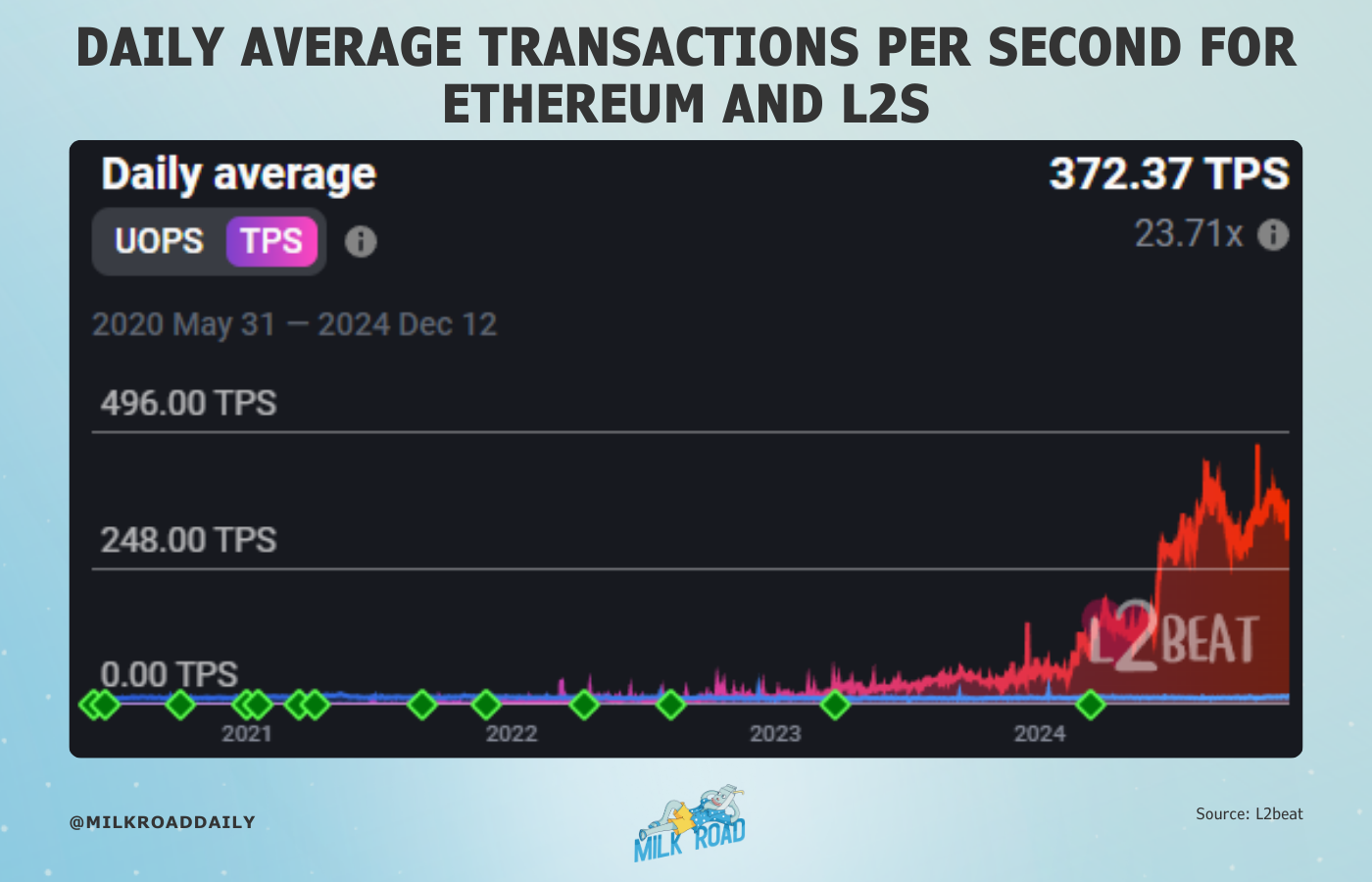
L2s have been a game-changer for Ethereum, boosting its scalability by an impressive 24x in terms of transactions per second.
[
Source: L2beat
Ethereum on its own can handle only about 15 transactions per second (TPS), but when you add in all the L2s, that number skyrockets to 372 TPS.
Thanks to L2s, many of Ethereum’s ecosystem metrics—like TVL, trading volume, and stablecoin supply—are hitting all-time highs.
TLDR: L2s have helped Ethereum scale, but now Ethereum needs to find ways to provide more value to L2s. Otherwise, they might look elsewhere, and Ethereum risks missing out on capturing the value created on top of its network.
And despite this growth in TPS and helping ethereum to scale, the user experience isn’t as seamless or smooth as you might hope – which leads us to the last thing we’re not too thrilled about…
4/ Liquidity fragmentation
We all know the user experience in crypto is far from perfect—it’s bad, and we need to do a lot better!
Right now, the Ethereum ecosystem is made up of Ethereum mainnet plus around 100+different L2s.
The problem?
You can only use an L2 if you already have funds there.
For instance, if you’ve got funds on Arbitrum but need to do something on Optimism, you’re stuck bridging your funds over.
That means extra steps, added friction, and increased risk for the user.
And it doesn’t stop there…
Imagine you’re a successful lending app on Ethereum mainnet. Sure, you can deploy your contracts on Base or another L2, but then comes the real challenge:
Rebuilding liquidity from scratch.
Every time you launch on a new L2, you’re stuck fighting to attract an entirely new pool of users and funds.
For builders, this fragmented system isn’t just frustrating—it’s an uphill battle every single time.
TLDR: Neither users nor builders are satisfied with the current state of things. It’s clunky, fragmented, and anything but seamless. 🥺
But there’s something that could fix it all and make both users and builders happy—and we’ll dive into that later.
It’s important to remember that the best technology doesn’t always come out on top—and that’s why this battle is far from over.
Just look at Facebook, Google, or YouTube…
They all started by building massive network effects without any clear plan for monetization, yet they’ve grown into trillion-dollar giants.
Their success shows that the path to the top is never easy or straightforward.
With that in mind, let’s focus on what makes Ethereum truly unique today.
THE THINGS WE LIKE
We’ve pinpointed 4 things we really love, and we’re excited to dive into them a bit deeper.
1/ Network effects
All blockchains are fighting for dominance in the same critical areas:
-
Developers: To build and expand their ecosystems.
-
Liquidity: To attract financial capital necessary for trading, lending, and supporting ecosystem growth.
-
Projects: To drive innovation and create meaningful use cases.
-
Users: To fuel adoption and activity through practical utility.
-
Validators: To secure the network and maintain decentralization.
-
Community: To foster loyalty and amplify growth through advocacy.
-
Mindshare: To remain top-of-mind and sustain public interest.
Ethereum is leading the pack in most of these areas—and by a huge margin.
These are advantages you can’t just copy, buy or create overnight. That’s exactly why Ethereum remains in such a strong position.
We believe all of the above factors have also played a role in Ethereum securing ETF approval, making it only the second cryptocurrency—after Bitcoin—to achieve this milestone.
And that brings us to another thing we really like.
2/ Existing Ethereum ETFs
Today, there are around 3.4 million $ETH held in Ethereum ETFs, representing 2.78% of the total Ethereum supply—not too shabby for ETFs that have only been around since July!
Here’s a chart showing the flow of Ethereum ETFs over time.

[
Source: Coinglass
It’s important to keep in mind that a significant amount of Ethereum has been held by Grayscale, which charges a hefty 2.5% management fee compared to competitors that charge just around 0.2%.
This explains the large outflows we saw in the early days, as investors sold off their expensive Grayscale trust shares to switch to much cheaper ETF alternatives.
Lately, we’ve seen a growing interest in Ethereum ETFs, with daily flows sometimes reaching hundreds of millions. Pretty good sign for investors. 🥳
But the approval of an Ethereum ETF was a game-changing development.
It adds credibility to Ethereum as an asset, signaling that regulators acknowledge its significance and long-term potential.
This institutional green light is likely to attract major players—banks, pension funds, and wealth managers—who previously lacked a compliant and accessible way to invest in Ethereum.
Perhaps most importantly, this approval delivers a strong message:
Crypto is no longer a niche experiment. It’s becoming a vital part of the global financial system, with Ethereum at the forefront as a key pillar driving this transformation.
So, hell yeah—having a live ETF is a huge deal!
But the ETFs aren’t the only benefit that Ethereum can offer.
3/ The most secure blockchain
Ethereum’s status as the most secure blockchain is critical because it attracts developers, institutions, and users.

[
Source: Hildobby/Dune
Ethereum’s economic security of $132 billion means the network is protected by that amount.
It makes it extremely expensive to attack as attackers would need to acquire 51% of that value in staked $ETH.
No other blockchain is near this level of security!
It’s also important to consider the decentralization of Ethereum’s validators. Ethereum has the most decentralized network of validators. This reduces the risk of centralization and ensures the network remains secure, transparent, and resilient to manipulation or control by any single group. 👍
And you might be thinking, “Why should I care about any of this?”—and that’s totally fine.
But guess what? The big players do care—a lot. They’re not going to pour massive resources into building on top of something that’s vulnerable to being hacked or shut down.
Which brings us to the last thing we really love about Ethereum.
4/ The number of companies building on Ethereum
It’s bullish that so many companies are building on Ethereum because it boosts its ecosystem, attracts more users, and increases demand for $ETH.
This growth creates more utility, drives economic activity, and validates Ethereum as the leading blockchain, reinforcing its long-term value and dominance.
Do any of these names below ring a bell (this year alone, they’ve all announced they’re building on Ethereum)?

[
Source: EthereumAdoption
We’re willing to bet you’ve heard of names like BlackRock, PayPal, Robinhood, or Google. Yes, all of them have announced plans involving Ethereum.
Still feeling bearish? Good luck with that!
But don’t sell your house and go all-in on $ETH just yet! Why?
Because all the unique advantages Ethereum has today won’t last forever. The competition is catching up fast, and Ethereum needs to adapt quickly to stay ahead.
So, let’s dive into what Ethereum’s solution is and how it plans to stay ahead.
ETHEREUM SINGULARITY: THE BIG SOLUTION
We’ve come up with a term: Ethereum Singularity.
This term represents the ultimate state where Ethereum becomes the foundation of almost everything in the blockchain space.
It’s like the center of a big web, connecting and powering everything else.
We all want Ethereum to hit a $1T valuation—and eventually $10T—but that won’t happen unless Ethereum aims big and disrupts industries by delivering novel, superior, and scalable solutions.
Though unfortunately, we’re not there yet.
We’ve already touched on how both the user experience and developer experience leave a lot to be desired these days—no one’s thrilled with the current state of L2s. That’s pretty obvious by now.
But here’s something even more important:
❌ Ethereum, on its own, isn’t capable of onboarding hundreds of millions of users. The next wave of adoption isn’t just going to happen by itself.
What is becoming clear, though, is that existing web2 companies are increasingly interested in blockchain technology.
Why? Because it gives them significant advantages over outdated alternatives.
✅ These companies like Coinbase, Stripe, or Sony are the ones that will drive the next wave of adoption—they have the tools, users, and incentives to make it happen.
L2s have proven to be the best way to scale.
They allow Ethereum to outsource onboarding and user acquisition to existing companies with massive user bases, leveraging their reach to bring more people into the ecosystem.
In return, Ethereum is giving up the execution layer—or, in simpler terms, the transaction fees.
That’s a fair trade-off.
👉 But Ethereum needs to focus on building stronger, long-term alignment with the entire ecosystem and reinforcing those ties!
With that in mind, let’s take a closer look at where we stand today and how Ethereum plans to improve moving forward.
This chart below is Ethereum’s "scaling" roadmap—explained in simple terms for non-technical folks.

Current Situation:
Today, interacting with blockchains is clunky and frustrating.
Users must manually bridge assets to specific chains they want to use, a process that’s both time-consuming and risky.
dApps face tough choices about which chain to deploy on, often fragmenting their user base across multiple chains.
Meanwhile, companies launching new chains are forced to start from scratch—building liquidity, infrastructure, and integrations—a process that’s expensive and slow.
TLDR: Users 😤, Apps (devs) 😤, Companies 😤
But all that is about to change…
EOY 2025:
The Ethereum ecosystem will evolve into a more interconnected experience.
Users will operate within a single, seamless ecosystem (like Superchain) that links multiple chains effortlessly. These chains will be able to share assets, data, and liquidity, creating a smoother experience for users and developers alike.
Meaning, no need to bridge between Base and Optimism anymore, it all just works, similar to the UX of Solana.
However, cross-ecosystem communication—for example, between Superchain and other ecosystems like Elastic chains or Arbitrum orbits —will still remain limited.
So definitely better, but still not optimal.
TLDR: Users 😐, Apps (devs) 😐, Companies 😐
Future:
Ethereum transforms into a fully interconnected and user-friendly ecosystem.
Imagine a world where users no longer need to bridge assets or manage complex wallets—everything just works.
dApps deploy once and are instantly accessible across the entire Ethereum ecosystem without fragmentation.
Companies launching new chains can tap into Ethereum’s powerful network effects, benefiting from shared liquidity, millions of existing users, and an integrated infrastructure.
1000’s of L2 blockchains, all seamlessly working as one.
This unified vision reduces friction for both users and developers, paving the way for exponential growth. Ethereum becomes the go-to platform for innovation, creating a future where blockchain is as easy to use as any web2 app today.
TLDR: Users 🥰, Apps (devs) 🥰, Companies 🥰
Great! We love that future.
This interconnected Ethereum ecosystem creates a win-win-win for everyone—users, developers, and companies—by eliminating friction and enabling a streamlined, efficient platform that drives innovation, adoption, and long-term growth.
Which all sounds very appealing.
…but how is it going to drive the value for $ETH?
ETHEREUM VALUE CAPTURE
To join the Ethereum ecosystem and tap into its network effects, L2s (or appchains) will need to rely on Ethereum as a settlement layer and data availability layer.
On top of that, Ethereum could also take some share of the priority fees (because Ethereum might be used as a sequencing layer too).
Yes, that’s yet another service provided by Ethereum—but don’t worry, we won’t bore you with the technical details right now. It’s quite complex and not something you need to fully grasp today.
But in this endgame state, Ethereum will take on a central role in everything, with $ETH's utility becoming crucial and significant. More utility = more fees. 🥳
And let’s not forget—L1s shouldn’t be valued solely based on cash flows (fees). What about their role as a store of value or their moneyness aspect?
It goes hand in hand – building more utility brings greater demand for $ETH as the primary “money” within the ecosystem, and from there, it’s a very fine line for $ETH to also become a store of value asset.
As Justin Drake, a lead researcher at the Ethereum Foundation, said:
"We are currently in a transitory phase, but $ETH will ultimately win in all three areas: utility, moneyness, and store of value!"
It also means that in this endgame state, Ethereum could be seen as:
-
Better money than Bitcoin
-
Faster execution than Solana
TLDR: There are plenty of opportunities to drive new demand to Ethereum and bring more people into the ecosystem.
So, let’s wrap it up with a few final thoughts.
CLOSING WORDS
Today, Ethereum is falling behind compared to Bitcoin and Solana—not just in the narrative game (e.g, who’s better money, who’s the faster blockchain, etc.) but also in terms of price performance.
But if we zoom in a little, the mood around Ethereum is clearly starting to improve and so has the price.
The chart below highlights how sentiment around Ethereum has evolved over the course of this year.

[
Source @_kaitoai
We’re hitting new all-time highs these days.
Ethereum only needed a two or three-week price surge to bring back the bulls, reignite the buzz around Ethereum, and silence the bears.
It just shows how important it is to avoid getting caught up in narrative games or spending too much time on Crypto Twitter. 🤣
If you still believe in Ethereum’s endgame, there’s no need to worry too much.
That said, for the price to go up, we still need new buyers.
And do you know what the best catalyst for $ETH is?
The price itself.
When the price rises, it triggers a flywheel effect:
People start paying attention, newbies buy in because it’s pumping, bullish threads and theses flood social media, influencers make moonshot predictions, and the cycle continues.
Here are the factors we believe are currently driving the price upward.
1/ Ethereum ETF inflows are through the roof
Ethereum ETFs have seen $2B in inflows over the past two weeks, with daily inflows averaging around $200M.
Below is the chart of Blackrock’s Ethereum ETF.
Because the Ethereum ETFs launched in June, that means the chart only tracks data from that point forward.
As a result, people can't view Ethereum's price performance from previous cycles and the only thing they see is the chart below. 👇

[
Source: Finance/Google
These ETF shares only cost $30, and we’ve just barely surpassed the all-time highs. That’s a pretty bullish setup for crypto newcomers.
The Bitcoin ETF chart on the other hand doesn't look so good (and it costs $55).
You would be surprised by how many people would rather buy Ethereum over Bitcoin because the price is lower.
We don’t know exactly who the new buyers of these ETFs are, but some might be jumping in because they’re feeling FOMO after missing out on Bitcoin runup to $100k.
And what about the crypto OGs?
2/ Ethereum is getting momentum
$ETH has been under scrutiny for quite some time, and now it’s time for it to play catch-up.
With sentiment shifting and ETF inflows hitting all-time highs, it seems like many in the crypto space are rethinking their strategies and starting to ape back into $ETH.
(Welcome back, weak hands! 🤣)
But there’s one more thing that happened just four weeks ago, and we believe it might have had the biggest impact on the recent price surge.
It’s something closely followed in detail by companies, funds, banks, and essentially all the big players.
3/ Historically, this is when $ETH outperforms
Last cycle, $ETH had its moment when Bitcoin Dominance topped out in December 2020. Over the next few months the ETH/BTC ratio went from .02 up to near .08, an almost 4x from December to May for $ETH over $BTC
You can see the Bitcoin Dominance chart here, with the red circle marking the top of last cycle and potentially the top of this cycle (still not confirmed of course)

[
Source: Tradingview
And now the ETH/BTC ratio circled in green at the same timeframe that BTC dominance occurred. That point also matches perfectly with ETH/BTC bouncing off a long-term support line.

[
Source: Tradingview
Of course none of this is a perfect science and prices could swing the wrong way at any point, but the market structure of this cycle feels eerily similar to that of last cycle, making this scenario of $ETH outperformance feel like it's becoming more and more of a reality.
4/ The Ethereum community is as strong as ever.
In mid-November, Ethereum organized a developer conference in Bangkok. The number of people and teams participating, the talent being drawn to build on Ethereum and tackle its challenges, and the visions and ideas shared were truly remarkable.
These things can’t be ignored, and they reassured us that Ethereum is in good hands. It’s not just the Ethereum Foundation driving innovation and improving the platform—it’s the entire global community.
Thousands upon thousands of people are working to make Ethereum better. It’s amazing to witness, and, in our opinion, not something anyone should bet against.
So, yeah, we think these are the three main reasons driving the recent price surge.
That said, it’ll be interesting to watch $ETH’s price performance over the next 12 months.
No doubt, we’ll see new narrative battles emerge during this cycle—maybe bears claiming Ethereum’s tech is outdated or non-performant. But that’s just part of the game.
And be aware that Ethereum won’t reach its endgame tomorrow—or even next year. Instead, we’re likely to see incremental improvements starting as early as next year, with major updates rolling out annually until 2029. That’s the estimated timeline for Ethereum’s endgame to fully materialize.
So the big question is: Is it worth waiting for, or should we start looking at other blockchains instead?
Ethereum is a $500B asset that serves as a home for more than $100B worth of other assets.
This isn’t just a simple software update like updating your iOS—it’s a much bigger deal.
If the future of finance is to be built on this blockchain, it’s only fair to give Ethereum 4–5 years to deliver its endgame.
We shouldn’t rush the process or make short-term decisions just because Ethereum might currently lag behind Solana or other blockchains in performance. The long-term vision is what truly matters.
We believe Ethereum is still a great investment. While we anticipate some bumps along the way, Ethereum remains the undeniable leader driving the entire industry forward, backed by an enormous pool of world-class talent dedicated to its mission. 💪
That being said, we’ll continue keeping a close eye on the L2 landscape, Ethereum’s relationships with them, the interest from companies building on Ethereum, the progress of its technology, and the overall money flows.
So don’t worry—we’re committed to staying proactive. 😉
That’s it for today!
Hopefully, you’ve learned something new and can start forming your own thesis about Ethereum—whether it’s something you’re willing to hold and "wait" for it to deliver, or if you’d rather invest in something flashier.
Feel free to share your thoughts on Discord, discuss your take with other community members, or simply drop your feedback on this report.
Take care, and good luck!
AI-GENERATED PODCAST 🤖
We’ve turned this PRO report into an AI-generated podcast to make it even easier to digest. Head over to our website and give it a listen! 🎧️
You’ll find this episode, along with all our other AI-generated podcasts, waiting for you there.
Disclaimer: This podcast was created using AI and is based on the research report above. While we've done our best to ensure accuracy, the audio may contain minor errors, technical glitches, or mispronunciations. Please note that this podcast provides an overview of the report and is not a comprehensive or definitive take on the topic.
FRESH AMA COMING UP 👀

We’re excited to host another PRO-only AMA to tackle your burning crypto questions! 🔥
Wen? December 17th (Tuesday this week).
Where? In the Milk Road PRO Discord (meetup channel).
What’s on the agenda? That’s up to you! Be sure to submit your questions here.
Not in the Milk Road PRO Discord yet? Join 2,100+ fellow members here & don’t miss out!
Note: Upon joining the Discord, you’ll be asked to fill out a form. Please, please pay attention to 2 things:
1/ Enter the exact email address you used to sign up to PRO with.
2/ Enter your exact Discord username (not your handle).
Do this with bomb-defusing precision—a single typo might lock you out! 😬
Join the PRO Discord Community Here
See you on the inside & chat more on Tuesday! 🥛
Start the Crypto Investing Masterclass (50% off just for you)
If you want to supercharge your portfolio and capture a piece of crypto's growth to a $100T market cap, then you need to understand these 4 basic concepts:
-
The fundamentals of crypto cycles
-
Liquidity flow in crypto
-
How to pick the right coins for your strategy
-
Building a portfolio that outsmarts 99% of crypto investors
You can learn all of the above (and more) inside the Milk Man’s Crypto Investing Masterclass — your ultimate cheat code to become a successful crypto investor.
This masterclass lays the foundation of investing in crypto, so you can maximize the value of the Milk Road PRO reports and build a portfolio that brings you generational wealth by the end of the next bull cycle.
The best part? Milk Road PRO members like you 🫵 get a 50% discount for lifetime. 🥳