Time to sell your $MKR? 👀
Why Maker is down (and what comes next)... 📊
November 02, 2024
[

Fusds and
GM! Welcome to Milk Road PRO. The newsletter that’s there when your portfolio needs a hug.
(“Shh, shh, shh, don’t worry, everything is going to be ok”).
Maker, the DeFi OG, is down. Badly.
We love Maker. So does our community. And $MKR is a part of our Milk Road PRO Portfolio.
So…what the hell is going on here?
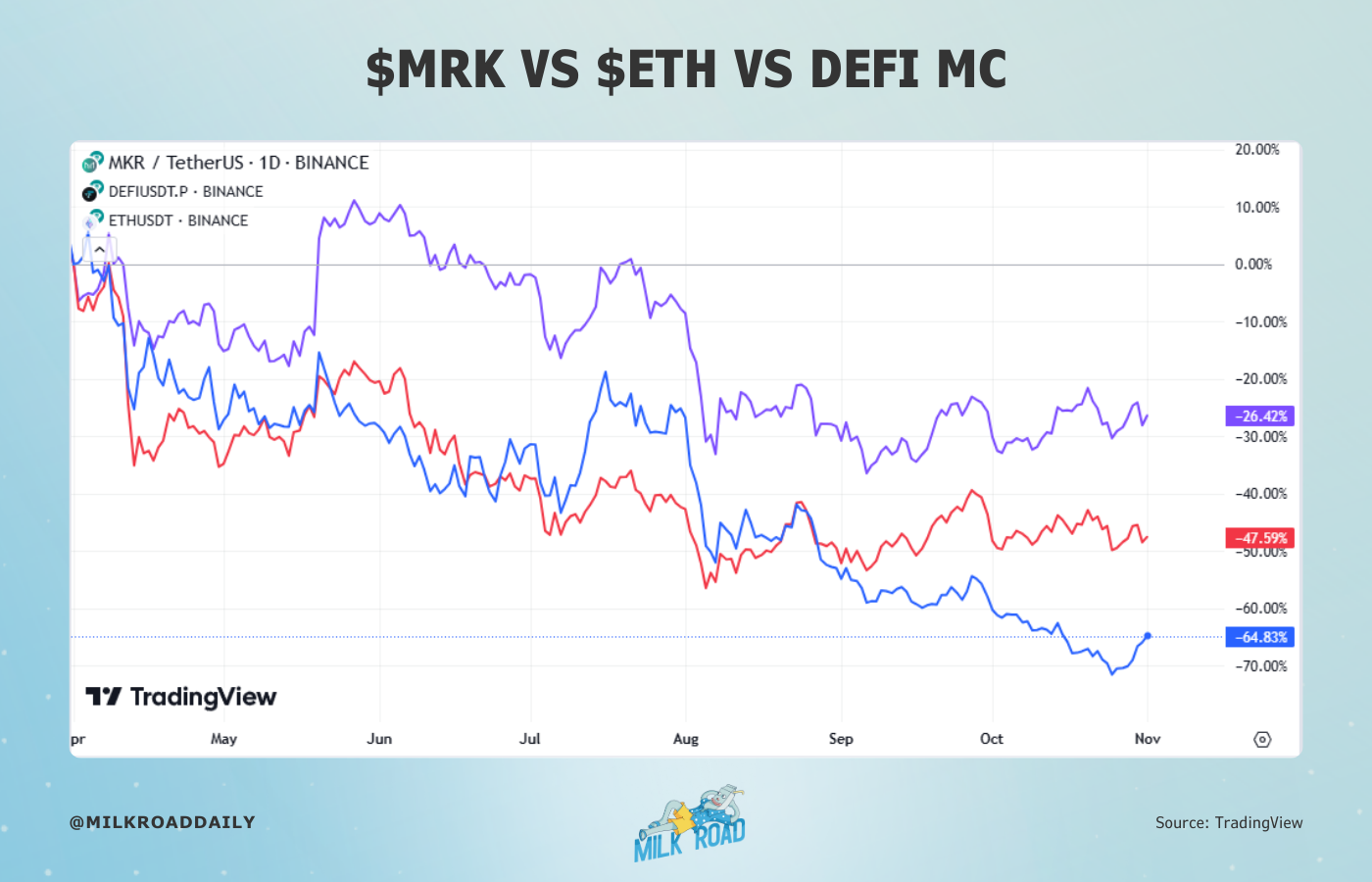
While Ethereum is down just 26% and the broader DeFi market 47%, Maker ($MKR) has taken a beating, dropping a staggering 65% since its March highs.
[
Source: TradingView
Looking at this chart, it’s hard not to start questioning our investment in Maker.
Is now the time to sell and cut our losses or double down and buy more $MKR at a bargain price?
That’s exactly what we’re going to answer today.
Here’s the rundown of how this report will unfold:
-
We’ll start with a look back at Maker’s history to understand the vision behind its endgame plan.
-
We’ll dive into what makes Maker unique and reveal its "north star" metric
-
Then, we’ll break down the main critiques currently being leveled at Maker.
-
We’ll explore some potential positive catalysts that could drive growth.
-
We’ll discuss the upcoming challenges Maker needs to tackle.
-
And finally, we’ll wrap it all up with our thoughts on the current situation.
So whether you're a current Maker investor questioning its future or someone eyeing these low prices as a buying opportunity, this report has something for you.
And hey, before you dive in, just a heads-up—there’s a lot of information here.
So grab a comfy chair, make yourself a coffee, and settle in. We packed this report with all the “behind-the-scenes” details and insights you might not find anywhere else.
You know the saying, “less is more”? Well, not this time.
We promise you won’t be bored for a second, and you know what?
By the end, you might even feel a little sad it’s over. Enjoy!
HISTORY OF MAKER
Let’s start by talking about the challenges Maker has faced in the past and what led them to create the Endgame Plan.
Maker went through what few startups are lucky enough to experience—explosive growth. (From $300 million in TVL in 2020 to a massive $10 billion in 2021.) 🤯
But unfortunately, there are very few companies that can handle that kind of rapid expansion, without things spiraling out of control – and Maker is no exception.
Maker struggled with the classic problems:
Overhiring, chaotic processes, and a level of complexity where people lost track of what was really happening.
It became a tangled mess where no one knew what others were doing, making it hard to keep everything on track.
All of this, combined with the goal of becoming more censorship-resistant and reducing regulatory risks, led to the creation of the Endgame Plan.
NEW ERA OF MAKER
The Endgame plan was a way for Maker to regain control, streamline operations, and protect itself in an increasingly complex landscape.
You might think the Endgame Plan would have been easily embraced by the majority, but that was far from reality.
There were intense debates among major stakeholders about whether this was the best path for Maker’s future – though despite the pushback, the proposal passed in August 2022, and the team got to work.
But even then – Maker still had a whole lot more going on behind the scenes.
MAKER EXPANDS ITS REVENUE STREAMS
Maker became the first crypto player to tap into U.S. treasuries, which were offering higher yields than traditional DeFi rails.
By September 2023, Maker had over $3.2 billion deployed in U.S. treasuries, generating a yield of around 4-5%—equivalent to roughly $150 million annually.
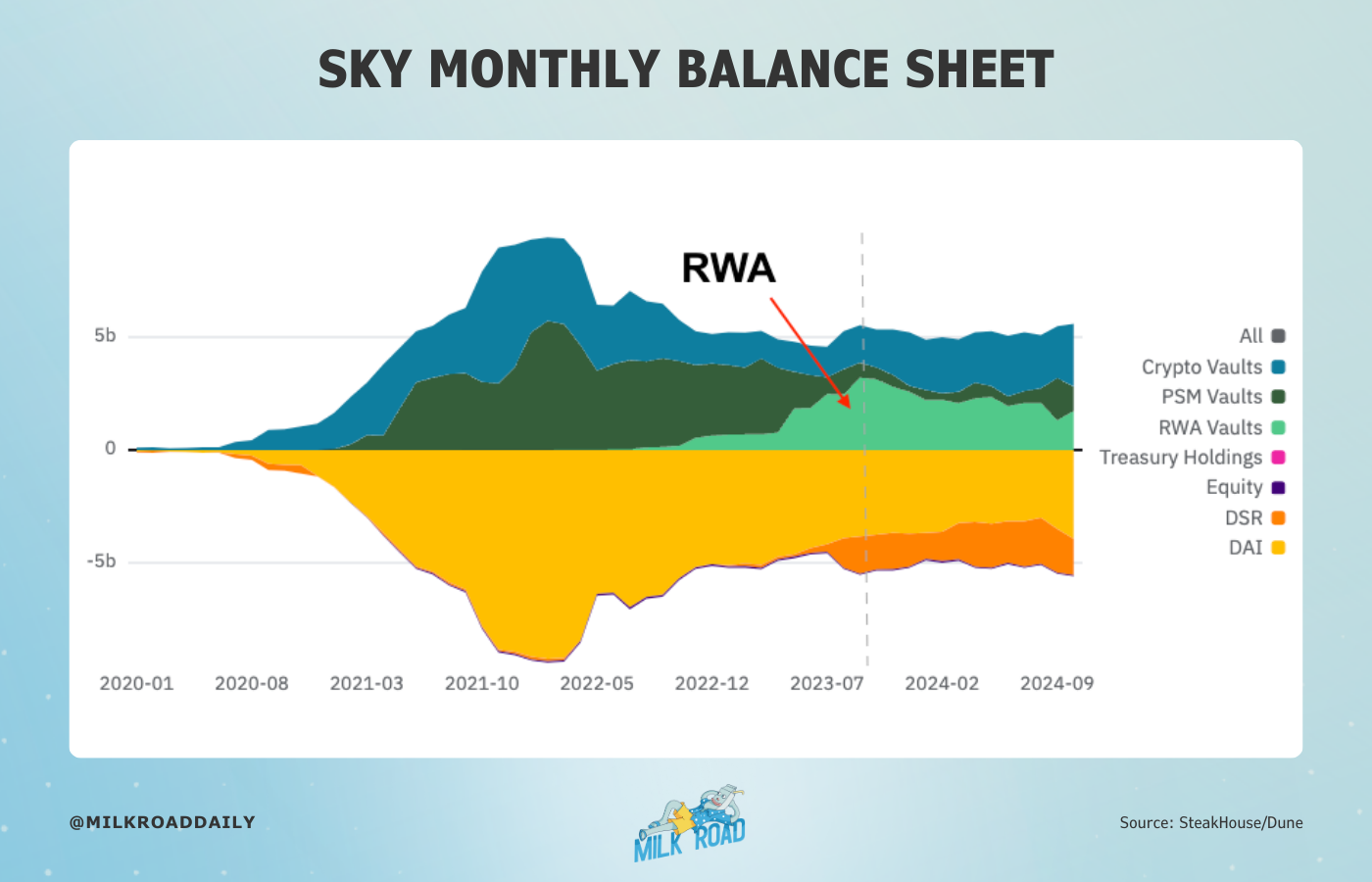
Check out Maker's composition below:
[
Source: SteakHouse/Dune
A year ago, Real-World Assets (see the green area on the chart), primarily U.S. treasuries, made up about 65% of Maker's total assets.
This sparked criticism from some in the community, who argued that Maker had become too centralized and overly dependent on U.S. treasuries.
While this criticism was valid, such an allocation allowed Maker to generate massive revenue—far beyond what anyone else in the space was making.
❌From the perspective of a blockchain maximalist, centralization is a bad thing.
✅ But from an investor’s standpoint, it was the best move at the time.
Obviously, it’s hard to fully quantify the risks involved, but we believe Maker wouldn’t tap into something without having high confidence that major risks were mitigated through off-chain agreements and top-tier security measures.
Especially when you're managing a few billion dollars, like Maker, you take every precaution to protect those assets.
Alright, let’s say you accept that Maker is making the right move for now….
Naturally, a new question still arises:
If 65% of Maker's assets are deployed into treasuries, what happens when yields drop back to the 1-2% range?
This has become even more apparent now that central banks have started lowering interest rates, with more cuts likely on the way. 🙄
How will Maker adapt to that challenge?
Enter Spark, a spinoff from Maker designed to be a lending platform similar to Aave.
Why Spark?
Because on Maker, you can only create a single vault, deposit $ETH or $BTC, and borrow against it—but here’s the catch:
You can’t combine the value of $ETH and $BTC to increase your borrowing limit. That’s where Spark changes the game, allowing users to combine assets for greater borrowing power!🔥
Spark lets users earn yield on their favorite crypto (which is a huge draw) allowing them to simply go to Spark, lend their assets, and earn some yield in return.
Ok, but why is this great for Maker? 🤔
Because Maker acts as a minting facility for Spark.
The more total value locked (TVL) Spark has, the more $DAI or $USDS it can mint through Maker and offer to users at cheaper borrowing rates.
The best part? The more $DAI in circulation, the more revenue for Maker. Win-win.
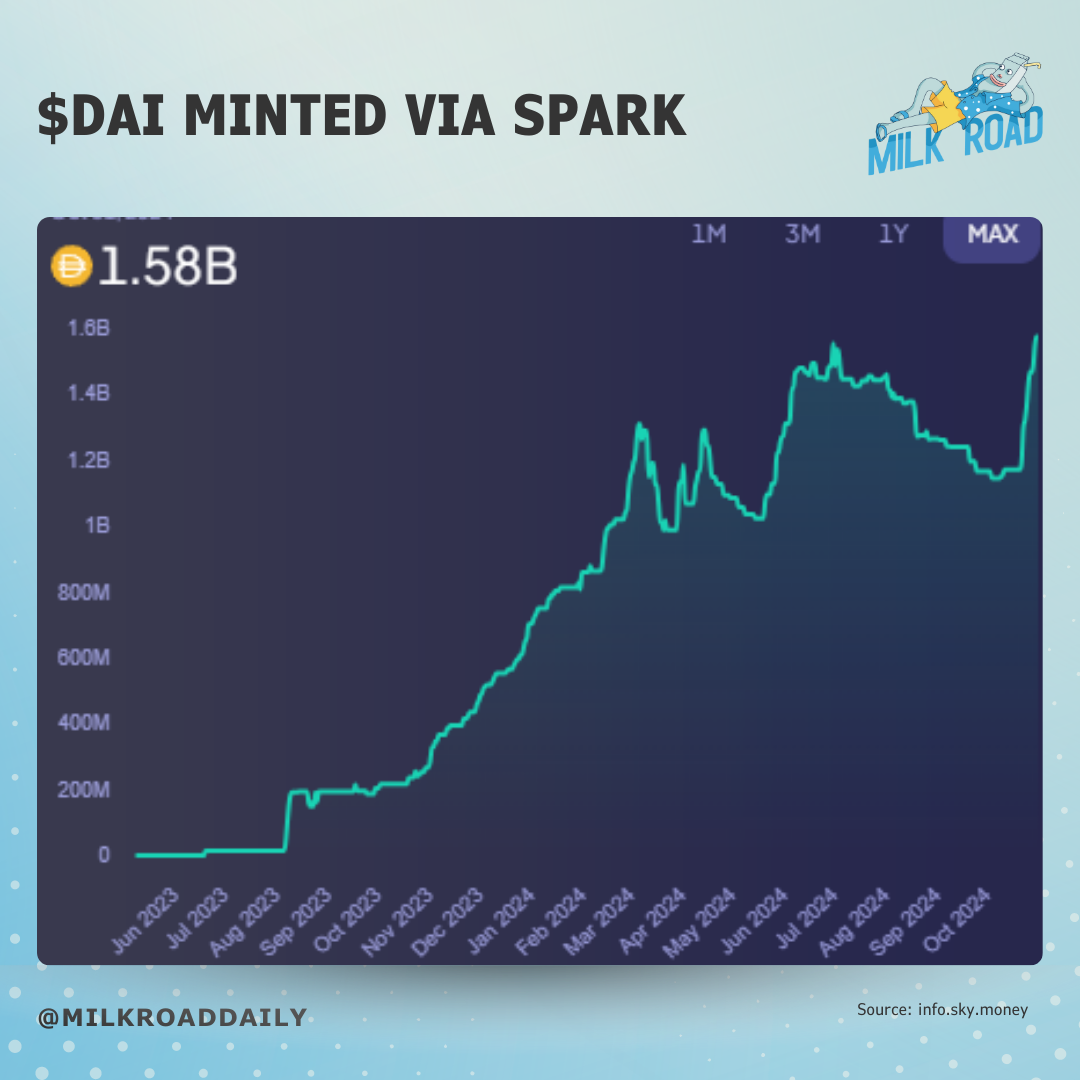
Just look at how much $DAI has been minted through Spark.
[
Source: Info.Sky.Money
Spark launched last summer and is now responsible for 1.58 billion $DAI in circulation. And generates around $70 million in revenue for Maker—pretty freakin’ impressive.
But that ain’t the half of it!
With $1.31 billion in excess stablecoin liquidity, Maker developed a vault called LitePSM, which lends stablecoins to Coinbase Prime—the institutional arm of Coinbase—earning a solid 4.25% APY.
(Another savvy move to boost revenue!).
Feeling a little lost with all the revenue streams Maker has built over time? We’re with you!
So let’s break it all down…
We'll stick to their official terms so that, if you're checking their dashboards yourself, you'll recognize the terminology.
-
Core – Borrowing on Maker by using single assets like $ETH and $BTC as collateral. (currently around 6% APY, expected to increase)
-
RWA - US treasuries (currently around 5% APY, expected to decrease)
-
Stablecoins - litePSM module (currently around 4.25% APY, expected to decrease)
-
Spark - Lending markets (currently around 6.5% APY, expected to increase)
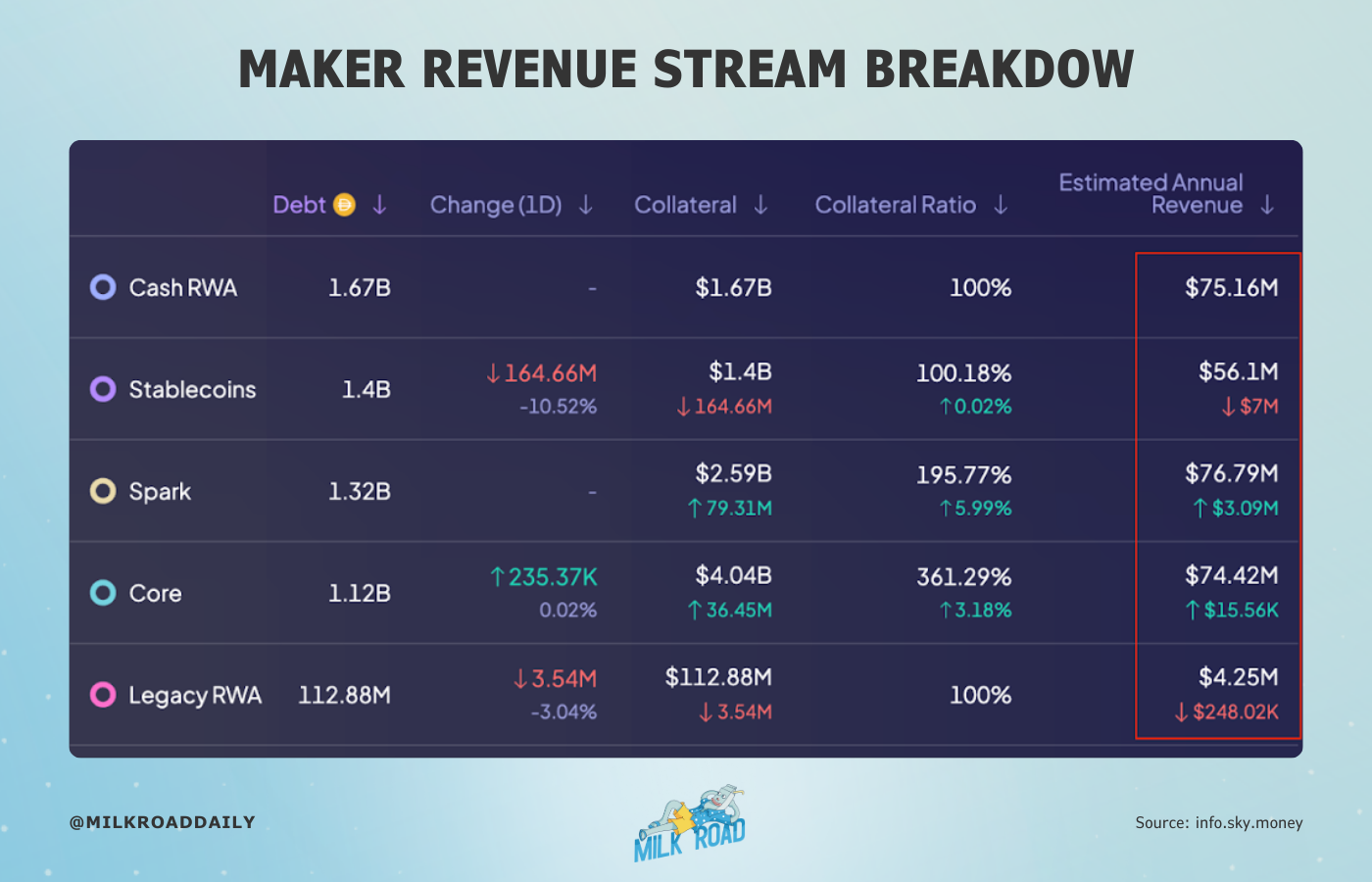
And before you ask, here’s the breakdown of how much each revenue stream contributes to Maker’s total revenue:
[
Source: Info.Sky.Money
Very well distributed across all revenue streams. 🤝
...which brings us to Maker's competitive advantage.
MAKER'S INNOVATIVE OFFERING
No other stablecoin issuer comes close to Maker as far as total number of revenue streams goes.
Even the giants like $USDC and $USDT—despite having a whopping 150 billion stablecoins in circulation—rely solely on U.S. Treasuries.
And perhaps even more importantly: they don’t pass any of that yield to their holders!
But Maker? They’ve taken things to the next level.
Not only do they have multiple revenue lines, but they actually share a chunk of that income with their stablecoin holders. If you’re holding $sDAI or $sUSDS, you’re automatically earning 5.5% or 6.5% without doing a thing.
No extra steps—just passive yield straight to your wallet. 🤗
That’s a pretty compelling value proposition.
But how do we actually measure the demand?
MAKER'S NORTH STAR
If you’re not familiar with the term "north star," it simply refers to the single most important metric we track.
For Maker, the circulating supply of its stablecoins is that north star—it’s the key indicator we watch closely.
Think of it this way: Maker is like a company “selling” its stablecoin. The more they issue, the more revenue they pull in.
But that growth doesn’t just happen on its own; it’s fueled by a mix of factors—liquidity, peg stability, trust, integrations, accessibility, network effects—all working together to expand the supply and drive Maker’s success.
So, let's see how this key metric has been shaping up for Maker recently!

[
Source: Info.Sky.Money
The supply remained pretty flat throughout the summer, but after Maker unveiled its new brand, Sky, the stablecoin supply surged from $5.1B to $5.8B in just two weeks.
Since then, it’s held steady around that number – however, it takes time for protocols to integrate a new stablecoin, for funds to review the smart contracts, and for the broader crypto community to build confidence around the new $USDS stablecoin.
Just a reminder, if you’re after yield-bearing stablecoins, you’ll need to “hold” the staked versions—not $DAI or $USDS, but $sDAI or $sUSDS.
But when we combine $sDAI and $sUSDS—the staked, yield-earning versions—they only make up 38% of the total supply.
That means a massive 62% of holders are missing out on the chance to earn 5.5% ($sDAI) to 6.5% yield ($sUSDS).
The boosted yield on $sUSDS is meant to draw more people to this new stablecoin over older options like $sDAI.

And If yield is the ultimate attraction, then why aren’t we seeing more people moving their staked $DAI into staked $USDS, where they could score higher returns?
(Why let extra yield slip away?).
To really get to the bottom of this, let’s rewind a bit through Maker’s journey…again.
QUICK FLASHBACK TO MAKER'S HISTORY (AGAIN) 🥴
Originally, $DAI was backed purely by Ethereum, reflecting the project’s dedication to decentralization and censorship resistance.
But things shifted when Maker introduced a multi-collateral model, allowing assets like $USDC and $BTC to back $DAI as well.
Suddenly, $DAI wasn’t just riding on $ETH—it was supported by a broader mix of assets.
This change sparked some serious debate.
Many early believers in the “pure” decentralized vision felt betrayed and left the project, saying Maker had abandoned its original mission of creating a truly decentralized stablecoin.
Just when the dust started to settle, Maker threw another curveball by launching a brand-new stablecoin: $USDS.
But here’s what’s really raising eyebrows—the least-liked feature of $USDS is Maker’s plan to add a freeze option.
This would allow governments or regulators to pressure Maker into freezing certain funds if they disapprove of any transactions.
For those who value decentralization, this feels like a big step in the wrong direction.
In short, Maker started with an ETH-backed stablecoin, then expanded to include more collateral options like highly centralized assets such as $USDC.
Then they added U.S. Treasuries as a new revenue stream, and most recently hinted at introducing a freeze function to their new $USDS stablecoin.
This is a good segue into discussing the recent critiques.
CURRENT CRITICISMS OF MAKER
Everyone expected $MKR’s price to skyrocket after the rebranding and the launch of a new stablecoin, but instead, it went the other way. And maybe these critiques are part of the reason why.
We’ve identified four key critiques:
-
$USDS and Compliance Issues
-
Rebranding Challenges
-
Centralized Decision-Making
-
Maker’s "Savings-Account" Strategy
Curious to learn more about these critiques? You should be—the market’s feedback is crucial and definitely not something to ignore. In fact, it’s just the opposite.
If that’s what’s causing the price drop, you’ll want to dig deeper, form your own opinion, and decide if these critiques are justified and worth your concern—or not.
And if you’re unsure about forming your own opinion, don’t worry—we’ll share ours to help you out.
1. $USDS and Compliance Issues
🚨 Critics argue that adding a freeze function to $USDS goes against MakerDAO’s original promise of decentralization.
A freeze function would let MakerDAO—or even regulators—lock up funds if they feel pressured, which feels like a betrayal to users who value freedom and censorship resistance.
But here’s the real problem:
Even with a freeze function, $USDS probably won’t dodge regulatory issues – because $USDS isn’t a truly separate stablecoin; it’s just $DAI with a new layer on top.
$USDS relies on the same $DAI protocol, assets, and systems. Anytime you convert $USDS to another stablecoin like $USDC, it first turns back into $DAI. They’re deeply connected.
So, if regulators crack down on $DAI, $USDS will likely get swept up too.
Critics see the freeze function as window dressing—it may look like compliance, but it doesn’t actually protect $USDS from regulatory risk.
And to some, it’s just unnecessary complexity that strays from Maker’s original vision of a fully decentralized stablecoin.
➡️ Those are fair points. It seems clear that Maker wants to position itself as a future-compliant stablecoin, signaling that it’s not looking to clash with regulators.
There’s still a long road ahead, and Maker isn’t fully compliant yet—but this proactive approach could be the right path forward.
For any stablecoin issuer with big ambitions, finding a way to work within regulatory frameworks is likely going to be essential.
At the end of the day, it might be time to put ideologies aside and focus on what actually works.
Balancing user appeal with proper risk management is key if we want stablecoins to attract the masses and achieve mainstream success.
2. Rebranding Challenges
🚨 Another common criticism centers around the $SKY rebrand.
It turns out that most people still prefer the original $MKR token—only about 7% of $MKR holders have actually converted to SKY so far, which says a lot.
And it’s not just individual users who are hesitant; major players like centralized exchanges, along with price-tracking sites like CoinGecko and CoinMarketCap, haven’t given $SKY much recognition either.
For now, it seems that both the community and the wider crypto ecosystem aren’t fully on board with the $SKY rebrand.
The feedback has been loud and clear, prompting Maker’s founder, Rune, to reconsider the whole rebranding strategy. He’s now suggesting three options on how to move forward:
Option 1: Stick with the Sky Brand
Sky remains the main brand for both the Sky.money front end and the Sky Ecosystem on the backend. The $MKR-to-$SKY transition continues as planned, with Sky at the center of it all.
Option 2: Recenter on Maker
Shift the focus back to the well-loved Maker brand.
Sky would still be used as the front-end brand for Sky.money, and $USDS would stay as the stablecoin brand, but the backend protocol would return to Maker branding, with $MKR re-established as the main asset.
Option 3: Recenter on Maker with a Brand Refresh
Bring back the Maker brand, but with a fresh, modern look.
Similar to Option 2, the backend protocol would revert to Maker, and $MKR would once again be the primary token.
However, Sky would still be the front-end brand for Sky.money, and $USDS would remain the stablecoin name.
These options are Rune’s way of addressing the community’s resistance to the Sky rebrand, acknowledging that both long-time users and the broader crypto ecosystem might not be ready to part with the iconic Maker name.
➡️ Let’s be honest—it was pretty surprising to see this kind of feedback.
A lot of effort, money, and resources went into building the Sky brand, and now it feels like much of that work is at risk of being tossed aside. Maybe not all of it, but certainly a big chunk.
Maybe we’re jumping to conclusions too soon. Or perhaps Sky was designed to attract a new audience and tap into demand that simply hasn’t shown up yet.
After all, big waves of new users in crypto usually come with price surges—and we’re not in that kind of market cycle just yet.
So it’s mostly crypto OGs—those who have been in the market for a while—who are giving feedback and voicing their opinions on this.
It’s definitely a positive sign to see the level of interest and feedback Maker is getting.
It shows that a lot of people care about the project and are paying attention—a true signal of a strong, engaged, and robust community.
At the same time, all of this feedback is slowing things down. Instead of focusing on expanding to other chains, Maker is now caught up in discussions about the future direction of the project.
❗The opportunity cost could be huge—if Maker can’t get its products onto retail-oriented chains soon, it risks missing out on a massive market.
3. Centralized Decision-Making
🚨 Another recurring issue is that Rune, founder of Maker, seems to be making all the key decisions with little pushback—he’s surrounded by people who just go along with his ideas.
When everyone around you only agrees, it’s easy to get stuck in an echo chamber, making it hard to see the bigger picture.
In this episode of The Milk Road Show, we learned that there are currently only 6 active voters in Maker governance—all of whom are indirectly connected to Rune.
Just a year ago, those numbers were much higher.
➡️ It’s a tricky balance. Having one person unofficially guiding the entire protocol can make things run smoothly and efficiently, but it also comes with big risks if that person makes a wrong move.
We don’t doubt that Rune genuinely wants Maker to succeed—he’s the largest $MKR holder, so he’s highly motivated to make the best decisions he can.
It definitely didn’t help when, just two weeks ago, Rune used his $MKR as collateral to take out a loan.
This move raised eyebrows, adding to concerns about concentrated control. He hasn’t provided any explanation for why he did it, leaving the community with more questions than answers.
4. Maker’s "Savings-Account" Strategy
🚨 Another point of criticism is that Maker aims to set itself apart by offering a yield-bearing stablecoin, positioning itself as the top choice for "savings" rather than just a straightforward stablecoin for payments.
Some people aren’t thrilled with this shift in focus.
➡️ With $USDT and $USDC holding a combined market cap of $154 billion, it’s clear that payment-focused stablecoins dominate the market compared to yield-bearing “savings account” stablecoins.
But while that’s true today, what about tomorrow?
Fintech giants like PayPal, Revolut, and Stripe have either launched or are likely to launch their own stablecoins soon. They’ll want full control and, of course, profit from these offerings.
Plus, they already have millions of users, giving them a major distribution advantage from day one.
So, should Maker compete directly with giants like Tether, Circle, and the upcoming wave of fintech stablecoins?
Or would it be smarter to focus on yield-bearing stablecoins that function as a kind of “savings account”?
Ask yourself this: if you could carry a $100 bill in your wallet, or a digital bill you bought for $100 that steadily accrues value—what would you rather hold and use?
Maybe yield-bearing stablecoins aren’t widely accepted by merchants today, but, in the end, users don’t really need to care.
Behind the scenes, their yield-bearing stablecoin can be instantly swapped into whatever currency the merchant accepts.
Users get to pay with a stablecoin that’s growing in value, while merchants receive the payment in their preferred form. It’s done in a flash and costs almost nothing.
It’s possible we’ll see these two categories converge in the future, where people increasingly choose to hold and pay with yield-bearing stablecoins.
We believe the future of finance will be centered around yield-bearing assets by default.
Maker is building the infrastructure now to provide access to a robust and diversified set of yield strategies, positioning itself for a massive advantage in the long run.
Alright, we've covered a lot, and it’s easy to lose track! Here’s a quick summary of the main points of criticism:
-
$USDS and Compliance Issues: $USDS is built as an upgradable contract, which means a freeze function could eventually be enabled. However, this doesn’t guarantee compliance, since $USDS is backed by $DAI in the backend—a token that doesn’t have a freeze function. So, even with this feature, $USDS may still face regulatory challenges.
-
Rebranding Challenges: The attempt to rebrand Maker as “Sky” hasn’t gone as planned. There’s now an ongoing debate about the direction of the brand, but a lot of resources have already been spent. This lack of clear vision is proving to be a distraction, pulling focus away from more business-oriented priorities.
-
Centralized Decision-Making: Maker’s governance appears to be heavily influenced by Rune and a close circle of "yes-men." This creates risks, as key decisions are made without enough independent feedback from the wider community or the users of Maker’s products.
-
Maker’s "Savings-Account" Strategy: Maker aims to position itself as a “savings account” rather than just a simple digital stablecoin for online payments. While the current market shows massive demand for payment-focused stablecoins, it remains to be seen if there’s significant demand for a yield-bearing, savings-oriented stablecoin.
In short, Maker is facing criticism for potential compliance issues with $USDS, a rebrand to "Sky" that hasn’t gained traction, centralized decision-making led by Rune, and an untested strategy to position itself as a yield-bearing “savings account” rather than a payment-focused stablecoin.
These are all fair points, and they shouldn’t be ignored.
Instead, we should double down and apply healthy pressure on Maker to address these concerns.
In fact, that’s already happening—we’re actively sharing our thoughts on the Maker Discord/Forum to keep the conversation going.🧐
Alright, let’s flip the script and explore the arguments from the Maker bulls' perspective.
Before diving into future growth catalysts, let’s quickly remind you what makes Maker unique and why it stands out.
MAKER'S EDGE
We’ve already touched on Maker’s innovative offering, but as the saying goes, “Repetition is the mother of learning.”
This time, we’ll use a TradFi analogy to make it easier to grasp what makes Maker truly unique.🤩
Think of Maker as an asset manager, focused on optimizing risk-adjusted yields for stablecoin holders.
Here’s a traditional finance analogy:
If you want to invest in stocks, you have two main options.
-
You can either handpick individual stocks you like
-
Or you can buy something like $SPY, an ETF that tracks the S&P 500 index.
While choosing your own stocks might seem appealing, the reality is that most people struggle to outperform the index over the long run.
In a similar way, Maker offers a stable, yield-bearing option for people who want consistent returns on their stablecoins without having to manage individual assets or chase high-risk yields.
Just like $SPY simplifies investing in the entire stock market, Maker aims to provide a balanced, risk-adjusted return that’s hard to beat over time for stablecoins.
Take a look at the visual below—it highlights all the yield strategies that Maker currently has access to or plans to integrate in the future.

Just like $SPY is the go-to choice for investors seeking broad exposure to stocks, Maker’s stablecoin could become the default option for those looking for a yield-bearing stablecoin—or a boosted “savings account,” if you will.
And there’s no one better positioned to offer this than Maker.
Feeling bullish? Don’t get too excited just yet!
We’ll cover some potential growth catalysts that could boost your enthusiasm even more – but remember, there’s no such thing as a free lunch.
We’re also going to dive into the future challenges Maker will face, which might bring you to think twice. 😆
Alright, let’s dive into the growth catalysts first and explore what could drive its expansion.
POTENTIAL CATALYSTS
We’ve identified four key catalysts—events that could unfold in the next few months and significantly boost Maker’s growth.
🔋 Central Banks Lowering Interest Rates
There’s an inverse relationship between central bank rates and onchain yields.
When central banks keep interest rates high, U.S. Treasuries and other traditional assets offer yields comparable to what’s available onchain, reducing the incentive to move capital into crypto.
But when central banks start lowering rates, onchain yields typically increase, making them more attractive.
Right now, U.S. Treasuries are offering around 5% and crypto yields are sitting at 7%, so the difference isn’t huge.
But imagine if that gap widens—what if onchain yields are 5% or even 10% higher than what traditional assets offer? At a certain point, the spread will be hard to ignore.
So, what’s your tipping point? How much extra yield would make it worth shifting to onchain products?
This potential widening yield gap could be a major growth catalyst for Maker and other DeFi platforms offering yield-bearing stablecoins.
🔋 Maker Expands to L2s and Solana
With Layer 2 solutions and chains like Solana driving down transaction costs, user activity is skyrocketing on these networks.
This creates a huge opportunity for Maker to extend its reach and bring its stablecoin to the heart of these fast-growing ecosystems.
To make this possible, Maker is developing MakerLink—a groundbreaking solution designed to seamlessly connect its stablecoin to every relevant chain.
We believe MakerLink has the potential to be a game-changer, enabling Maker to deliver its products directly to where the users are, integrating effortlessly with the hottest chains in crypto.
🔋 Horizontal Growth
Projects are incentivized to join the Maker ecosystem and become “stars” because Maker provides them with a reliable supply of stablecoins.
In this model, Maker handles the heavy lifting of managing tail risk, allowing these projects to focus on driving innovation, adoption, growth, and profits.
As we mentioned earlier, Maker currently has four revenue streams. Once Spark launches, it will take on the responsibility of managing the majority of those.
And while Spark will be the only "Star" in the ecosystem for now, the potential for adding many more yield-generating projects is enormous.
This ability to diversify income sources could become one of Maker’s biggest competitive advantages moving forward.
With the flexibility to explore new yield strategies while maintaining high security standards, Maker is positioned to expand its revenue and strengthen its ecosystem.
🔋 New Integrations
We believe that more projects and apps will be interested in integrating $sUSDS directly, thanks to its unique value as a yield-bearing stablecoin.
Unlike traditional stablecoins that simply hold value, $sUSDS offers users the benefit of earning yield by default.
This could make it an attractive option for platforms looking to provide an added layer of value for their users.
Similar to how Bybit adopted Ethena's stablecoin as its default collateral, we could see exchanges, DeFi apps, and wallets adopting $USDS as their preferred stablecoin, driving broader adoption across the ecosystem.
These are the four key catalysts that could drive greater demand for Maker’s products, and, in turn, generate more revenue for Maker.
But, as we said, it’s not all smooth sailing—there are some upcoming challenges on the horizon that Maker will need to tackle as well.
UPCOMING CHALLENGES
If you remember our MilkRoad PRO Playbook, we talked about the importance of growth forecasting.
The idea is simple: once you truly understand a project, you can start making informed projections about its future.
This includes looking at both potential catalysts and upcoming challenges—things that aren’t a factor today but could have a big impact down the line.
We’re huge fans of Maker’s product, but there are definitely some hurdles it will need to overcome.
Worried we’re about to crush your excitement? 😆
Don’t worry—we’ve only got two major challenges to discuss for now.
💡Spark’s Fee Cut and Upcoming $SPK Token Launch
Spark is gearing up to launch its own token, $SPK, later this year.
Although the distribution details haven’t been released, this is something Maker investors should watch closely.
Spark was essentially spun off from Maker, with its development largely funded by Maker’s resources.
Even though the proposal to allocate a portion of $SPK directly to Maker didn’t pass (for unknown reasons), over 20% of the $SPK supply will be set aside for incentives aimed at $USDS and $MKR stakers.
The relationship between Maker and Spark is set to deepen significantly.
Spark will soon take over the Andromeda RWA structure, which gives Maker access to U.S. Treasuries and T-bills, and will also manage the Peg Stability Module (PSM).
In other words, Spark will play a major role in supporting Maker’s ecosystem and revenue streams.
Additionally, Maker’s future revenue model involves charging only a base rate on all stablecoins deployed into “stars” like Spark.
This Base Rate will be tied to the average return of 3-month T-bills. So if T-bill yields decrease, Maker’s revenue could take a hit as well.
In summary, while Spark’s launch presents exciting growth opportunities, it also introduces new dependencies and revenue challenges that Maker will need to navigate.
💡 Star Allocation Framework
We’ve highlighted throughout this report how valuable it is for Maker to have multiple yield strategies available—but nothing comes without a cost.
To manage these strategies effectively, Maker needs a solid allocation framework that keeps risks under control.
This may sound straightforward, but it’s anything but.
Developing a robust framework that balances risk management with attractive returns will be a major challenge for Maker, and getting it right is essential for long-term sustainability.
We just wanted to put these 2 challenges on everyone’s radar so we can keep a close eye on how they play out.
Are these the only hurdles Maker will face?
Definitely not.
As the project grows and evolves, new obstacles will pop up that we can’t even see yet.
All right so let's take a deep breath in...and out.
Congratulations!🥳
You made it to the end. We know that was a lot of information to take in.
All that’s left now is to share our thoughts.
MILK ROAD TAKEAWAYS
And before we get into it…
For those who missed it, we had an amazing guest on The Milk Road show this Monday – Christopher Cameron.
Why was he such a great guest? Because he's a longtime Maker contributor and delegate who shared some truly unique insights.
He also explained why he recently sold all his $MKR. If you haven’t listened to it yet, we highly recommend you check it out here!
P.S. That was the first of three podcasts in our Maker series.
(Next up, we’ll be talking with Sam MacPherson from Spark, and we’ll wrap up the series with our Milk Road PRO team sharing their insights and takeaways)
Unsurprisingly, Chris’ views sparked some lively discussions in our Discord.
Here’s a look at some of the reactions:
Some people are genuinely worried.
"Honestly, I get super concerned listening to him. I’m active in the startup world—both as a founder and a highly active investor—and what I’m hearing are big red flags! I’m seeing major team risk, poor execution, and governance shifts that concentrate power in the team, moving away from independent control."
– Karma1009
Others, however, have a more balanced take:
"To me, his take wasn’t all that bearish. It seemed more like disappointment with the current governance and voting structure at Maker. He mentioned concerns around $USDS and $DAI but didn’t sound outright bearish. In fact, he seemed bullish on Maker’s fundamentals and future if they execute correctly."
– Xellon16
This mix of feedback highlights both real concerns and confidence in Maker’s potential.
On one hand, there’s worry about governance centralization and execution risks; on the other, there’s belief in Maker’s fundamentals and its long-term growth—provided the right steps are taken.
So, what do we think? Well for context, here’s what we said in august when we revisited our position in Maker:

[
Source: Time to sell or buy DeFi tokens?/PRO Report
So, is the execution of the endgame plan going as expected?
Well, some things could definitely be handled a bit better. But let’s be realistic—this is a massively ambitious plan, so a few bumps in the road are to be expected.
We’re not thrilled to see long-term contributors leaving the project, and we’re concerned about a governance structure that lacks diverse viewpoints—where it feels like not everyone is aligned, and challenging decisions or offering a counterbalance might not be welcomed.🧨
Maker’s endgame goal was to become less complex and more transparent, but right now, the opposite seems true.
The Atlas—the playbook for Maker governance that outlines how everything is managed, who holds which rights, and so on—is primarily written by the founder, with limited input or familiarity from the rest of the community.
Then there’s Spark, a project funded by Maker, yet the exact financial details remain unclear.
We think this kind of information should be fully transparent and easily accessible to everyone.
We’re really curious to find out how much Maker spent on developing Spark—especially considering Maker won’t receive any $SPK allocation.
It’s something we’re still trying to wrap our heads around.🥺
The upside to all of this is that these issues are internal—and they’re all solvable.
Rune’s recent proposal to reconsider the Sky rebranding raises important questions about how this transformation was handled and what lessons can be learned.
Additionally in a recent community call, he admitted they underestimated the value of Maker’s brand and overlooked the importance of exchange listings among other things.
But to be fair, we don’t want to paint Rune in a negative light.
As the founder who has been with Maker since the beginning, he has strong incentives to do what’s best for the project.
And really, who better to lead than the person who built it from the ground up?
That said, there are plenty of signs that something needs to shift.
Now feels like the right time for the community to speak up, create a bit of healthy pressure, and push for a more open, collaborative approach in Maker’s governance.
Maker has built something truly unique—it’s still the most profitable DeFi project in the space, with strong network effects and solid fundamentals that continue to improve.
But even the best-designed spaceship (Maker) can struggle to navigate uncharted territory without the right crew.
We hope to see Maker learn from past mistakes and begin actively onboarding more governance participants, welcoming diverse views and opinions to help shape its future direction.
A stronger, more inclusive governance model will be key to unlocking Maker’s full potential.
Are we selling or capitulating on Maker? Definitely not.
We remain optimistic that Maker can navigate this challenging period and ultimately fulfill its full potential.
We’re shifting our focus slightly from onchain fundamentals to the community—digging into Maker’s Discord, forums, proposals and discussions.
This will help us gauge if there’s real progress in addressing the issues we’ve outlined, or if Maker is simply ignoring feedback and continuing to operate in isolation.
This isn’t something that will change overnight, but we’ll revisit our thesis in a few weeks/months to assess if any progress has been made.
By then, we’ll also have a clearer view of the challenges and potential catalysts we’ve outlined here.
Until then, we’re holding our position.
Before we wrap this up, make sure to catch next week’s episode (on Thursday) of the Milk Road Show podcast, featuring Sam MacPherson, the “unofficial” founder of Spark Protocol.
And the following week, there’ll be an episode featuring the Milk Road PRO team, where we’ll dive into the latest updates about Maker and share our reflections.
And don’t forget—you can always jump into our Discord to share your views.
Challenge opinions, ask tough questions, and think critically.
Just remember, we’re all in this together!
Good luck and take care!
ACTION STEPS FOR PRO MEMBERS 🥛
Join the private PRO community now!
This is your all-access hub for engaging directly with the Milk Road PRO research crew and fellow PRO members, diving into live AMA sessions, digital events, and daily robust discussions on market trends, fundamentals, and industry insights.
🚨 Important: Upon joining the Discord, you’ll be asked to fill out a form. Please, please pay attention to 2 things:
-
Enter the exact email address you used to sign up to PRO with.
-
Enter your exact Discord username. To find your Discord username, click on your profile picture in Discord. Your username is the smaller text name under your profile picture.
Do this with bomb-defusing precision—a single typo might lock you out! 😬
Join the PRO Discord Community Here
See you on the inside! 🥛
Start the Crypto Investing Masterclass (50% off just for you)
If you want to supercharge your portfolio and capture a piece of crypto's growth to a $100T market cap, then you need to understand these 4 basic concepts:
-
The fundamentals of crypto cycles
-
Liquidity flow in crypto
-
How to pick the right coins for your strategy
-
Building a portfolio that outsmarts 99% of crypto investors
You can learn all of the above (and more) inside the Milk Man’s Crypto Investing Masterclass — your ultimate cheat code to become a successful crypto investor.
This masterclass lays the foundation of investing in crypto, so you can maximize the value of the Milk Road PRO reports and build a portfolio that brings you generational wealth by the end of the next bull cycle.
The best part? Milk Road PRO members like you 🫵 get a 50% discount for lifetime. 🥳