The next big winners are... 🥇
Our guide to uncovering hidden gems in the current market 💎
October 26, 2024

GM! Welcome to Milk Road PRO. The newsletter that collects ingredients and provides recipes, so you can get to cooking!
You’ve probably experienced it before…
That moment of sheer, unadulterated frustration (like an itch that you just can’t reach to scratch).
That moment when the information you’re taking in from YouTube, Crypto Twitter, and random online pundits reaches a tipping point — shifting from ‘helpful’ to ‘excessive,’ as all the inputs begin to conflict.
We’ve been there before. It sucks!
And it’s in these moments that the little voice in your head starts chirping at you.
(You know the one).
It’s that voice that prods you with thoughts like:
“This sh*t is too hard to figure out. You gave it a shot, now call it a day.”
We’ve designed the following guide to be a metaphorical ball gag that you can use to shut that voice up once and for all.
Cause here’s the thing — when you’re analyzing new tokens, you really only need to look at 7 key factors to figure out whether they’ll be winners or losers in the long term, with some degree of confidence.
It’s not perfect (nothing is) — but together, these factors act as a bullshit detector (of sorts), giving you a repeatable framework for analyzing unproven tokens.
Now, it’s worth noting: these factors alone won’t deliver you the clarity, confidence, and conviction you’re looking for when considering an investment — because not all of them are created equal.
So we’ve assigned percentage weights — or “give-a-f*ck” levels (if ya nasty) — to each factor, so you can understand their level importance when analyzing a new project.
This way you can explore your options with confidence, and stem the fire hose of information down to a stream of pure alpha.
Sounds good? Good 🫡 Let’s get into it!
Here are the 7 factors that make up the Milk Road playbook:
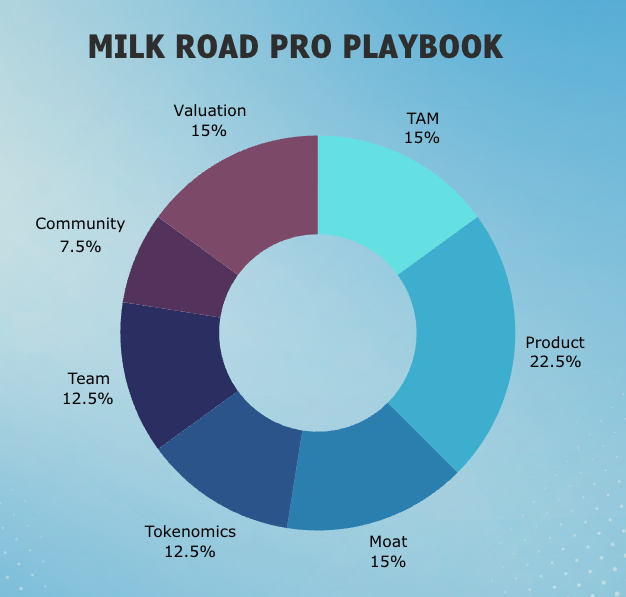
You've probably heard some of these terms like TAM or Moat – but without context, they’re close to useless! They leave you wondering why they matter, and where you should focus.
We ain’t about that! Today we’re breaking it all down for you, in exact detail, with a bunch of examples to really drive things home.
With so much to cover, we’d say it’s about time to get into it! Ready? Let’s go!
PRODUCT (22.5%)
We love being users of the products we invest in—there’s no better way to truly understand them than by using them yourself.
But be careful—slick UX or seamless integrations can sometimes make you fall in love too quickly.
The real question you should be asking is:
👉 Is this the best product out there?
It’s not always that simple though—sometimes the best tech or product doesn’t win right away.
However, we believe that, in the long run, the best product usually comes out on top.
So, it’s important to understand what truly makes a ‘great product’ – what are its strengths, and why does it stand out in the market?
Example 1:
Let’s say I want to borrow money against my crypto. Which project am I going to choose?
First, I’d look for:
-
A project that’s been around for a while
-
Proper security audits in place
-
Proof that others are using it (measured by TVL)
After that, I’d narrow it down based on two key factors:
-
The project accepts my collateral (e.g., $stETH)
-
It offers me the best borrowing rate
This process might lead me to ask:
What are they doing differently that allows them to offer the lowest borrowing rate? By digging deeper, I’d finally get the answer to whether this project really offers a competitive edge.
By going through this exercise, I’m putting myself in the user’s shoes to better understand their needs and figure out if the product from my chosen project truly stands out as the best option.
✅ And you know who would come out on top? $SKY.
P.S: We know $SKY’s price has been dipping recently 😔, but everything else is on the rise.
With upcoming deployments of $USDS on L2s, Solana, and the Spark launch, plus other exciting developments, selling isn’t on our minds—quite the opposite, in fact!
Example 2:
I’m now considering which stablecoin to use. I’ve got my eye on $FRAX (the decentralized version of $USDC) and using the same process. For a stablecoin, here are the key factors to consider:
-
Sufficient liquidity
-
Ability to consistently hold its peg
-
Strong safety measures
-
Offers some juicy yield
-
Is composable and integrated across DeFi platforms
❌ I quickly realize that $FRAX isn’t widely integrated into other DeFi protocols, and it mainly generates yield from U.S. Treasuries—yields that are expected to decline soon. While they’re slowly trying to gain exposure to Ethena’s yield, it doesn’t seem like a winning stablecoin to me.
Example 3:
In the blockchain world, the "product" is essentially the block space each network provides. But there are different ways to evaluate which block space offers the most value, depending on what you prioritize.
Here’s our take, though others might have a different perspective.
✅For Ethereum, its block space stands out because it has the largest user base, the most liquidity, the biggest developer community, and a sprawling ecosystem. Plus, its growing Layer 2 solutions add even more utility.
✅Solana’s block space is all about speed and cost. It’s the cheapest and fastest blockchain available, offering unparalleled throughput for high-performance applications.
✅Then, there’s TON—its block space has a unique advantage: access to Telegram’s 800 million active users. This gives it massive potential, leveraging one of the largest messaging platforms in the world.
So, when evaluating new emerging Layer 1 blockchains, think about what they can uniquely bring to the table and how they plan to compete with the established L1s and what sets them apart.
Example 4:
If you're a U.S. citizen using T-Mobile or AT&T, there's a new project using blockchain technology to offer an unbeatable mobile plan—unlimited service for just $20 a month.
✅Helium can offer such an affordable mobile plan mainly because blockchain technology cuts costs and significantly lowers capital expenses.
When it comes to mobile plans, price is one of the most important factors. As a result, they’ll be able to offer the lowest-priced plans with continuously expanding coverage.
TLDR: Understanding the product and knowing how to define the "best" product in a specific sector is crucial and offers valuable insights. It’s not always easy to pinpoint the product or the users' needs exactly, but aim to stay as objective and unbiased as possible!
Keep in mind that usage or revenue can sometimes be inflated by incentives or a lack of fees. So, it's important to ensure that not only is it the best product out there, but also that its pricing is competitive and people are actually willing to pay for it.
MOAT (15%)
The secret to any company's success – whether it's a tech giant or a century-old powerhouse – lies in its "moat." A moat is that special edge that protects a business from its competitors. It could be anything from network effects, to high switching costs, or economies of scale. Without a moat, companies can't keep the competition at bay or hold onto their value for long.
Now, let’s talk about crypto – where moats aren’t just important, they’re a requirement. In the fast-moving world of crypto apps, building a moat is essential for survival. Here's why:
1. Forkability: In crypto, apps can be copy/pasted (or "forked") in a heartbeat, which means it's way easier for competitors to jump in.
2. Composability: Since crypto apps are connected and work together, users can switch between them with almost zero effort. Loyalty? Not much of it here.
3. Token-Based Acquisition: Crypto projects can offer tokens to reel in users at a fraction of the cost, making customer acquisition incredibly cheap.
These unique crypto dynamics supercharge competition. The moment a crypto app flips on its "fee switch," a flood of lookalike apps are ready to swoop in—offering the same service for less, or even paying users to jump ship with token rewards.
Without a strong moat, most crypto apps are stuck in an endless race to the bottom, quickly becoming just another generic option in a crowded market. If you want to survive and thrive in crypto, you need more than just a cool idea—you need a fortress of a moat to fend off the fierce competition.
Warren Buffet’s simple test for defensibility is this: “If I had a billion dollars, could I build a competitor and steal market share?”
In crypto, tweak it slightly: “If I fork this app with $50 million in token subsidies, can I take and keep their users?”
If the answer is yes, competition will likely erode the app’s dominance. If not, then the app has a strong moat—a key to surviving the fast-paced crypto market.
Example 1:
If I fork Aave and offer $50 million in incentives, can I take some of their market share?
❌ Yes, in the short term (since switching costs for AMMs are low). We think that liquidity or TVL can be easily influenced or subsidized, so they shouldn't be seen as strong, long-term competitive advantages.
Example 2:
If I fork Lido and offer $50 million in incentives, can I take some of their market share?
✅ People love Lido's products because they integrate seamlessly with other DeFi apps. This creates powerful network effects, building a strong, defensible moat for Lido, making it harder for competitors to break in.
Example 3:
If I fork Sky (previously Maker) and offer $50 million in incentives, can I take some of their market share?
✅ Sky has made partnerships/agreements and built infrastructure to access US treasuries through Andromeda, lending yields via Spark, perps yields through Ethena, and more.
Plus the endgame strategy focuses on creating infrastructure that can’t be easily forked or subsidized, giving Maker a strong and defensible edge in the market.
Example 4:
If I fork Jupiter and offer $50 million in incentives, can I take some of their market share?
✅ Jupiter has established itself as the go-to platform for trading on Solana, giving them strong bargaining power by "owning" the end-user experience.
This advantage allows them to secure exclusive deals and potentially vertically integrate in the future.
TLDR: Overall, we should view moats as "un-forkable" and "un-subsidizable" qualities. These can include things like a strong brand, big community, exclusive off-chain agreements, robust backend infrastructure, network effects, and more.
P.S. - We’re hosting a PRO AMA next week — scroll to the bottom for more info. 👀
These factors will tell you where a project is at right now.
…but what about the future?
We’ll also show you exactly how we forecast a project's future potential growth (with examples to really drive things home)!
This is a must have framework for any serious investor.
Don’t miss it!
TOTAL ADDRESSABLE MARKET (15%)
We are also interested in TAM—it’s a quick snapshot of how big the market is that the project is targeting.
The important thing to ask is: how significant is the problem you're solving? You want to aim for a large market with plenty of room for growth and scalability, rather than a small, niche market with limited potential customers.
Ultimately, we’re here to answer one key question:
👉 How big is the market today, and how will it evolve over time?
No need for more explanation—it’s clear. Let’s dive into some examples and learn through practice!
Example 1:
Data Availability (DA) was a major buzzword in early 2024, and it still holds a lot of attention. Many projects have jumped into the DA space, including Celestia, EigenDA, Avail, and others.
Quick reminder: DA refers to storing data on the blockchain that anyone can verify at any time. Think of it as a proof system—showing what changed between state A and new state B.
Makes sense – but here’s the catch: the market is still relatively small. Currently, only around $30k is spent daily on data availability. And while the market is expected to grow significantly, the big question remains: will it ever truly become a billion-dollar industry?
❌ Even though it's projected to grow significantly, the cost of storage will also drop thanks to technical advancements. So, this isn’t shaping up to be a multibillion TAM anytime soon.
Example 2:
Lending is something we’re all familiar with—think of it like a digital version of a savings account.
✅ In traditional finance, lending is a multi-trillion-dollar industry. And guess what? In today’s DeFi space, we’re already seeing tens of billions of dollars being lent.
That’s a pretty exciting signal, especially if you believe DeFi is just getting started and will continue to attract more users. So even a small piece of a trillion-dollar market still represents a huge opportunity!
TLDR: To sum up this first block, we want to understand if the project is solving an existing problem or tackling something entirely new.
New problems come with higher risks due to more uncertainties. But overall we need to assess how big the problem is and how quickly it's expected to grow.
But don’t be discouraged if the TAM is small today—there could still be massive potential if you believe there’s potential for rapid growth.
However growth markets can carry more risk, so keep that in mind as you evaluate the opportunity!
P.S. You might have noticed that we give this building block a 15% weight in our overall score. We'll discuss this at the end.
TOKENOMICS (12.5%)
Tokenomics is a unique factor in crypto that we don’t typically consider when evaluating stocks, but it’s essential in this space.
There are several key questions we should ask to get the full picture:
1. What’s the token distribution?
We need to understand how the tokens are allocated between the community, treasury, investors, and the team. The current trend suggests that around 50% should go to the public community (including treasury), and the other 50% to investors and the team.
2. How many tokens are circulating?
The conversation around low circulating supply and high Fully Diluted Value (FDV) is important here. If only 10% of the total supply is in circulation, strong selling pressure could hit when the remaining tokens are unlocked or used as incentives. In simple terms, the more tokens that are already circulating, the less dilution you’ll face, which can be better for price stability.
3. Are there ongoing incentives?
If there are incentives, it’s important to ask if they’re being used effectively. Are they attracting new users or expanding market share? And, more importantly, will the impact of these incentives be sustainable in the long run?
4. Could the business operate without the token?
Right now, many projects don’t really need (or even use) their tokens beyond initial incentives and airdrops. However, some projects, like Uniswap’s recently announced Unichain, put real utility behind their tokens – using them as bonds for validators to participate in securing the network. If they don’t NEED the token, it’s probably not worth investing in.
5. What are the benefits of owning the token?
Protocols should eventually offer reasons to hold their tokens, such as exclusive access, better rates, or revenue-sharing opportunities.
TL;DR: We need to understand the complete picture of a token’s economics, from distribution and supply to incentives and utility, to make informed decisions.
Also, keep in mind that points 4 and 5 don’t need to be in place from the start.
For newer projects, these aspects can develop over time. But for more mature projects, tokens can evolve into powerful tools for creating competitive moats.
TEAM (12.5%)
You’ve probably heard of product-market fit, but what about founder-market fit? It’s not as common a term, but the idea is just as important.
The question here is:
-
If anyone were to build this product, is this the best team to do it?
-
Do the founders have unique insights, skills, or experiences that give them an edge in bringing this idea to life?
Let’s look at some examples to make it clearer.
Example 1:
✅ Sui, just like Aptos, is a prime example of founder-market fit done right.
Why? Because the team behind Sui wasn’t just some random group of developers—they spent years inside Meta (yep – the company formerly known as Facebook) working on a brand-new Layer 1 blockchain.
And Meta didn’t pick them by accident.
They were the go-to experts for building something groundbreaking in this space. Even though Meta shut down the project, these founders walked away with a wealth of experience and insights.
Now, they’re applying everything they learned to Sui, and that gives them a major advantage. With a track record like that, their chances of success are pretty high.
Example 2:
✅ Blast founder Pacman’s journey has been nothing short of extraordinary.
At 16, he cloned a startup and got hired by the company. By 17, he launched StrongIntro, passed YCombinator, and raised $120K, learning from early setbacks and finding his perfect co-founder at MIT.
Together, they launched Namebase, which quickly hit $10 million in transactions in just three months. The company was successful, but they decided to sell the company after two years.
Next, Pacman dove into the NFT world, creating Blur, which rapidly became the largest global NFT marketplace.
And he didn’t stop there—Pacman took things further with Blast, a groundbreaking Layer 2 solution with native yield that saw explosive growth, even in the face of early skepticism.
COMMUNITY (7.5%)
Think of community as the heartbeat of any project. It’s not just a nice-to-have—it’s essential. Every project should focus on attracting, building, and growing a strong community because, over time, a dedicated community can bring immense value and even become a powerful moat that’s hard to replicate.
Community isn't just about people hyping up the token on Twitter – in fact, it’s not about this at all.
It’s about active members engaging on Discord or forums, the content creators spreading the word, people building in the ecosystem and everyone genuinely interested in the project's success (not just token price).
A thriving community is what gives a project life and long-term staying power.
Example 1:
✅ Jupiter boasts an incredible community, and it shows in many ways.
Just look at the number of active participants in voting, the listens on community calls on YouTube, or how quickly you get answers on Discord—it’s clear this is a strong, engaged group.
And it’s no accident.
Jupiter understands the power of community, offering incentives for governance participation so everyone feels aligned and involved.
As the founder puts it, "The community eats first," which perfectly captures how central the community is to the project's success.
Example 2:
✅ Rocket Pool is another fantastic example of a strong, dedicated community, driven by the mission to offer the most decentralized liquid staking token for Ethereum.
The community actively creates valuable content, which is supported by the DAO, showing how deeply involved and passionate they are.
Even small but impactful things like community-driven merch help boost brand awareness and keep pushing the project forward.
It’s the kind of community where everyone contributes, making the project stronger with every step.
TLDR: Building a strong community is more than just token distribution and airdrops—it’s about creating something people believe in.
It starts with thoughtfully distributing tokens, followed by strategic airdrops to ignite early excitement.
But the real magic happens when people unite around a shared vision and mission.
When everyone feels aligned with the project's goals, the community transforms into an unstoppable force, driving the project forward.
To really get a feel for how strong a community is, you’ve got to immerse yourself in it.
Spend time in the conversations, feel the energy, and see if people are there for the long haul or just chasing quick price pumps.
VALUATION (15%)
Maybe the project looks amazing—kind of like a dream beach villa in Hawaii.
But then you check the price tag, and suddenly, your excitement takes a hit. Just like with real estate, you want to make sure you’re not paying too much.
In simple terms, you want to invest in businesses that are undervalued or at least fairly priced—definitely not something that’s overvalued.
It’s all about getting in at the right time, not just chasing something because it looks great on the surface.
On the other hand, we believe this concept should be relatively straightforward—something people can grasp quickly.
We’ve already shared a detailed report on how to value tokens, which you can check out here.
But instead of repeating ourselves, let’s dive a bit deeper.
Here’s the key idea:
Don’t just focus on revenue or the price/sales (P/S) ratio, because many projects aren’t just pocketing their revenue—they're using a significant portion to cover costs of sales, which help drive demand.
This is critical to understand for a more accurate valuation.
Let’s take Sky as an example. We suggested using the P/S ratio on TokenTerminal, which compares a project’s fully diluted valuation (FDV) to its annualized revenue.
For Sky, with a $1.2 billion FDV and $300 million in annualized revenue, the P/S ratio is 4—seemingly low.
But here’s the catch: Sky isn’t simply holding onto that $300 million in revenue. They allocate a substantial portion toward costs of sales to fuel growth.
Here’s the breakdown: Sky spends $130 million annually on their savings rate expenses, which helps attract demand for their stablecoins by offering users yields.
They also have $61 million in workforce expenses—fixed costs that don’t scale directly with revenue.
Now, why is this important? Unlike fixed costs like salaries, costs of sales (like the savings rate expenses) increase as revenue grows.
So, if Sky's revenue jumps to $1 billion tomorrow, they won’t need to triple their headcount, but their costs of sales—such as the savings yield—will likely scale up proportionally.
This makes it essential to factor in variable costs when determining the real value of the project.
In simple terms: once you subtract operating expenses and costs of sales from revenue, you get net earnings. In Sky’s case, this leaves them with roughly $109 million in annualized earnings.
You’ve probably heard of the term ‘P/E ratio’ before. It’s one of the most common ways to value traditional businesses.
Now, if we can apply the exact same metric to crypto projects, we can finally compare apples to apples, which is a HUGE win!
This gives us a clear, direct way to evaluate and understand the true value of these projects, just like we do with traditional companies.
Example 1:
✅ Applying this logic for Sky, we arrive at a P/E ratio for Sky (Maker) of 13, which is pretty low! Even with the current data, it’s clear that Sky is undervalued.
P.S: To put this in context, the average P/E ratio for the Nasdaq 100—which represents the 100 largest U.S. tech companies—is around 32.
Example 2:
✅ Lido’s P/E ratio currently stands at 28, which also suggests solid value at its current price.
So, TLDR: Whether you use revenue/FDV (P/S ratio) or earnings/FDV (P/E ratio), you get a number you can compare with peers or even traditional markets to gauge the current valuation.
If everything else about the project looks great but it seems overpriced right now, just add it to your watchlist and wait for the market to give you a better entry point.
So, is that it? Just learn these building blocks and make a bet? Eh, not exactly!
MILKROAD FULL PLAYBOOK
So far, we’ve broken down all the key elements of what we call our Milk Road PRO Core Analysis—checking out the total addressable market (TAM), digging into the product, analyzing the competitive edge, and more.
This deep dive into a project’s fundamentals is essential. Without it, you can’t make informed predictions or spot the next big winner.
But here’s the thing: Core Analysis is just the starting line. It gives you a snapshot of where a project stands today, but as an investor, your eyes are on the future.
You’re betting on growth.
Once a project passes this first test (you can use a scoring system to measure it), that's when things really start to get exciting.
Now you’re ready for Growth Forecasting—the part where you look ahead and ask the big, game-changing questions:
-
🚀 Can this project grab a bigger slice of the market?
-
📈 Will it scale its revenue and keep users coming back for more?
-
💡 Can it keep delivering value while protecting its margins?
This is where the real magic happens—when you shift your focus to growth and unlock the project’s true potential. This is how you find the game-changers!
The deeper your insights from Core Analysis, the sharper your predictions will be in Growth Forecasting.

Let’s give you a real-world example:
Example 1:
✅ Tesla in 2020.
At first glance, a Core Analysis might have pegged them as just an EV manufacturer.
But if you dug deeper, you’d have uncovered so much more—Tesla is a software company, an insurance provider, a robotics leader, and a major player in AI.
They weren’t just a car company – they were at the cutting edge of everything exciting in tech.
If you had caught that early, you could have entered Growth Forecasting with a much clearer vision.
You’d see Tesla not just as a car maker, but as a tech giant ready to disrupt multiple industries.
This is what happens when you go beyond surface-level analysis—you spot the true game-changers before everyone else does.
Example 2:
✅ Let’s talk about Sky.
After completing Core Analysis, everything looks great.
Their product, TAM, team—no red flags. Everyone knows the basics, and it seems quite attractive…
But here's the twist: Do people know that Sky makes $70 million in revenue from Spark, and that once Spark launches its token in about two months, they’ll likely claim that revenue for themselves?
That means Sky could lose $70 million of its current $300 million revenue stream. But don’t worry, there’s no need to panic.
There are 2-4 new subDAOs (or "stars," as they call them) launching within the next year. These stars will offer token incentives, which will drive demand for $USDS or $SKY as users leverage these farming opportunities.
The key takeaway? Even if you think you fully understand a project today, you need to be forward-looking.
Ask yourself: What’s coming next? What risks or opportunities could reshape the picture?
Staying aware of what’s happening—and what might happen—is the difference between just knowing the basics and truly mastering Growth Forecasting.
Let’s be real—our playbook may seem straightforward, but executing it properly takes real effort.
We’re constantly refining, learning, and staying ahead of the game. We don’t have a crystal ball, but we’re fully committed to making sure our strategy evolves and delivers results.
And if you want to stay ahead, you’ll have to do the same.
MILKROAD PRO PORTFOLIO MONTHLY UPDATES
Now, here’s the exciting part—something NEW is on the horizon!
We’re launching Milk Road PRO Portfolio Monthly Updates—a monthly video deep dive that delves into our portfolio like never before.
Why are we doing this? Because we listen to our community.
We’ve heard your feedback—many of you want more insights into our holdings, updated views, and a closer look at the metrics that matter.
These video recordings with the PRO research team are our way of addressing that.
In each session, we’ll break down every position, revisit key metrics, and ask the tough questions:
Are the fundamentals still strong? Is the growth potential still there? Are we holding the right cards? We’ll challenge our thinking and make sure we’re always on track.
These monthly sessions will keep you in the loop with sharp insights and detailed analysis. If you want to stay updated on our positions and the thinking behind them, you won’t want to miss this.
We can’t wait to kick off these recordings on the second Wednesday of each month, starting on November 13th!
We hope you feel the same way 😊
CLOSING NOTES
Today, we gave you an inside look at how we evaluate the projects in our portfolio, and the ones we are considering.
We want to give you a clear understanding of our process, showing how we break down each project into key building blocks.
Each part plays a role in shaping our overall view, though we don’t rely on a strict scoring system.
The approach is simple: if we don’t spot any red flags and our core analysis and growth forecasting shows strong potential, the asset earns a spot in our portfolio.
But the work doesn’t stop there.
Once a project is in, we constantly monitor key metrics and revisit our investment thesis to ensure we’re still on the right track.
That’s where the MR PRO Portfolio Monthly Updates come into play—giving you the full picture of how our positions are performing and whether they still align with our expectations.
We’re sharing this strategy not just for transparency, but also so you can learn from it or take inspiration.
We’ve included plenty of examples to make our process as easy to follow as humanly possible.
And if any discussions pop up in Discord about a specific project, this report will be a handy reference point to dive into those details.
P.S. We know this was a lot of information and fewer charts than usual, but we believe it's worth it!
Drop your feedback in Discord – and if you discover any hidden gems along the way, be sure to share them with us too! 😄
As always, take care and good luck out there! 💪
FRESH AMA COMING UP 👀

We’re excited to host another PRO-only AMA to tackle your burning crypto questions! 🔥
Wen? October 30th (Wednesday this week).
Where? In the Milk Road PRO Discord (meetup channel).
What’s on the agenda? That’s up to you! Be sure to submit your questions here.
Not in the Milk Road PRO Discord yet? Join 1,000+ fellow members here & don’t miss out!
🚨 Important: Upon joining the Discord, you’ll be asked to fill out a form. Please, please pay attention to 2 things:
-
Enter the exact email address you used to sign up to PRO with.
-
Enter your exact Discord username. To find your Discord username, click on your profile picture in Discord. Your username is the smaller text name under your profile picture.
Do this with bomb-defusing precision—a single typo might lock you out! 😬
Join the PRO Discord Community Here
See you on the inside! 🥛
Start the Crypto Investing Masterclass (50% off just for you)
If you want to supercharge your portfolio and capture a piece of crypto's growth to a $100T market cap, then you need to understand these 4 basic concepts:
-
The fundamentals of crypto cycles
-
Liquidity flow in crypto
-
How to pick the right coins for your strategy
-
Building a portfolio that outsmarts 99% of crypto investors
You can learn all of the above (and more) inside the Milk Man’s Crypto Investing Masterclass — your ultimate cheat code to become a successful crypto investor.
This masterclass lays the foundation of investing in crypto, so you can maximize the value of the Milk Road PRO reports and build a portfolio that brings you generational wealth by the end of the next bull cycle.
The best part? Milk Road PRO members like you 🫵 get a 50% discount for lifetime. 🥳