Is $AAVE the next big DeFi token in crypto? 📈
Our bullish thesis for Aave 🐂
August 24, 2024

GM! Welcome to Milk Road PRO – where your weekly crypto fix is served piping hot, just like DeFi Summer vibes.
Love $ETH? So do we.
But what really catches our eye are those hidden gems that quietly outperform $ETH and then skyrocket. 🚀
Imagine catching one of these winners early…
The trick to it is analyzing price charts in $ETH, instead of dollars. When we see an uptrend, it means the token is outpacing $ETH.
(It’s like a secret weapon for finding potential breakout stars).
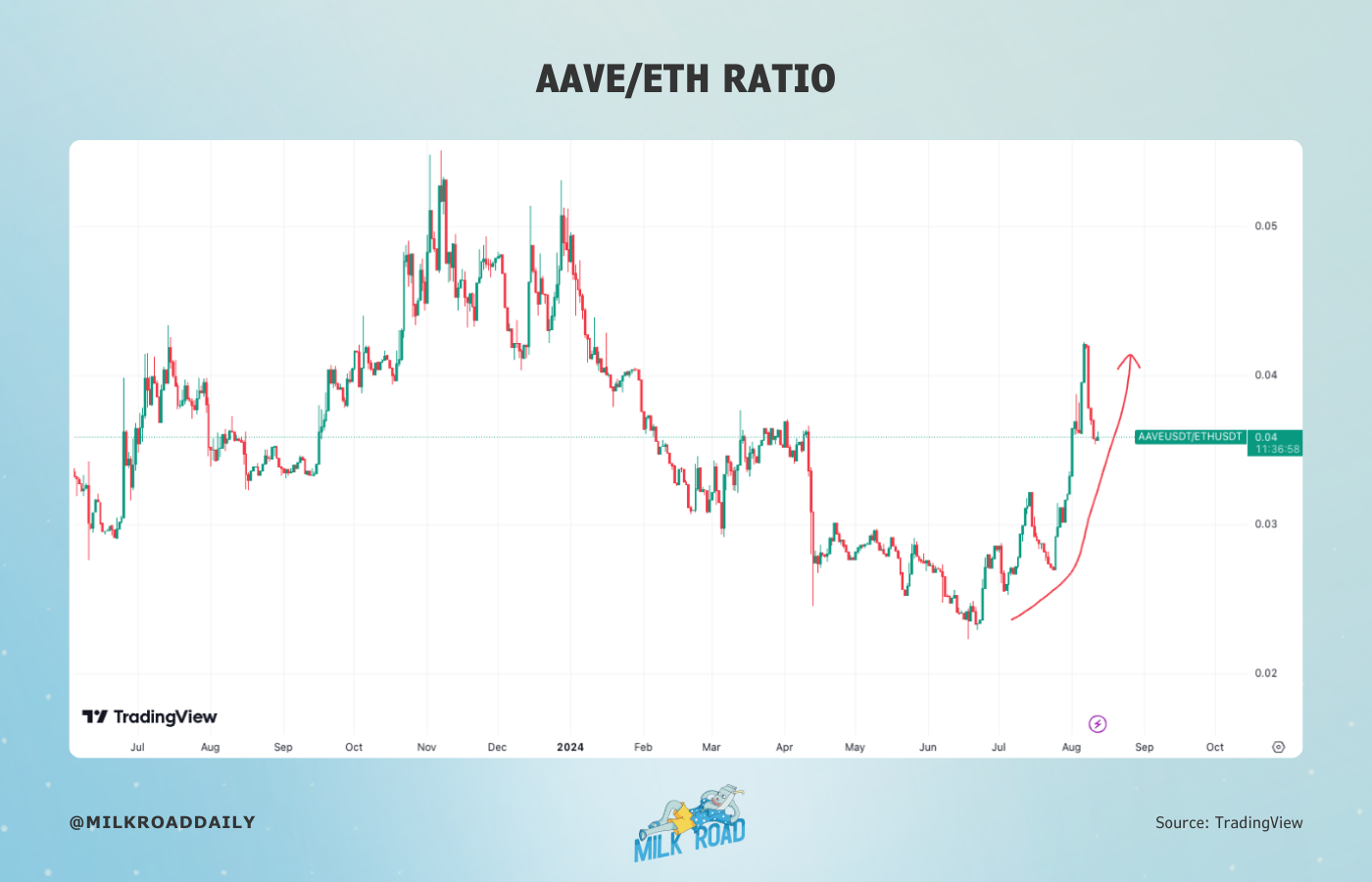
Recently, we stumbled upon an intriguing chart showing $AAVE’s price compared to $ETH.
[
Source: TradingView
We tried our best, but we couldn’t ignore it! Something big is brewing… and it seems like the market is yet to catch on.
This surge isn't the result of a few people buying in here and there – it takes significant buying pressure to outperform $ETH this dramatically.
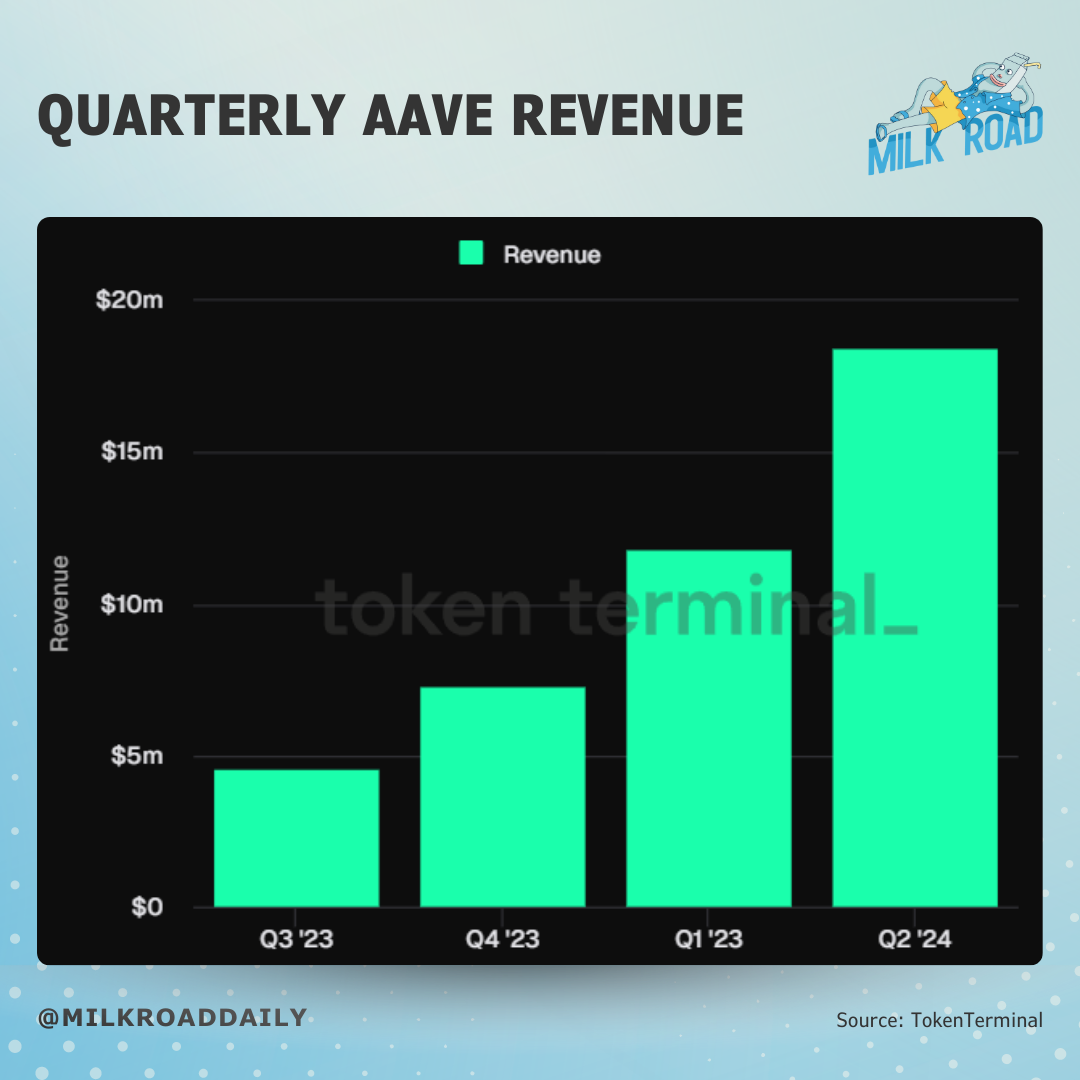
Not only that, but Aave’s revenue is on the rise. 📈
[
Source: TokenTerminal
We're loving this uptrend in quarterly revenue.
Plus, we've heard about new proposals for updated tokenomics and activating the fee switch—yet another reason this setup is impossible to ignore!
But hold on—sometimes short-term hype or incentives inflate revenue. Is that the case with Aave, or is it a genuinely solid investment opportunity? 🤔
That’s the focus of our report, along with other key questions like:
-
Can Aave compete with Goldman Sachs?
-
Where are Aave's 1M users coming from?
-
Is Aave still the market leader in the lending and borrowing sector?
-
Is the revenue growth driven by incentives?
-
What are the key support and resistance levels to watch for?
P.S. - We’re hosting a PRO AMA next week — scroll to the bottom for more info. 👀
And because we value everyone's time, we’re going to jump right into it.
WHAT IS AAVE? 🤔
Aave, a respected pioneer in DeFi, first launched as ETHLend in 2017.
In 2020, it rebranded to Aave and has been on quite a journey since (that's what we are exploring today)—a remarkable one at that. 👏
Aave is a decentralized lending platform that connects lenders and borrowers, functioning similarly to a bank.
Users can deposit their money to earn yield, while others can borrow funds. To borrow, users must deposit collateral that exceeds their debt, ensuring repayment.
Aave keeps the difference between the interest paid by borrowers (higher) and the interest paid to lenders (lower).💰
But unlike traditional banks, Aave relies on smart contracts to handle everything—no need for grumpy loan managers asking why 100% of your net worth is in crypto. 🤣
People love the permissionless, 24/7 access Aave offers for lending and borrowing. No KYC, no approvals, no waiting. It’s a massive improvement over traditional banking!
So let's tap into Aave's potential.
AAVE POTENTIAL 📈
Over the years, Aave has attracted substantial liquidity, further cementing its place in the DeFi space.
Just take a look at the TVL, which shows the amount of money currently deposited in the protocol.

[
Source: TokenTerminal
Aave currently holds around $12 billion in Total Value Locked (TVL), which may seem small compared to major U.S. banks like JPMorgan ($2.1 trillion) or Goldman Sachs ($363 billion).
But this ain’t a bug, it’s a feature! One that highlights the enormous market Aave could tap into. 👀
…ok, but how can a crypto protocol look to compete against global financial giants like JP Morgan and Goldman Sachs?
In a single word: efficiency.
Aave has 30 times less TVL than Goldman Sachs, but it also has 750 times fewer employees. Just take a look at the number of employees needed per $1 billion in TVL:
-
Aave: 5 employees
-
JPMorgan: 114 employees
-
Goldman Sachs: 123 employees
See the difference in efficiency? We certainly do, and that's why we believe Aave could eventually disrupt these giants.
Now, let’s dive into how Aave’s business works.
AAVE BUSINESS MODEL 🤓
Aave's business model is relatively straightforward: They offer yield to lenders, charge borrowers a higher interest rate, and the difference generates the protocol's revenue—essentially the same way banks make money.
Let’s take a look at the chart below, which shows the interest rates for lenders and borrowers of $USDC.

[
Source: Dune
Notice how the green line (yield for lenders) is always lower than the red line (interest for borrowers). That difference is Aave’s revenue. 🤑
For example: Currently, you can lend $USDC on Aave for 5.8% and borrow it for 7.6%. These percentages vary based on usage.
We don't want to bother you with the specific formula…
But if a bunch of $USDC is borrowed and there's not much left in reserve, the yield and interest rates will increase to attract new depositors, while discouraging additional borrowing (and vice versa).
Pretty smart, no?
PS: We also covered the lending sector in our PRO Report about DeFi. Feel free to read more here.
Now that we grasp Aave’s massive potential and how it generates revenue, it’s tempting to feel bullish. 🤣
But hold on—we still need to dive deeper before drawing any final conclusions.
WHERE AAVE OPERATES 🔧
Don’t be mistaken—we’re not talking about countries, but blockchains.⛓️
Imagine the hassle and the number of new employees a bank would need to hire, just to expand into a new country.
Luckily for Aave, they operate on the blockchain (serving the entire world), so ‘expansion’ simply means launching on new chains.
Let’s see where Aave operates.

[
Source: Dune
This chart shows that Aave operates on seven blockchains, and most user interactions occur on Base, Arbitrum, Polygon, and Optimism – which together serve 88% of users.
Despite Aave starting on the Ethereum mainnet, only 4% of their total users are now on it. Expanding to other chains was clearly a smart move.👏
It's also great to see Aave's user base well-distributed across multiple chains. Relying on a single blockchain can be risky, especially as we move toward a multichain future.
But are there any blockchains that attract more new users than the others?

[
Source: Dune
We can see that new users are increasing across all chains, which is a great sign.
However, Base (purple line) stands out with extreme growth in new users over the last few months.
The total number of Aave users on Base is now at 319k, contributing to Aave's total user base of over 1 million—a significant achievement that few apps in crypto can boast. 🥳
This is another great sign that Aave is staying vigilant and actively monitoring the market for new opportunities.
When Base, the L2 blockchain from Coinbase, gained popularity with a growing user base, Aave seized the opportunity.
They deployed their contracts on Base, quickly becoming the #1 lending and borrowing platform on this emerging blockchain. 🥇
A strong user distribution and presence on the fastest-growing L2 certainly adds to Aave's appeal. However, we haven't discussed the competition yet.
AAVE COMPETITION 🥊
Things may look promising, but if there are competitors out there eating Aave's lunch and gaining more market share, that’s something we definitely need to know.
So let's see what the lending landscape looks like.

[
Source: TokenTerminal
During the DeFi boom in 2021, the competition was mostly between Aave (green) and Compound (pink).
Aave quickly captured close to 50% of the market, largely thanks to its attractive incentives.
Today, while there are many more competitors (some of which have gained a decent market share), Aave still maintains a strong 65% market dominance.
However, we're interested in learning more about the new, rapidly growing players in the space: Spark and Morpho.
1/ Spark Protocol
Spark is a new project that has seen phenomenal growth, skyrocketing its market share from 0.5% to 15% – and it doesn’t even have a token yet.
The protocol is a friendly fork of Aave, created to offer lending and borrowing services to the Maker ecosystem. 🤝
Maker users were limited to using a single vault as collateral and had a less user-friendly interface compared to Aave.
To solve this, Spark Protocol was developed by forking Aave contracts and shares 10% of its revenue with Aave.
Spark might offer lower borrowing costs because Spark through Maker can mint and burn $DAI to meet users' needs.
However, Aave is catching up with its $GHO stablecoin to achieve the same borrowing costs. And since Spark uses the same contracts, there are no additional advantages.
2/ Morpho
Morpho started 2 years ago as a Morpho Optimizer on top of Aave and Compound, but has evolved into Morpho - an independent project offering lending markets in a permissionless way.
Since its launch in June 2022, they have gained a 9% market share, now standing on equal footing with Compound.
Morpho allows users to deposit funds into vaults managed by risk professionals.
These professionals allocate funds into whitelisted lending markets to optimize for the best risk/reward yields.
When you deposit $USDC into Aave, it can be borrowed against any collateral asset approved by Aave governance.
In contrast, depositing $USDC into Morpho means it can only be borrowed against assets whitelisted by the vault manager.
This approach increases LTV (Loan To Value) while reducing risk to only blue-chip assets.
Let's look at Morpho’s website to better understand.

[
Source: Morpho
You can see the vault name, amount supplied, and other details, but the most important columns are the last two: Curator and Collateral.
Look at the last two rows which are $USDC vaults curated by Gauntlet, a highly respected risk manager.
One vault has an APY of 11.02%, while the other has an APY of 6.61%. The difference lies in the risk.
The vault with the 6.61% APY only lends against $ETH and $BTC (red rectangle), offering lower risk.
The vault with the 11.02% APY accepts more collateral assets (blue rectangle), resulting in higher risk but greater returns.
This setup lets users choose their preferred risk level, something the current version of Aave doesn't offer. 🧮
But is that really what most users want?
Some might appreciate the flexibility, but many could be overwhelmed by too many options and might prefer Aave's straightforward lending approach.
Now that we understand Aave and its main competitors, let's take a closer look at Aave's financials.
AAVE FINANCIALS 💸
Aave's treasury holds about $60 million in stablecoins, with a yearly burn rate of around $10 million.
But despite Aave's six-year runway, which is impressive, it's worth noting that Aave is already generating enough revenue to sustain itself well beyond that.

[
Source: TokenTerminal
Over the last five months, Aave has generated over $5 million per month, bringing its annualized revenue to $67.9 million. 🤯
The current price-to-sales (P/S) ratio stands at 18.3, nearly at all-time lows.
P.S. If you are not familiar with this indicator and how we value tokens, learn more here.
Aave’s current revenue matches the levels it achieved during the DeFi Summer hype in 2021, but there’s a key difference this time.
Take a look at the chart below, which shows the relationship between revenue (pink) and incentives (green).

[
Source: TokenTerminal
Back in 2021, Aave was generating about $5 million in monthly revenue, but it was also spending $50 million on incentives to bootstrap its product.
The difference is striking: In 2021, every $1 in revenue cost Aave $5, but now it only costs them $0.20. That’s a game-changer.
Additionally, Aave is now focused on bootstrapping the adoption of their new stablecoin, $GHO, rather than the lending and borrowing market itself.
They’ve already found product-market fit in that area, so there's no need to bootstrap it anymore.
This means that even without incentives, Aave would still be able to generate significant revenue today. 💰️
And that’s the key:
-
They’re generating sustainable revenue without relying on incentives!
-
They're using small incentives to bootstrap $GHO adoption, creating another revenue stream!
We’re totally on board with that and fully support it.
Now, let’s try to project Aave’s future revenue.
AAVE PROJECTIONS 🔮
As a quick reminder, Aave generates revenue from the spread between lending and borrowing rates.
In simple terms, the more Total Value Locked (TVL) they have, the more money they can lend out, and the more revenue they can generate.
Current factors affecting Aave's revenue:
-
TVL: Currently $12 billion
-
Average fees: $400 million paid by borrowers (3% of TVL)
-
Margin: Aave’s cut from all fees is $67.9 million (17% margin)
12-month projection and reasoning:
-
TVL: We expect it to increase 5x to $60 billion, driven by higher asset prices and a growing number of users lending money.
-
Average fees: Anticipated to rise to 6%, due to higher demand for leverage.
-
Margin: Expected to stabilize around 15%.
In this scenario, Aave would generate $3.6B in fees and retain $540M as protocol revenue.
If we apply this projected revenue to the current market cap, we get a P/S value of 3.
This suggests that $AAVE is currently undervalued!
But what’s the potential?
If we keep the current P/S ratio and apply our projected revenue, the market cap would reach $12.4 billion—equating to $840 per $AAVE (up from $142 at the time of this writing). 🤗
If you are not familiar with P/S and what it tells you, learn more here.
From an investor's perspective, Aave appears very promising!
But, before analyzing the chart and drawing final conclusions, let's explore some potential upcoming catalysts for Aave.
POTENTIAL CATALYSTS 🔥
There are 3 main catalysts which could have a really positive effect for the protocol.
1/ $GHO - new stablecoin by Aave
Aave can now lend out its own stablecoin, allowing it to keep the entire interest rate paid by borrowers (e.g., 7%).
This dramatically increases profitability, as Aave no longer needs to pay a share to lenders (e.g., 5%).
2/ $AAVE buybacks
The updated Aavenomics outlined the conditions required to initiate $AAVE buybacks, which would create significant buy pressure on the token.
3/ Restaking on Aave
Users who lend to Aave receive liquid tokens, such as 'aUSDC', which can be further staked on Aave for additional yield. However, these tokens may be slashed in the event of bad debt.
These factors could bolster Aave's position and potentially drive the price higher. While maintaining an edge is challenging, Aave is uniquely positioned to do so through:
-
Brand strength
-
Vibrant community
-
Proven longevity
Overall, we're quite bullish on Aave's future and are considering adding it to our portfolio.
HOW TO GET INTO THE POSITION 🏃
For those interested in capitalizing on Aave's success and future growth, buying their governance token, $AAVE, is a great option.
We've covered most of the important points, but there's one more critical detail: The token supply.
You don't want to buy tokens with huge unlocks and emissions on the horizon.
That's not the case for Aave!
With 94% of tokens already circulating, there's minimal room for dilution. ✅
And since many of you often ask how and when to enter, let's take a quick look at the chart.

[
Source: TradingView
We focus on Aave's price in $ETH because we believe it can outperform $ETH. Otherwise, we wouldn't consider it at all.
Since mid-June, Aave's price has bottomed out and started trending upward. We've identified key resistance and support levels that we're closely monitoring.
We like this setup, but we're waiting for confirmation—specifically, a break above these previous highs (the red arrow in the above graph 👆). That would signal our entry point. ✅
We’re not rushing into this trade, but having our thesis ready is crucial. Once the price action confirms our bullish outlook, we’ll look for the right entry.
That’s it for today! We hope we’ve provided valuable insights about Aave, helping you build your own thesis and decide whether to invest.
Good luck out there!
WANT A 1 YR PRO SUBSCRIPTION, FREE? 💸
We’re doing a podcast giveaway chock-full of milky-goodness, with prizes including a free 1-year subscription to Milk Road PRO!
Here’s everything that’s up for grabs:
-
Profit from the Future: Crypto Investing Masterclass ($499) 🎓
-
Milk Road PRO 1-year subscription ($250) 💪
-
Milk Road PRO 1-month subscription ($25) 📅
-
Mystery Box 🤔
Here’s how to enter:
All you have to do is subscribe to The Milk Road Show, on the platform of your choice (1 entry). 👇
YouTube | Spotify | Apple Podcasts
Want to increase your chances with more entries?
Take a screenshot of our Podcast page → post it to Twitter and/or Instagram → tag us → and you will get an extra entry for each (1 entry per platform).
Anyone who subscribes between now and the end of August will be entered to win, with winners announced September 4th in our daily episode!
So make sure to tune in! 🎧
FRESH AMA COMING UP 👀

We’re hosting a PRO-only AMA to answer your burning crypto questions! 🔥
-
Wen? August 28th (Wednesday this week).
-
Where? In the Milk Road PRO Discord (meetup channel).
-
What are we talking about? That’s up to you! Submit your questions here.
Not in the Milk Road PRO Discord yet? Join 1,000+ fellow members here & don’t miss out!
🚨 Important: Upon joining the Discord, you’ll be asked to fill out a form. Please, please pay attention to 2 things:
-
Enter the exact email address you used to sign up to PRO with.
-
Enter your exact Discord username (not your handle).
Do this with bomb-defusing precision—a single typo might lock you out! 😬
Join the PRO Discord Community Here
See you on the inside & chat more on Wednesday! 🥛
Start the Crypto Investing Masterclass (50% off just for you)
If you want to supercharge your portfolio and capture a piece of crypto's growth to a $100T market cap, then you need to understand these 4 basic concepts:
-
The fundamentals of crypto cycles
-
Liquidity flow in crypto
-
How to pick the right coins for your strategy
-
Building a portfolio that outsmarts 99% of crypto investors
You can learn all of the above (and more) inside the Milk Man’s Crypto Investing Masterclass — your ultimate cheat code to become a successful crypto investor.
This masterclass lays the foundation of investing in crypto, so you can maximize the value of the Milk Road PRO reports and build a portfolio that brings you generational wealth by the end of the next bull cycle.
The best part? Milk Road PRO members like you 🫵 get a 50% discount for lifetime. 🥳# Is $AAVE the next big DeFi token in crypto? 📈
Our bullish thesis for Aave 🐂
August 24, 2024
[
GM! Welcome to Milk Road PRO – where your weekly crypto fix is served piping hot, just like DeFi Summer vibes.
Love $ETH? So do we.
But what really catches our eye are those hidden gems that quietly outperform $ETH and then skyrocket. 🚀
Imagine catching one of these winners early…
The trick to it is analyzing price charts in $ETH, instead of dollars. When we see an uptrend, it means the token is outpacing $ETH.
(It’s like a secret weapon for finding potential breakout stars).
Recently, we stumbled upon an intriguing chart showing $AAVE’s price compared to $ETH.
[
Source: TradingView
We tried our best, but we couldn’t ignore it! Something big is brewing… and it seems like the market is yet to catch on.
This surge isn't the result of a few people buying in here and there – it takes significant buying pressure to outperform $ETH this dramatically.
Not only that, but Aave’s revenue is on the rise. 📈
[
Source: TokenTerminal
We're loving this uptrend in quarterly revenue.
Plus, we've heard about new proposals for updated tokenomics and activating the fee switch—yet another reason this setup is impossible to ignore!
But hold on—sometimes short-term hype or incentives inflate revenue. Is that the case with Aave, or is it a genuinely solid investment opportunity? 🤔
That’s the focus of our report, along with other key questions like:
-
Can Aave compete with Goldman Sachs?
-
Where are Aave's 1M users coming from?
-
Is Aave still the market leader in the lending and borrowing sector?
-
Is the revenue growth driven by incentives?
-
What are the key support and resistance levels to watch for?
P.S. - We’re hosting a PRO AMA next week — scroll to the bottom for more info. 👀
And because we value everyone's time, we’re going to jump right into it.
WHAT IS AAVE? 🤔
Aave, a respected pioneer in DeFi, first launched as ETHLend in 2017.
In 2020, it rebranded to Aave and has been on quite a journey since (that's what we are exploring today)—a remarkable one at that. 👏
Aave is a decentralized lending platform that connects lenders and borrowers, functioning similarly to a bank.
Users can deposit their money to earn yield, while others can borrow funds. To borrow, users must deposit collateral that exceeds their debt, ensuring repayment.
Aave keeps the difference between the interest paid by borrowers (higher) and the interest paid to lenders (lower).💰
But unlike traditional banks, Aave relies on smart contracts to handle everything—no need for grumpy loan managers asking why 100% of your net worth is in crypto. 🤣
People love the permissionless, 24/7 access Aave offers for lending and borrowing. No KYC, no approvals, no waiting. It’s a massive improvement over traditional banking!
So let's tap into Aave's potential.
AAVE POTENTIAL 📈
Over the years, Aave has attracted substantial liquidity, further cementing its place in the DeFi space.
Just take a look at the TVL, which shows the amount of money currently deposited in the protocol.
[
Source: TokenTerminal
Aave currently holds around $12 billion in Total Value Locked (TVL), which may seem small compared to major U.S. banks like JPMorgan ($2.1 trillion) or Goldman Sachs ($363 billion).
But this ain’t a bug, it’s a feature! One that highlights the enormous market Aave could tap into. 👀
…ok, but how can a crypto protocol look to compete against global financial giants like JP Morgan and Goldman Sachs?
In a single word: efficiency.
Aave has 30 times less TVL than Goldman Sachs, but it also has 750 times fewer employees. Just take a look at the number of employees needed per $1 billion in TVL:
-
Aave: 5 employees
-
JPMorgan: 114 employees
-
Goldman Sachs: 123 employees
See the difference in efficiency? We certainly do, and that's why we believe Aave could eventually disrupt these giants.
Now, let’s dive into how Aave’s business works.
AAVE BUSINESS MODEL 🤓
Aave's business model is relatively straightforward: They offer yield to lenders, charge borrowers a higher interest rate, and the difference generates the protocol's revenue—essentially the same way banks make money.
Let’s take a look at the chart below, which shows the interest rates for lenders and borrowers of $USDC.
[
Source: Dune
Notice how the green line (yield for lenders) is always lower than the red line (interest for borrowers). That difference is Aave’s revenue. 🤑
For example: Currently, you can lend $USDC on Aave for 5.8% and borrow it for 7.6%. These percentages vary based on usage.
We don't want to bother you with the specific formula…
But if a bunch of $USDC is borrowed and there's not much left in reserve, the yield and interest rates will increase to attract new depositors, while discouraging additional borrowing (and vice versa).
Pretty smart, no?
PS: We also covered the lending sector in our PRO Report about DeFi. Feel free to read more here.
Now that we grasp Aave’s massive potential and how it generates revenue, it’s tempting to feel bullish. 🤣
But hold on—we still need to dive deeper before drawing any final conclusions.
WHERE AAVE OPERATES 🔧
Don’t be mistaken—we’re not talking about countries, but blockchains.⛓️
Imagine the hassle and the number of new employees a bank would need to hire, just to expand into a new country.
Luckily for Aave, they operate on the blockchain (serving the entire world), so ‘expansion’ simply means launching on new chains.
Let’s see where Aave operates.
[
Source: Dune
This chart shows that Aave operates on seven blockchains, and most user interactions occur on Base, Arbitrum, Polygon, and Optimism – which together serve 88% of users.
Despite Aave starting on the Ethereum mainnet, only 4% of their total users are now on it. Expanding to other chains was clearly a smart move.👏
It's also great to see Aave's user base well-distributed across multiple chains. Relying on a single blockchain can be risky, especially as we move toward a multichain future.
But are there any blockchains that attract more new users than the others?
[
Source: Dune
We can see that new users are increasing across all chains, which is a great sign.
However, Base (purple line) stands out with extreme growth in new users over the last few months.
The total number of Aave users on Base is now at 319k, contributing to Aave's total user base of over 1 million—a significant achievement that few apps in crypto can boast. 🥳
This is another great sign that Aave is staying vigilant and actively monitoring the market for new opportunities.
When Base, the L2 blockchain from Coinbase, gained popularity with a growing user base, Aave seized the opportunity.
They deployed their contracts on Base, quickly becoming the #1 lending and borrowing platform on this emerging blockchain. 🥇
A strong user distribution and presence on the fastest-growing L2 certainly adds to Aave's appeal. However, we haven't discussed the competition yet.
AAVE COMPETITION 🥊
Things may look promising, but if there are competitors out there eating Aave's lunch and gaining more market share, that’s something we definitely need to know.
So let's see what the lending landscape looks like.
[
Source: TokenTerminal
During the DeFi boom in 2021, the competition was mostly between Aave (green) and Compound (pink).
Aave quickly captured close to 50% of the market, largely thanks to its attractive incentives.
Today, while there are many more competitors (some of which have gained a decent market share), Aave still maintains a strong 65% market dominance.
However, we're interested in learning more about the new, rapidly growing players in the space: Spark and Morpho.
1/ Spark Protocol
Spark is a new project that has seen phenomenal growth, skyrocketing its market share from 0.5% to 15% – and it doesn’t even have a token yet.
The protocol is a friendly fork of Aave, created to offer lending and borrowing services to the Maker ecosystem. 🤝
Maker users were limited to using a single vault as collateral and had a less user-friendly interface compared to Aave.
To solve this, Spark Protocol was developed by forking Aave contracts and shares 10% of its revenue with Aave.
Spark might offer lower borrowing costs because Spark through Maker can mint and burn $DAI to meet users' needs.
However, Aave is catching up with its $GHO stablecoin to achieve the same borrowing costs. And since Spark uses the same contracts, there are no additional advantages.
2/ Morpho
Morpho started 2 years ago as a Morpho Optimizer on top of Aave and Compound, but has evolved into Morpho - an independent project offering lending markets in a permissionless way.
Since its launch in June 2022, they have gained a 9% market share, now standing on equal footing with Compound.
Morpho allows users to deposit funds into vaults managed by risk professionals.
These professionals allocate funds into whitelisted lending markets to optimize for the best risk/reward yields.
When you deposit $USDC into Aave, it can be borrowed against any collateral asset approved by Aave governance.
In contrast, depositing $USDC into Morpho means it can only be borrowed against assets whitelisted by the vault manager.
This approach increases LTV (Loan To Value) while reducing risk to only blue-chip assets.
Let's look at Morpho’s website to better understand.
[
Source: Morpho
You can see the vault name, amount supplied, and other details, but the most important columns are the last two: Curator and Collateral.
Look at the last two rows which are $USDC vaults curated by Gauntlet, a highly respected risk manager.
One vault has an APY of 11.02%, while the other has an APY of 6.61%. The difference lies in the risk.
The vault with the 6.61% APY only lends against $ETH and $BTC (red rectangle), offering lower risk.
The vault with the 11.02% APY accepts more collateral assets (blue rectangle), resulting in higher risk but greater returns.
This setup lets users choose their preferred risk level, something the current version of Aave doesn't offer. 🧮
But is that really what most users want?
Some might appreciate the flexibility, but many could be overwhelmed by too many options and might prefer Aave's straightforward lending approach.
Now that we understand Aave and its main competitors, let's take a closer look at Aave's financials.
AAVE FINANCIALS 💸
Aave's treasury holds about $60 million in stablecoins, with a yearly burn rate of around $10 million.
But despite Aave's six-year runway, which is impressive, it's worth noting that Aave is already generating enough revenue to sustain itself well beyond that.
[
Source: TokenTerminal
Over the last five months, Aave has generated over $5 million per month, bringing its annualized revenue to $67.9 million. 🤯
The current price-to-sales (P/S) ratio stands at 18.3, nearly at all-time lows.
P.S. If you are not familiar with this indicator and how we value tokens, learn more here.
Aave’s current revenue matches the levels it achieved during the DeFi Summer hype in 2021, but there’s a key difference this time.
Take a look at the chart below, which shows the relationship between revenue (pink) and incentives (green).
[
Source: TokenTerminal
Back in 2021, Aave was generating about $5 million in monthly revenue, but it was also spending $50 million on incentives to bootstrap its product.
The difference is striking: In 2021, every $1 in revenue cost Aave $5, but now it only costs them $0.20. That’s a game-changer.
Additionally, Aave is now focused on bootstrapping the adoption of their new stablecoin, $GHO, rather than the lending and borrowing market itself.
They’ve already found product-market fit in that area, so there's no need to bootstrap it anymore.
This means that even without incentives, Aave would still be able to generate significant revenue today. 💰️
And that’s the key:
-
They’re generating sustainable revenue without relying on incentives!
-
They're using small incentives to bootstrap $GHO adoption, creating another revenue stream!
We’re totally on board with that and fully support it.
Now, let’s try to project Aave’s future revenue.
AAVE PROJECTIONS 🔮
As a quick reminder, Aave generates revenue from the spread between lending and borrowing rates.
In simple terms, the more Total Value Locked (TVL) they have, the more money they can lend out, and the more revenue they can generate.
Current factors affecting Aave's revenue:
-
TVL: Currently $12 billion
-
Average fees: $400 million paid by borrowers (3% of TVL)
-
Margin: Aave’s cut from all fees is $67.9 million (17% margin)
12-month projection and reasoning:
-
TVL: We expect it to increase 5x to $60 billion, driven by higher asset prices and a growing number of users lending money.
-
Average fees: Anticipated to rise to 6%, due to higher demand for leverage.
-
Margin: Expected to stabilize around 15%.
In this scenario, Aave would generate $3.6B in fees and retain $540M as protocol revenue.
If we apply this projected revenue to the current market cap, we get a P/S value of 3.
This suggests that $AAVE is currently undervalued!
But what’s the potential?
If we keep the current P/S ratio and apply our projected revenue, the market cap would reach $12.4 billion—equating to $840 per $AAVE (up from $142 at the time of this writing). 🤗
If you are not familiar with P/S and what it tells you, learn more here.
From an investor's perspective, Aave appears very promising!
But, before analyzing the chart and drawing final conclusions, let's explore some potential upcoming catalysts for Aave.
POTENTIAL CATALYSTS 🔥
There are 3 main catalysts which could have a really positive effect for the protocol.
1/ $GHO - new stablecoin by Aave
Aave can now lend out its own stablecoin, allowing it to keep the entire interest rate paid by borrowers (e.g., 7%).
This dramatically increases profitability, as Aave no longer needs to pay a share to lenders (e.g., 5%).
2/ $AAVE buybacks
The updated Aavenomics outlined the conditions required to initiate $AAVE buybacks, which would create significant buy pressure on the token.
3/ Restaking on Aave
Users who lend to Aave receive liquid tokens, such as 'aUSDC', which can be further staked on Aave for additional yield. However, these tokens may be slashed in the event of bad debt.
These factors could bolster Aave's position and potentially drive the price higher. While maintaining an edge is challenging, Aave is uniquely positioned to do so through:
-
Brand strength
-
Vibrant community
-
Proven longevity
Overall, we're quite bullish on Aave's future and are considering adding it to our portfolio.
HOW TO GET INTO THE POSITION 🏃
For those interested in capitalizing on Aave's success and future growth, buying their governance token, $AAVE, is a great option.
We've covered most of the important points, but there's one more critical detail: The token supply.
You don't want to buy tokens with huge unlocks and emissions on the horizon.
That's not the case for Aave!
With 94% of tokens already circulating, there's minimal room for dilution. ✅
And since many of you often ask how and when to enter, let's take a quick look at the chart.
[
Source: TradingView
We focus on Aave's price in $ETH because we believe it can outperform $ETH. Otherwise, we wouldn't consider it at all.
Since mid-June, Aave's price has bottomed out and started trending upward. We've identified key resistance and support levels that we're closely monitoring.
We like this setup, but we're waiting for confirmation—specifically, a break above these previous highs (the red arrow in the above graph 👆). That would signal our entry point. ✅
We’re not rushing into this trade, but having our thesis ready is crucial. Once the price action confirms our bullish outlook, we’ll look for the right entry.
That’s it for today! We hope we’ve provided valuable insights about Aave, helping you build your own thesis and decide whether to invest.
Good luck out there!
WANT A 1 YR PRO SUBSCRIPTION, FREE? 💸
We’re doing a podcast giveaway chock-full of milky-goodness, with prizes including a free 1-year subscription to Milk Road PRO!
Here’s everything that’s up for grabs:
-
Profit from the Future: Crypto Investing Masterclass ($499) 🎓
-
Milk Road PRO 1-year subscription ($250) 💪
-
Milk Road PRO 1-month subscription ($25) 📅
-
Mystery Box 🤔
Here’s how to enter:
All you have to do is subscribe to The Milk Road Show, on the platform of your choice (1 entry). 👇
YouTube | Spotify | Apple Podcasts
Want to increase your chances with more entries?
Take a screenshot of our Podcast page → post it to Twitter and/or Instagram → tag us → and you will get an extra entry for each (1 entry per platform).
Anyone who subscribes between now and the end of August will be entered to win, with winners announced September 4th in our daily episode!
So make sure to tune in! 🎧
FRESH AMA COMING UP 👀
We’re hosting a PRO-only AMA to answer your burning crypto questions! 🔥
-
Wen? August 28th (Wednesday this week).
-
Where? In the Milk Road PRO Discord (meetup channel).
-
What are we talking about? That’s up to you! Submit your questions here.
Not in the Milk Road PRO Discord yet? Join 1,000+ fellow members here & don’t miss out!
🚨 Important: Upon joining the Discord, you’ll be asked to fill out a form. Please, please pay attention to 2 things:
-
Enter the exact email address you used to sign up to PRO with.
-
Enter your exact Discord username (not your handle).
Do this with bomb-defusing precision—a single typo might lock you out! 😬
Join the PRO Discord Community Here
See you on the inside & chat more on Wednesday! 🥛
Start the Crypto Investing Masterclass (50% off just for you)
If you want to supercharge your portfolio and capture a piece of crypto's growth to a $100T market cap, then you need to understand these 4 basic concepts:
-
The fundamentals of crypto cycles
-
Liquidity flow in crypto
-
How to pick the right coins for your strategy
-
Building a portfolio that outsmarts 99% of crypto investors
You can learn all of the above (and more) inside the Milk Man’s Crypto Investing Masterclass — your ultimate cheat code to become a successful crypto investor.
This masterclass lays the foundation of investing in crypto, so you can maximize the value of the Milk Road PRO reports and build a portfolio that brings you generational wealth by the end of the next bull cycle.
The best part? Milk Road PRO members like you 🫵 get a 50% discount for lifetime. 🥳