How/when to enter/exit positions? 💰️
Tips and tricks to manage your portfolio this bull run... 📊
November 30, 2024

GM! Welcome to Milk Road PRO. This is your captain speaking, please note the entrances and exits throughout the Banana Zone, our hosts will point them out to you now 👇
The bull run is here and opportunities are everywhere.
But with that comes challenges. Without a plan, it's easy to get overwhelmed and make costly decisions.
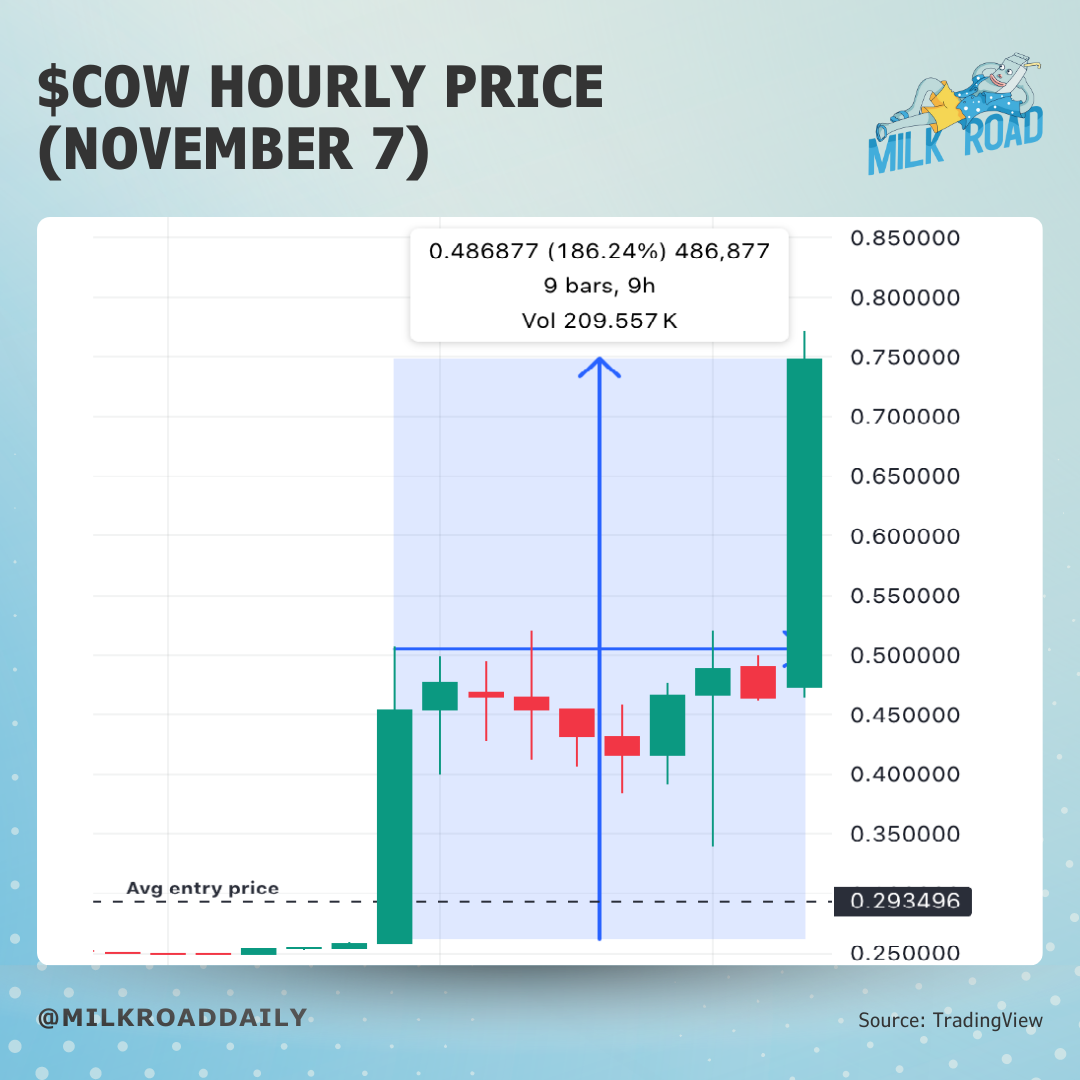
One of our PRO Portfolio coins has already taken off—$COW shot up 186% in just 9 hours on November 7th!
It’s moments like these that force us to make a decision: should we buy, sell, or hold?
[
Source: Tradingview
The right move is rarely obvious. In the heat of the moment, confusion can take over.
With so many choices, it’s easy to feel overwhelmed.
And let’s be honest—situations like this are going to happen again and again over the next 12 months.
Without a clear strategy, it’s easy to get caught off guard and freeze, unsure of what to do.
That's exactly why this report exists—to give you a winning strategy for entering and exiting positions confidently.
Here's what you'll discover:
-
A recent example featuring our $COW investment
-
How we strategically enter positions
-
How we time and execute exits
-
Key takeaways that you can apply to your investments
Yes, we’re in the Banana Zone right now, and it’s more important than ever to prepare yourself mentally for what’s ahead—doing so will drastically reduce your chances of screwing it up.
So grab a comfy chair, pour your favorite coffee, and let’s dive in—it’s time to turn all this knowledge into an actionable strategy!
Let’s start with Cow Protocol and walk you through the full story—how it made its way into our portfolio and why we’ve already sold a portion of it.
OUR $COW STORY
We don’t just invest in DeFi—we actively use it!
And that hands-on experience gives us a huge edge.
Which is exactly why Cow Protocol caught our attention. We were using it regularly and started noticing its potential.
Just a heads-up: this report won’t be doing a deep dive into Cow Protocol. If you’re interested in that, you can check out our full report here.
Back in June, we put together that report on Cow Protocol because we absolutely loved their product.
At that time, Cow already had three working products, two of which were generating substantial revenue and serving hundreds of thousands of users.
The price looked pretty attractive too, especially considering Cow's potential.
Did we buy the token right after releasing the report? Nope. We added it to our watchlist and waited nearly 4 months before finally entering the position.
[
Source: Tradingview
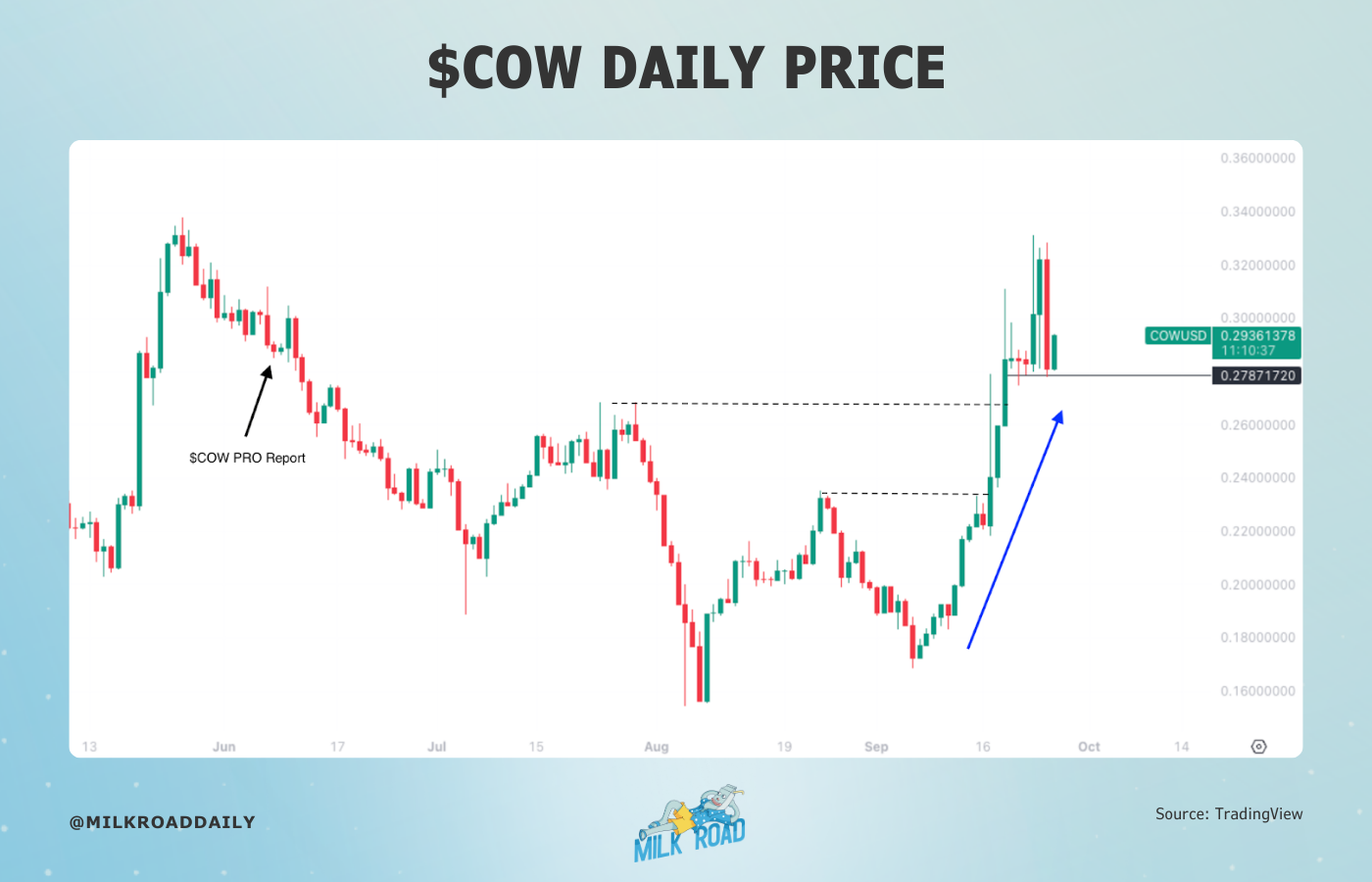
In September, we spotted an emerging trend as $COW's price started breaking through previous highs with ease. That was our signal to jump in (see the blue arrow).
(Btw: Cow had its best month ever in terms of revenue in August. Maybe the market was starting to take notice?)
And yes, we could have bought it at a lower price, but we’re not in the business of catching falling knives.
Instead, we wait for the price to start picking up—it’s a signal that more market participants are getting interested and buying in.
P.S. We’ll dive into this in more detail in just a bit!
Anyway, we finally added $COW for an average price of 0.29$ to our portfolio. Great.
Fast forward to early November—$COW token got listed on multiple Asian centralized exchanges, and the price skyrocketed 180% in just 9 hours, hitting $0.75!
[
Source: Tradingview
That’s a massive price spike, but we know it’s not a healthy or sustainable trend.
Why? Because we know who the buyers are—centralized exchanges (CEXs). They’re buying the token just to offer it on their platforms. It’s a one-time, big buyer causing all the hype.
Even though we have a much higher target for $COW in this cycle, we saw this as an opportunity we couldn’t pass up. We wanted to take some profits from the table.
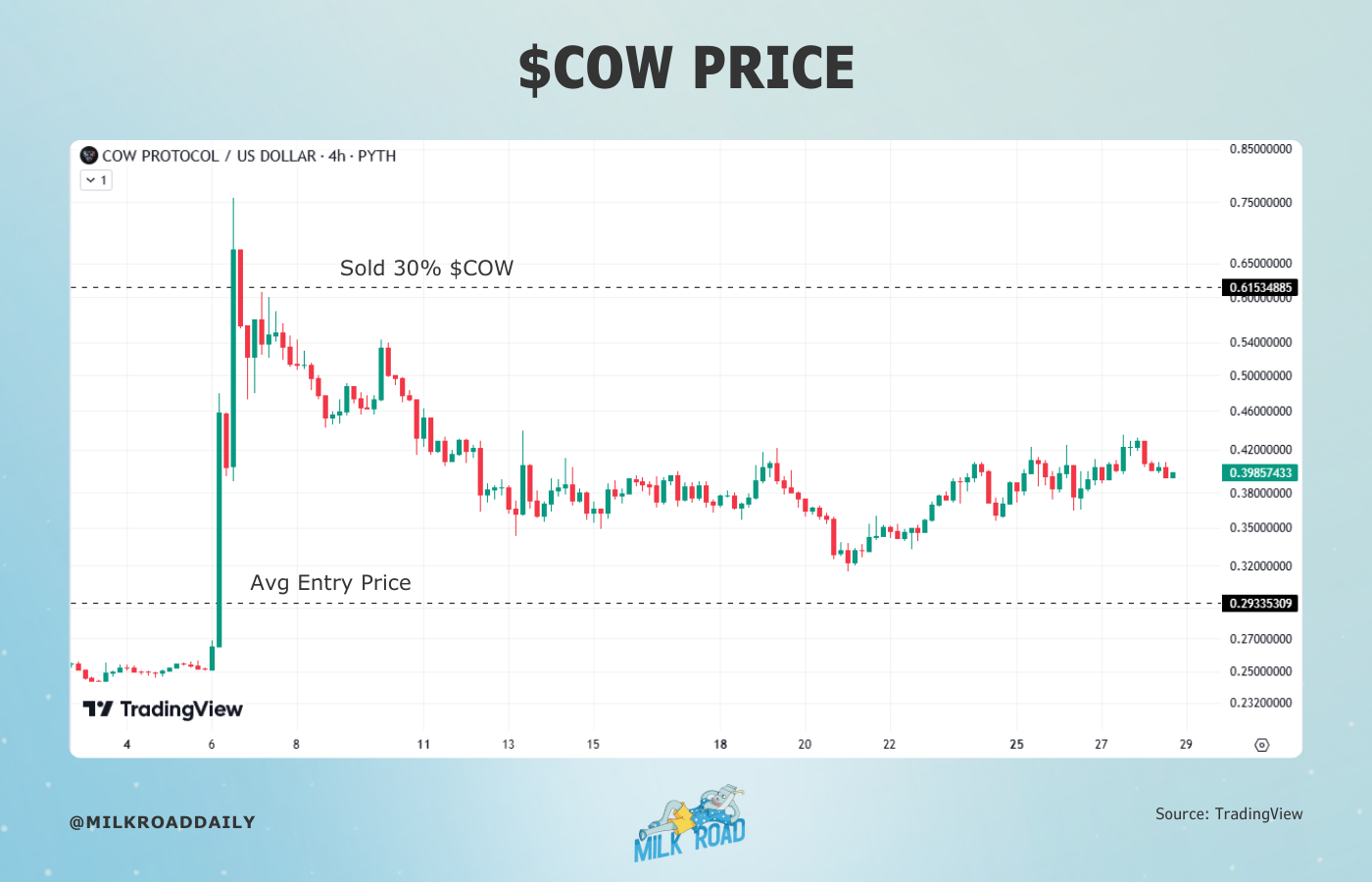
So, we sold nearly 30% of our holdings at $0.615.
[
Source: Tradingview
The current price is $0.42—down 31% from where we sold.
We made the right move. And what was the key?
Understanding who the buyer was and determining whether the trend was healthy or not. We’ll break this down in more detail later.
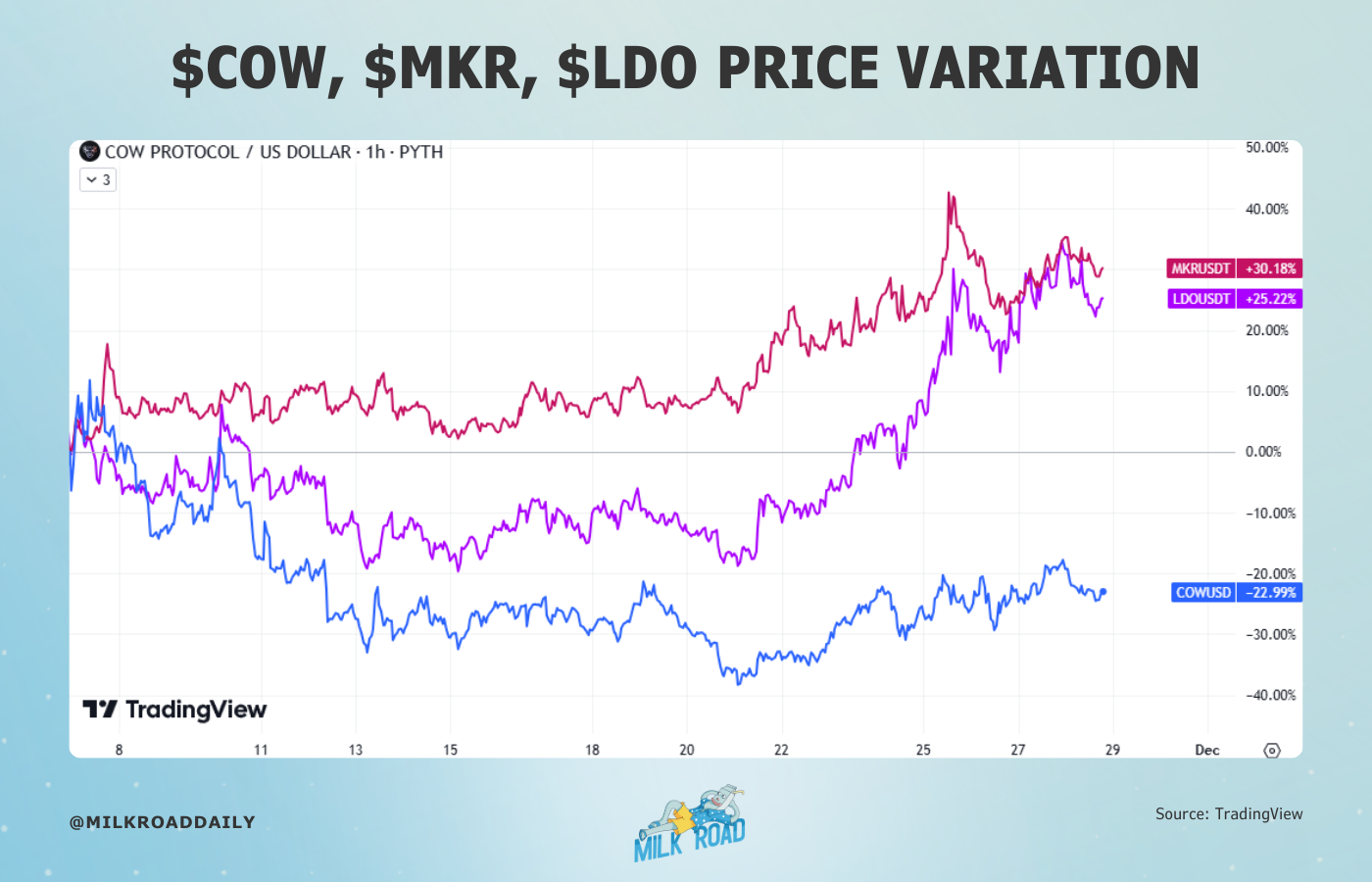
But we didn’t cash out into stablecoins—right now, we don't want to hold any stablecoins at the moment. Instead, we reallocated the profits, splitting them 50/50 between $MKR and $LDO.
Here are the charts showing how they’ve performed since we made that move.
[
Source: Tradingview
Since then, $MKR is up 30%, while $LDO is up 25%.
The main reason we chose these two tokens is that their prices had been under heavy scrutiny recently, but we still have high conviction in these projects, and saw these levels as very attractive.
That was our latest move, and we know some of you in the community missed it—maybe you didn’t buy, didn’t sell, or are kicking yourself right now.
Don’t sweat it! This is your chance to learn a valuable lesson.
In the next section, we’ll break down how to nail your entry and exit strategies so that next time an opportunity like this comes around, you’ll be ready to crush it!
ENTRY STRATEGY
We’re about to walk you through all the key steps we consider before entering a position.
We’ll break down each point in detail and wrap it all up with a quick summary at the end of this section.
1/ Business Cycle
Understanding where we are in the business cycle is crucial. It helps us determine if we should even be buying volatile assets right now—and if we should, which ones make the most sense.
(Don’t know what a ‘Business Cycle’ is? Say no more – we have everything you need to know, covered right here!)
We share our business cycle chart every Thursday in the newsletter, so be sure to stay tuned and keep yourself updated!
See the chart below.

We’re heading into the summer season, which means we want to be fully allocated and avoid holding any stablecoins.
Why? Because summer is prime time for investors!
So, we’ve got the green light to enter new positions!
But now it’s time to roll up our sleeves and get our hands dirty!
2/ Do your homework
Before buying any token, take the time to really dig into it—understand the project inside and out.
The goal? Create your thesis, make realistic projections, and map out a clear path for the token to grow in value.
But don’t stop there. Price matters!
Even the best projects can be bad buys if the price is too high, the risk-reward isn’t favorable, or there are big, price-tanking token unlocks on the horizon.
Not sure how to properly analyze tokens? No worries—we’ve got you covered. Check out this detailed report to level up your research game!
And before jumping in, take a good look at your portfolio structure!
3/ Portfolio Allocation
It’s essential to think about your portfolio structure to avoid being overexposed to a single market or sector—or worse, not diversified enough.
Not sure how to structure your portfolio? No problem—check out this report for a full breakdown!
But let’s say you want exposure to DeFi. Great. But remember, DeFi isn’t just one sector—it’s made up of many facets, like lending, decentralized exchanges, liquid staking, and more.
Make sure you’re spreading your bets across these categories (or the ones you have conviction in), or at least avoid having too many tokens concentrated in the same niche. Balance is key!
Here is our allocation:
-
Stablecoins: Maker
-
Lending: Aave
-
Liquid Staking: Lido
-
DEX: Cow
-
Perpetuals/trading: Ethena
We’ve also got a report covering all the DeFi sectors. You can check it out here.
So, can you check all three boxes now?
✅ Business Cycle: Good time to buy volatile tokens
✅ Project Analysis: Promising project with reasonable valuation
✅ P****ortfolio Allocation: Fits into my portfolio
Great! Now we can start thinking about how to enter the position (finally! 🤣).
4/ Identify Trend
If everything looks good, all that’s left is to pull the trigger and buy some tokens.
But before you do, take a moment to pause and think:
-
Is there a specific event or catalyst on the horizon that could push the price higher?
-
What’s going to make people suddenly want to buy this token?
-
What initially caught your attention about this project?
Because let’s be real—why should people suddenly start buying this token after you? For the price to go up, you need more buyers to step in.
That’s why identifying a catalyst can help (a lot).
It could be anything—a new product launch, a fresh feature, a big partnership, improving fundamentals, or even growing market share. You name it.
The key is spotting what could attract new buyers and drive demand!
People often rush into projects the moment they hear about something promising, aping in without a second thought.
But our approach is a bit different.
Sure, we might know about the potential catalysts coming for a project—but we wait for market confirmation.
We want to see that others are noticing those catalysts too and are actually buying the token.
[
Source: Tradingview
We were already bullish on COW, but we didn’t rush in. Instead, we waited for a clear signal—a sign that the market was paying attention too.
After Cow’s record-breaking month in August, the price started climbing in September, breaking past previous highs.
The trend was undeniable, and that’s when we knew it was time to make our move.
Not to mention, both BTC and ETH had made higher lows and higher highs, signaling the overall crypto market was ready to turn.
This approach doesn’t make us the first to jump in on a trend—and that’s okay.
Instead, it helps us reduce risk by avoiding the danger of catching a falling knife. We wait for our thesis to be confirmed by increased market interest, then take a position.
However, we’re in the banana zone right now, which means we’re likely to see a lot of false price confirmations—because, let’s be honest, in this environment, everything is going up.
Forget looking at prices in just dollar terms. Instead, we measure assets against a market benchmark.
For us, that’s $ETH or $SOL (though $BTC works too).
Why? Because it gives us a clearer picture of how the token is performing relative to the market, not just riding the bull market wave.
Here’s the AAVE/ETH chart to show exactly what we mean:

[
Source: Tradingview
Instead of checking $AAVE priced in dollars, we tracked how it performed against $ETH.
We entered after spotting the price breaking through two previous highs on the chart.
The trend was crystal clear—$AAVE was outpacing $ETH.
In other words, it wasn’t just growing—it was growing faster than the entire market!
But for context, here’s the chart showing $AAVE in USD terms.

[
Source: Tradingview
The trend in USD is much less noticeable than the one against $ETH.
This is mainly because AAVE’s price didn’t really increase, but ETH’s price dropped, which made the trend on the $ETH chart look much stronger.
And that’s exactly why we were focusing on this chart—it highlights AAVE’s strength relative to $ETH.
So, keep this in mind when spotting trends for your entry point.
Oh, and while we have you – here are some general tips:
-
Use daily charts for a clearer picture.
-
Look for at least two breaks of previous highs or key resistance levels.
-
Make sure the trend has been forming for at least 10 days to confirm momentum.
Hopefully, everything is clear. If not, feel free to ask us any questions on our Discord.
We also include a full recap of everything at the end, to really drive things home. 😉
Now, let’s dive into the exit strategy!
EXIT STRATEGY
Exit strategy is just as important as entry strategy—because let’s face it, profits don’t count until they’re actually in your pocket.
Those “theoretical profits” you see on your portfolio dashboard?
Yeah – they can vanish in no time if you don’t act.
Last cycle, a lot of people held on too long, watching their hundreds of percent in gains evaporate almost overnight.
Do not make the same mistake.
Don’t get drunk on unrealized profits—know when to take some off the table!
We follow a clear set of rules when deciding if it’s time to sell, but we never sell everything all at once.
Instead, we break our exits into 2 or 3 smaller sales to spread out the exit price over time and reduce risk.
Now, let’s walk you through these rules step by step so you can easily follow along and apply them yourself.
1/ Business cycle
You’re still holding some assets, but the summer season is winding down.
The macro outlook is starting to weaken, and the market forecast doesn’t look as bright moving forward. This is the moment when you want to start thinking about exiting your positions.
But don’t misunderstand—it’s not something you do all in one day.
There will be signs and signals that we’re nearing a potential top or market peak. Pay close attention, stay aware, and start selling gradually when the time feels right.
Don’t worry—we’ve got you covered. It’s our job to keep you updated with the latest and most relevant data, so you’ll know exactly when those signals start to appear.
As of right now we are far from there! 😉
2/ Short-term price spike
A sudden, sharp price increase that isn’t backed by a sustainable, healthy trend. COW is a perfect example of this strategy in action.
3/ Reaching a reasonable valuation
Some assets in our portfolio eventually hit what we consider a fair valuation. When that happens, the risk/reward ratio changes, making it less attractive to continue holding.
Rather than focusing solely on specific price targets, we pay closer attention to widely-used valuation ratios like Price-to-Earnings (P/E) and Price-to-Sales (P/S).
These metrics help us determine if something is undervalued, fairly valued, or overvalued.
Why do we care so much about these ratios?
Because they’re what most market participants are watching.
These metrics shape how people behave, and ultimately, drive the market.
It doesn’t matter what we think the price should be—what matters is how the broader market views these numbers.
Not familiar with these ratios? No problem. You can check out this report and this report to learn more.
Here’s an example:
Maker’s current P/E ratio is 20. To put that in perspective, many fast-growing companies trade at much higher double-digit multiples.
We believe a P/E around 50 is fair for Maker, and in the right conditions, it could go even higher.
Maker’s P/S ratio is currently 3. For comparison, some software companies trade with P/S ratios closer to 15.
We’re confident Maker’s earnings and sales will grow at least 3x in the future.
As a result, these ratios would drop even further, creating strong upward pressure on the price and making it an even more attractive asset.
4/ Losing conviction
We’ve done our research and genuinely believe this project has strong potential. However, there are times when our conviction starts to fade.
Here’s why:
-
Weakening fundamentals or loss of market share.
-
A new competitor emerges with a superior product, threatening the project’s position.
-
A shift in direction or strategy that no longer aligns with our investment thesis.
And there you have it—those are the key reasons we start considering a sale.
It’s not rocket science, but it’s definitely more complex than it seems.
On paper, it might look simple, but in reality, you need to stay deeply connected to the market, keep up with the constant shifts, and understand the subtle dynamics at play.
Now, do you know where most people make the biggest mistakes?
It’s when they lose conviction too quickly.
Why does that happen? Because they didn’t have strong conviction to begin with.
Remember, there’s no free lunch in investing.
The more time you spend researching and analyzing a project, the stronger your conviction will be—and the less likely you are to get shaken out.
The real issue during the Banana Zone?
People jump from one trade to another, chasing shiny new projects. Their conviction only lasts until the next “hot” opportunity catches their eye.
It’s a recipe for scattered decision-making and missed opportunities. Stay focused, stay disciplined, and don’t let the hype pull you off course.
And before you start thinking which tokens to sell into, here’s something to keep in mind:
Taxable events: Every sale creates a taxable event. Selling into another token instead of stablecoins comes with added risk—if the new token drops in value, you could end up in a tricky situation (not being able to afford your tax bill - this happens all the time to crypto investors!).
Prioritize stablecoins: It’s often smarter to sell into stablecoins first. Once you’ve done that, revisit the “entering process” to carefully evaluate and justify your next move.
Always keep the risks we just mentioned in mind before reallocating.
Now, let’s address the elephant in the room—we sold $COW into $LDO and $MKR…
Why? Because we’re still in the early stages of summer, and we’re comfortable taking that risk right now.
But let’s be clear: if this were a few months later, we’d be playing it differently and selling into stablecoins instead. Timing is key!
So, there you have it—our entry and exit strategies.
We try to keep it simple and avoid overcomplicating things. This approach has worked really well for us, but if you disagree with anything or want to tweak it to suit your own style, go for it.
Before we wrap up, let’s quickly recap what we’ve covered today!
KEY TAKEAWAYS
By now, we hope you understand just how important the business cycle is.
We use it as a key tool—not only when deciding to enter a position but also when determining the right time to exit.
Ideally, you want to enter positions during spring (when opportunities start blooming) and exit during fall (before the market begins to cool down).
It’s not an exact science, but the idea should be clear—timing matters.
To sharpen our timing and improve our entries, we use this checklist:
-
Business Cycle: Is now a good time to buy volatile tokens?
-
Project Analysis: Does this project have strong potential?
-
Portfolio Allocation: Does it fit well into our portfolio structure?
-
Identify Trend: Is there an emerging trend (vs ETH/BTC) signaling market interest?
Everything checked? Great, you’ve nailed your entry!
Now that you have your positions, it’s crucial to monitor them constantly. No one’s going to knock on your door and say, “Hey, it’s time to sell!”
So, here are the scenarios we watch for that signal it might be time to sell:
-
Business cycle: Is the summer season coming to a close? Are macro conditions starting to turn less favorable?
-
Short-term price spike: Has there been a sudden, unsustainable surge in price that you can capitalize on?
-
Fair valuation reached: Has the asset hit a reasonable valuation, leaving less room for upside?
-
Losing conviction: Has something changed in the fundamentals, competition, or strategy that makes you doubt the project’s future?
If any of those 4 scenarios occur, we start selling.
However, we never sell everything at once. Instead, we spread it out over 2 or 3 different sales to average our exit price and reduce the risk of timing the market wrong.
Again, to be clear:
We don’t plan on selling anything (except for unsustainable pumps) until later in the cycle.
And rest assured, we’ll keep you updated when we start selling our assets and preparing for the transition into fall and winter.
In the meantime, make sure to join our Discord and share your entries, exits, or ideas with the community.
We can all learn from each other and grow together as investors!
Alright, that’s everything we wanted to share with you today.
Hopefully, you’ve picked up some valuable insights that you can use moving forward—it’ll help you become a better investor and steer clear of overtrading.
Good luck, and we’ll see you next time! 🚀
AI-GENERATED PODCAST 🤖
To make this report even easier to digest, we’ve included an AI-generated podcast version. Give it a listen below! 👇️
If there’s an issue with the audio file, like the media player not appearing or loading properly, don’t worry—you can access all our AI-generated podcasts here.
Disclaimer: This podcast was created using AI and is based on the research report above. While we've done our best to ensure accuracy, the audio may contain minor errors, technical glitches, or mispronunciations. Please note that this podcast provides an overview of the report and is not a comprehensive or definitive take on the topic.
ACTION STEPS FOR PRO MEMBERS 🥛
Join the private PRO community now!
This is your all-access hub for engaging directly with the Milk Road PRO research crew and fellow PRO members, diving into live AMA sessions, digital events, and daily robust discussions on market trends, fundamentals, and industry insights.
🚨 Important: Upon joining the Discord, you’ll be asked to fill out a form. Please, please pay attention to 2 things:
-
Enter the exact email address you used to sign up to PRO with.
-
Enter your exact Discord username. To find your Discord username, click on your profile picture in Discord. Your username is the smaller text name under your profile picture.
Do this with bomb-defusing precision—a single typo might lock you out! 😬
Join the PRO Discord Community Here
See you on the inside! 🥛
Start the Crypto Investing Masterclass (50% off just for you)
If you want to supercharge your portfolio and capture a piece of crypto's growth to a $100T market cap, then you need to understand these 4 basic concepts:
-
The fundamentals of crypto cycles
-
Liquidity flow in crypto
-
How to pick the right coins for your strategy
-
Building a portfolio that outsmarts 99% of crypto investors
You can learn all of the above (and more) inside the Milk Man’s Crypto Investing Masterclass — your ultimate cheat code to become a successful crypto investor.
This masterclass lays the foundation of investing in crypto, so you can maximize the value of the Milk Road PRO reports and build a portfolio that brings you generational wealth by the end of the next bull cycle.
The best part? Milk Road PRO members like you 🫵 get a 50% discount. 🥳
P.S. This one-time purchase grants you lifetime access to the course – no further payments required, ever!
| ### What'd you think of today's edition? |