The Rise of Liquid Staking on Solana
Can Solana match Ethereum’s liquid staking success?
May 25, 2024

GM! Welcome to Milk Road PRO—your go-to weekly crypto report that's always buzzing with something exciting. This week is no exception!
Staking, liquid staking, restaking… Feeling overwhelmed by all the crypto jargon? Don’t worry, we get it. But trust the Milk Man, you don’t want to miss out on what we have in store.
Here’s the opportunity for Liquid Staking on Solana laid out for you in one image.
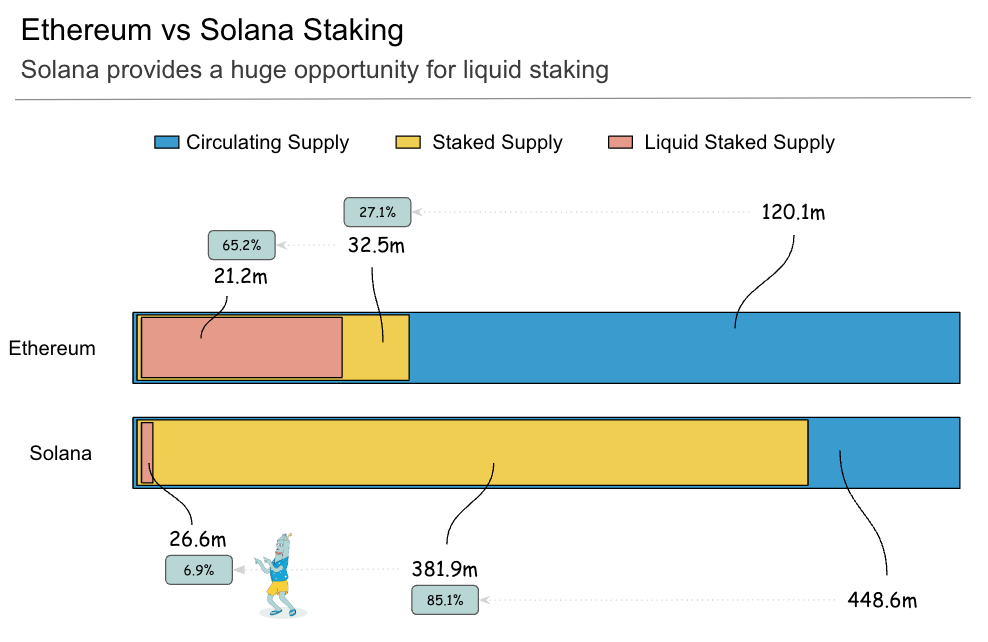
Notice that Solana has 3x the amount of $SOL staked vs. Ethereum, yet only 6.9% of that is liquid staked.
Whereas on, Ethereum 65% of staked $ETH is liquid staked.
What happens next for staked $SOL is very obvious here, and that friends, is the big opportunity at hand!
If the reason for this is unclear, no worries, we’re going to break it down in today’s report and finish off with 3 ways to capitalize on this opportunity.
Here's what you can expect from this report:
-
The immense opportunity in liquid staking on Solana.
-
An overview of the current landscape.
-
Key factors driving demand.
-
Why we believe Sanctum is crucial in this trend.
-
Potential winners in this market.
P.S. - We’re hosting an AMA next week — scroll to the bottom for more info. 👀
Our focus today is to compare Solana to Ethereum as we believe that the liquid staking market on Solana has a massive opportunity to mimic Ethereum’s success.
👉 Solana, with over $50 billion staked via native staking, leaves a vast amount of capital illiquid.
This means all those stakers aren't able to take advantage of the main benefits of liquid staking, which includes having tokens that are freely usable across various DeFi platforms with instant liquidity.
Money always flows where it’s treated best, and in this case, that’s in liquid staking protocols.
This contrast highlights significant growth potential for liquid staking on Solana, so this trend is already happening. 🔥
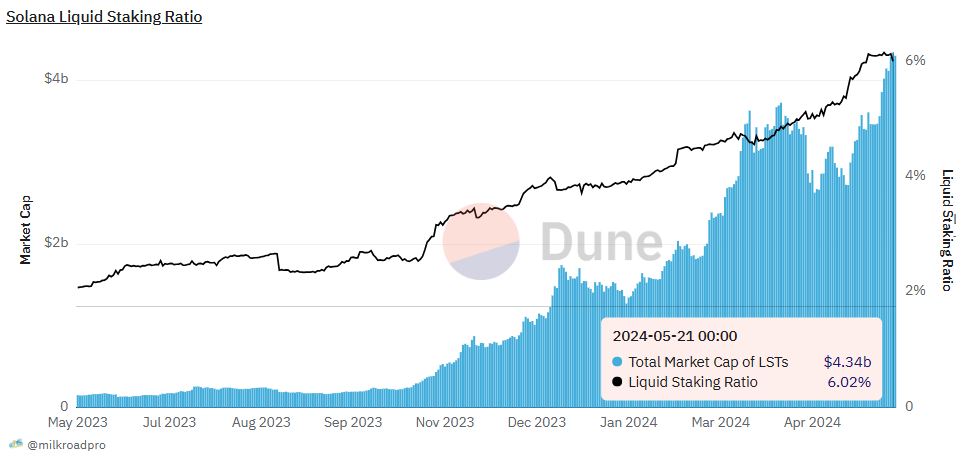
The market share for liquid staked $SOL has recently hit 6%, up from 2% ~6 months ago! We see no reason why this growth won’t continue or likely accelerate.
But before we get into the opportunity, let's step back and understand the incentives of staking, as this is what makes up the basis of this opportunity.
WHY DO PEOPLE STAKE? 🤔
Proof-of-Stake (PoS) blockchains offer an attractive incentive: staking yields.
-
These yields help users avoid the effects of inflation that are built into the system.
-
This inflation rewards those who stake their tokens by giving them a portion of the newly created tokens.
-
This system helps secure the network.
If you're not staking, you're essentially missing out on these gains which could offer anywhere from 3% - 12% APY. Therefore, many people prefer to stake.
Other Proof-of-Stake blockchains like Cardano, Avalanche or Sui have staking ratios in the high double digits, ranging from 50%-70%.
There is a staggering $670 billion staked across the top PoS blockchains.
It only confirms that people love the idea of making extra money through staking yields (who wouldn't? 😆), but not everyone is ready to tackle the technical challenges it involves.
HOW TO GET ACCESS TO THE STAKING YIELD? 👀
There are 2 main ways to stake on Ethereum, each catering to different levels of technical expertise:
1/ Native Staking: This method requires you to run your own validator with 32 $ETH as a deposit.
It's a tech-heavy commitment that involves maintaining a stable, secure system capable of running 24/7. Clearly, this isn't everyone's cup of tea.
2/ Liquid Staking: For those who prefer a simpler approach, liquid staking protocols, such as Lido, Rocket Pool or Frax Finance, are the perfect solution.
These protocols manage all the complex aspects of blockchain validation for a small fee. In exchange, they issue a token that represents your stake.
This token not only signifies your involvement but can also be used actively within the decentralized finance (DeFi) ecosystem, providing additional opportunities for earning and participation.
Ok, now let's move to Solana.
Staking on Solana presents a distinctive method for earning yields, thanks to its delegated proof-of-stake (dPoS) system.
This system varies from Ethereum's approach, making it unique. Here’s a simplified guide on how to access staking yields on Solana:
1/ Native Staking: You don’t need to run a validator yourself; you simply delegate your $SOL to an existing validator.
This makes the process much easier and more accessible. This approach involves an activation period to start earning yields and a cooldown period for unstaking.
2/ Liquid Staking: Similar to its application on Ethereum, this method involves staking through protocols that manage and delegate to validators on your behalf, charging a small fee.
They issue Liquid Staking Tokens (LSTs) in return, which represent your staked $SOL and can be used within Solana’s DeFi ecosystem for added flexibility and liquidity.
Both options allow you to tap into Solana’s staking yields with varying levels of direct involvement and liquidity.
Let's compare native vs liquid staking on both Ethereum and Solana.

Our conclusion about native staking on Solana:
1/ Native staking on Solana is more user-friendly and accessible.
There's no minimum amount required to stake, so anyone can participate with whatever amount of $SOL they have.
2/ Stakers don't need to run their own validators; instead, they simply delegate their SOL to an existing validator.
This significantly lowers the barriers to entry compared to Ethereum, where the requirements can be more demanding.
These features might explain why the staking ratios through native staking differ so much between Solana and Ethereum.
Despite the user-friendly nature of native staking on Solana, we anticipate that the ratio of liquid staking to native staking will continue to grow. The main reasons for this growth include:
Immediate Liquidity: With liquid staking, you gain instant access to your funds, allowing for quick adjustments to your investment strategy without the typical lock-up periods associated with native staking.
Use in DeFi: This means you can earn staking rewards while simultaneously using the same tokens as collateral or in other financial activities, maximizing your potential returns.
These advantages make liquid staking an increasingly attractive option, offering both flexibility and additional earning opportunities that native staking does not provide.
HOW THE LIQUID STAKING MARKET LOOKS ON SOLANA
Marinade Finance pioneered liquid staking on Solana, and for quite some time, it was the dominant player in this market.
However, as Solana's ecosystem has expanded, with more DeFi applications launching and more users arriving, the demand for Liquid Staking Tokens (LSTs) has surged.
With approximately $50 billion worth of $SOL currently locked in native staking and remaining illiquid, there's a massive opportunity for liquid staking protocols to make their mark.
This situation sets the stage for a more competitive landscape among liquid staking providers on Solana, aiming to capitalize on the untapped potential.
This growth will likely continue to evolve the dynamics of Solana's staking market, offering new opportunities for investors. 👀
All right so let's finally have a look at some data. The best way to understand this market is to look at the market share of existing players and see how it changes over time.

While mSOL is seeing a decline in its market share (27% market share), Jito is on the rise (46% market share) within the LSTs market on Solana.
What sets Jito apart?🧐
Jito offers more than just staking yields; it also includes MEV rewards.
Think of it as a combination of LIDO and Flashbots in the Ethereum ecosystem.
Jito achieved this by upgrading the original Solana client with MEV-boost, allowing rewards typically captured by MEV searchers to be distributed to validators using Jito's client and then shared with stakers.
What's notable about Jito is that they provide their modified client, the jito-solana client, to everyone.
This openness has led to over 73% of all staked SOL being managed by validators using Jito's client.
Here’s how they are able to capture some MEV rewards:
1/ Bundle Up: MEV searchers who want their transactions processed fast group them together into bundles.
2/ Auction Time: These bundles are then shown to validators who pick the highest paying bundle.
3/ Win and Process: The highest paying bundle gets processed first.
4/ Profit Sharing: Most of the money from this process goes back to the stakers, and the rest goes to validators.
That's great. But how exactly does jitoSOL profit from this?
Well, jitoSOL delegates all the staked SOL to validators who:
-
Use the jito-sol client
-
Charge less than 10% from staking yield
-
Charge less than 10% from MEV rewards
This innovative approach not only optimizes returns by capturing additional MEV rewards but also democratizes access to these benefits, making Jito a standout player in the Solana ecosystem.
And these MEV rewards are not negligible.
JitoSOL distributes about 1,000 $SOL per week as extra MEV rewards for stakers. The more activity there is on Solana, the better the rewards. So these numbers can go much higher.
What's truly remarkable is that Jito has made their client open-source, allowing anyone to use it without needing special permission.
This is a big win for the Solana community. However, it raises some questions for Jito's investors about the implications of this move.
If liquid staking really takes off on Solana… There is a question:
WHO WILL DRIVE THE DEMAND? ⚖️
To figure out who will come out on top, the above is the right question to ask.
The market for a specific liquid staked token (LST) will be shaped by user preferences, which can be split into two major categories:
1/ Yield Maximizers 🤑
Users in this group prioritize returns above all else. They are likely to choose LSTs that:
-
Utilize the jito-solana client to capture MEV rewards in addition to regular staking yields
-
Have a 0% validator fee from staking yield
-
Have a 0% validator fee from MEV rewards
Such LSTs might not be profit-focused since they return all earnings to stakers. Instead, they might be used to enhance a project's existing offerings or for other strategic reasons.
Brand strength and community support are crucial for success here. A great example is $jupSOL, which is $SOL staked with Jupiter's 0% fee validator.
This arrangement not only helps Jupiter process transactions more smoothly during high network traffic but also strengthens their entire system.
2/ Purpose-Driven Stakers 🥸
This group values the impact and goals of the project more than the immediate financial returns. They are willing to accept reduced yields to support a cause reflected by the LST. These LSTs might:
-
Impose higher validator fees
-
Retain some MEV rewards
An example is iceSOL, which channels its generated yields and rewards towards supporting open-source projects and public goods on the Solana blockchain.
This creates a sustainable funding model that appeals to users who are motivated by the project's mission rather than just profit.
In both scenarios, the attractiveness of an LST hinges on its alignment with user values—whether it’s maximizing returns or supporting meaningful causes.
This will ultimately drive the demand for specific tokens in the evolving landscape of Solana's blockchain.
Until recently, launching an LST came with high entry barriers. The established LSTs that already had strong liquidity were in the best position to benefit from this emerging trend, thanks to their ability to leverage network effects.
That's exactly why Sanctum has developed a solution to make it easier to launch and manage LSTs, helping to level the playing field.
SANCTUM BRINGS A LIQUIDITY LAYER FOR LSTs 🌊
Sanctum is revolutionizing the way liquid staking tokens (LSTs) operate on the Solana blockchain by creating a thriving ecosystem where numerous LSTs can exist simultaneously.
Their innovative approach centers around a "unified liquidity layer," which essentially means that all LSTs can share a common pool of liquidity.
👉 This makes it easier and more affordable for anyone to launch their own LST, even without massive starting capital.
One of the issues for new liquid staking providers to start and compete with existing LSTs is liquidity.
Liquidity is essential for several reasons:
Fair Pricing: Users can buy or sell LSTs anytime at fair prices. What should be worth 150$, is worth 150$.
Increased Usability: Liquidity leads to wider acceptance and integration across various DeFi platforms, expanding its uses and benefits for holders.
Sanctum has addressed these liquidity issues head-on with several key developments:
1/ The Reserve: This is a pool of liquid SOL that lets you unstake any LST instantly. Normally, unstaking takes up to 2.5 days, but The Reserve does it right away, which is very useful.
2/ Sanctum Router: Developed with Jupiter, this tool is essential for LSTs because it lets you swap one LST to another smoothly, even without a direct route.
This helps smaller LSTs tap into the liquidity of bigger ones, making the market more connected.
3/ Infinity: This isn't your typical pool that only swaps two assets. Infinity is a super pool that can handle transactions across thousands of LSTs, making it super efficient.
It's designed for a future with an ever-growing number of LSTs.
4/ $INF: When you put any LST into the Infinity pool, you get $INF tokens. These tokens earn you staking yields, MEV rewards, and trading fees.
Essentially, Sanctum has created an infinite pool of liquidity for all LSTs.
The Sanctum Router directs transactions through this pool whenever there's a swap in or out of any LSTs. Additionally, if you hold their $INF token, it represents all the LSTs held in this liquidity pool.
By holding $INF, you earn staking yields + MEV rewards + trading fees!
And people like $INF. You can see on the chart below how much their user base is growing and how much $SOL has been already deposited into Infinity.

With 200,000 addresses now holding $INF, a clear upward trend is emerging. This growth supports $INF's ambition to become the default liquid staking token (LST) on Solana. Additionally, Sanctum's Infinity has already attracted about 2.5 million $SOL in TVL.
This trend is further confirmed by looking at the top 5 growing LSTs on Solana over the last 30 days.
- $INF, $jupSOL, $hSOL, $bSOL, $compassSOL
Besides $INF itself, all these LSTs were created by different projects using the Sanctum solution to easily create an LST. It highlights its widespread use and effectiveness.
It's important to note that Sanctum LSTs have done so well over the last weeks because of 2 main reasons:
1/ The launch of a Sanctum points program - Wonderland.
The program is designed to draw more users into the Sanctum ecosystem and ensure they have fun while engaging in Wonderland activities. But let's save the Wonderland story at the end - stay tuned and I will show you how to capitalize on it.
The other reason which could be even more important is the new patch from Solana. And we will explain why in a bit.
2/ Solana's new update introduced stake-weighted quality of service (SWQOS).
This update is a game changer, especially after the congestion issues earlier this year.
Essentially, validators holding more stake can now submit more transactions to the leader who constructs the block. It helps to prevent the kind of bottlenecks caused by spam attacks and bot activities that led to many transactions dropping or failing.
This update provides a strong incentive for projects that care about user experience to take action.
If you're running a project and want to avoid scenarios where user transactions fail or drop, it's beneficial to create your own LST.
By doing this, you can attract more $SOL, which are delegated to your validator.
The more $SOL staked and delegated to your validator, the higher the chances that your users' transactions get processed swiftly and successfully make it onto the blockchain.
So a validator with 1% stake has the right to transmit up to 1% of the transactions to the block builder.
This approach not only improves user experience but also strengthens the overall performance of your project on Solana's blockchain.
Now we see why so many projects are eager to launch their own LSTs and manage their validators.
Sanctum has made this process much easier by simplifying the creation of LSTs and solving liquidity issues, making it increasingly popular in the industry.
They really hit the jackpot by being in the right place at the right time! 🧨
But let's dive back into the emerging trend of liquid staking on Solana. If I'm an investor, how can I capitalize on this opportunity?
WHO WILL BE THE WINNER? 🏆
We believe that the majority of the demand will be driven by those looking to maximize their yields. Therefore the winner is likely to be the one that offers the highest yield. 🥇
We have created this table which allows a quick comparison among the mentioned LSTs.

We believe that the liquid staking trend will persist, and we see $jitoSOL, $jupSOL, and $INF as being well-positioned to capitalize on it. Let's review which LST might offer the highest yield.
1/ jitoSOL delegates to validators running the jito-solana client, charging less than 10% on staking yields and MEV rewards.
They also apply a 0.3% management fee from the total staked value.
2/ jupSOL charges a small 0.1% fee on deposits to prevent arbitrage attacks. They don't take any fees affecting yield and have added 100k $SOL to boost rewards for $jupSOL holders.
3/ INF is an index of different LSTs, and Sanctum charges a flat 0.01% fee on every LST to $SOL swap processed through the Sanctum Router.
Based on the information provided, Jupiter could likely offer the highest yield for their liquid staking token (LST).
Also, while $INF trading fees are an interesting addition, we don’t expect them to be high enough to surpass the returns from $jupSOL.
👉 Jupiter ($JUP)
As a quick refresher, Jupiter is a decentralized exchange (DEX) aggregator that offers a variety of trading options including:
-
Swaps
-
Dollar-cost averaging (DCA)
-
Limit orders
-
Perpetual contracts
It has:
-
Handled more than $145 billion volume
-
Facilitated over 250 million swaps
-
Served over 4 million addresses
Jupiter has established itself as a key player on the Solana network, becoming the go-to platform for many users. They have recently introduced their own LST – $jupSOL.
Since they have additional incentives to operate a validator and have their own liquid staking token (LST), we expect that they will be able to maintain a zero fees policy.
In the long run, this could help them capture a significant share of the liquid staking market on Solana.
Now, we’ve shared our reasons to why we think $jupSOL, run by Jupiter could become a major player in the market. However, we still have several open questions that we are committed to monitoring and addressing over time.
Starting with Jupiter…
- If Jupiter isn't going to charge any fees, is it still an attractive option for me as an investor, and how can $JUP as a token benefit from this?
Moving from Jupiter to Jito. Rumors are swirling that Jito is already developing a re-staking solution.
This would mean that jitoSOL could be used as a token which also validates some other blockchains, not just Solana blockchain. It could eventually drive more yield into jitoSOL.
- If that's true, isn't $JTO a more interesting play to capitalize on this trend?
Also, with the jito-solana client being widely used there's an exciting development on the horizon. The new Firedancer client is set to arrive in Q4 2024, promising to boost performance of the network by 2x to 10x.
- If Firedancer launches later this year, how will this impact the overall liquid staking landscape?
We're still exploring those questions and searching for answers. In the meantime, we'll offer you some suggestions on how you can take advantage of this trend today.
3 WAYS TO CAPITALIZE ON SOLANA LIQUID STAKING GROWTH 💰
There are several ways you can benefit from this trend. Here are our suggestions.
1/ Buy LSTs (example: $jupSOL)
This one is easy and obvious... earn about 7%-10% yield and don't let your $SOL get diluted.
Plus, you get a token representation of your staked SOL, which you can potentially use further in DeFi if you want to.
2/ Participate in Sanctum/Wonderland for their upcoming airdrop
Sanctum just rolled out Wonderland, a fresh and exciting loyalty program that lets users make the most out of their $SOL and LSTs.
In Wonderland, users can gather adorable Pets and rack up EXP points to boost their levels. Or, dive into various Quests to unlock the full potential of Wonderland.
How can you participate?
-
Check which LSTs are whitelisted for Season 1 (18 tokens)
-
If you don't hold any LSTs, don't worry. Select the LST you want to buy and you will see an option “BUY”
-
Once you hold some of the whitelisted LSTs, you automatically receive EXP points
-
Watch your pet evolve
It's not clear if Sanctum will give better rewards (higher airdrop) to $INF holders compared to other tokens.
But we are pretty sure that other projects will also reflect on these EXP points to reward their users. It means you can collect points and possibly receive multiple airdrops.
We believe a great strategy might be to mix $INF with other notable LSTs. Here’s our recommended list:
-
$INF (Infinitie)
-
$jupSOL (Jupitie)
-
$bonkSOL (Bonksie)
-
$dSOL (Driftie)
Example: By holding $jupSOL, you earn EXP points that help your Jupitie 👻 level up.
3/ Invest in $JTO or $JUP
It's unclear yet how either token will accrue value from their liquid staking tokens as they are both simply governance tokens.
However, we believe that jitoSOL and jupSOL are likely to gain the most liquidity and users from liquid staking (and other services they provide).
In our opinion, this is what truly matters as it allows them to succeed long term and eventually find a way to distribute value back to their token holders.
With this in mind, we believe Jito and Jupiter will be long term successful projects on Solana and thus investing in their tokens could be a way to capitalize on the liquid staking growth as well as other aspects of DeFi within the Soalna ecosystem.
We believe that both $JUP and $JITO could outperform $SOL this cycle.
KEY TAKEAWAYS 🧵
We are excited about this trend and plan to monitor it closely to identify additional opportunities for profit.
If there are only a few key takeaways from this report, they should be the following:
-
Solana liquid staking has significant potential for growth.
-
Recent developments from Sanctum and the new patch from Solana are expected to catalyze this growth.
-
Many projects on Solana are incentivized to introduce their own LST and operate their own validator to improve user experience.
-
Projects involved in other businesses can offer zero fees and thus provide the highest yields.
-
$INF aims to become the default LST on Solana.
-
Wonderland offers a great opportunity to get multiple airdrops.
-
$JUP and $JTO are the liquid tokens that could benefit from this trend the most.
That wraps up today's report.
If you'd like to dive deeper into the topic, feel free to join our Discord community below 👇. We'd love to chat more about it there.
Stay safe out there. 👋
GET YOUR MILK READY - WE’RE HOSTING AN AMA 🥛

We’re hosting a PRO-only AMA to answer your burning crypto questions! 🔥
Wen? 29th of May (Wednesday next week).
Where? In Discord (the meetup channel).
What are we talking about? No idea… We need your questions first! Please submit any questions here.
Important: If you don’t submit your Qs ahead of time, we might not get to yours. 😢
You’re not inside the Milk Road PRO Discord? Well shame on you… Join 1,000+ fellow members here.
Note: Upon joining the Discord, you’ll be asked to fill out a form. Please, please pay attention to 2 things:
1/ Enter the exact email address you used to sign up to PRO with.
2/ Enter your exact Discord username (not your handle).
Do this with bomb-defusing precision—a single typo might lock you out! 😬
See you on the inside & chat more on Wednesday!