Solana: Price vs. Fundamentals ⚔️
A Big Opportunity 🚀
July 13, 2024

GM! Welcome to Milk Road PRO – your weekly crypto dive that’s sharper than a Solana price dip. 😬
Solana's price has dropped 35% since its peak in March.
Despite the dramatic price drop, we believe $SOL is poised for a major breakout.
Why? Because the fundamentals of Solana are continuously improving. 📈
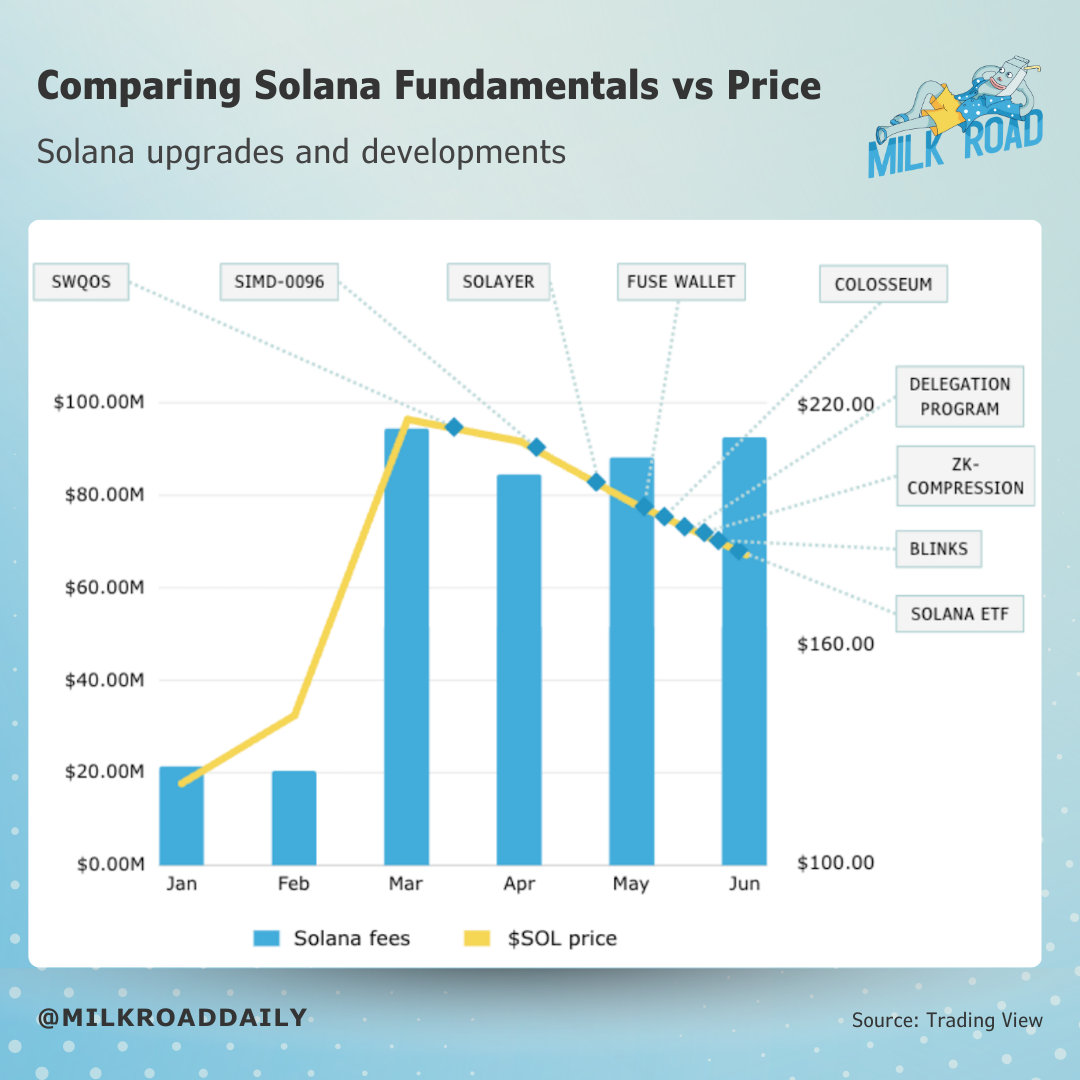
The divergence between the price and fundamentals creates an incredible opportunity. Check out this chart which highlights our thesis.
[
Source: TradingView
The price is dropping while fees are not, and there are some key developments which make Solana even more promising.
Imagine this: You buy a software business. The numbers (users, revenue etc...) look great, and your software keeps improving, but the price of your company is dropping.
What do you do? 🤔
Actually hold on. Let's revisit all the numbers and key improvements ourselves before we answer that. We will share our answer at the end of this report. ⤵️
As investors, we should remain objective about our holdings and constantly challenge and revisit our investment thesis.
In today's edition, we will:
-
📊 Examine the onchain fundamentals on Solana
-
🚀 Identify the latest bullish developments on Solana
-
📉 Explore the price action of $SOL
-
🔮 Share where we think the price of $SOL goes next
By the end of this report, you'll know everything about the current state of Solana. So, get comfortable and let’s dive into the blockchain data first!
ONCHAIN METRICS 📊
When the price of an asset falls by 35%, the first thing we want to do is take a look at the fundamentals to see if anything has changed.
When analyzing a blockchain, certain metrics are crucial. Today we are going to look at these metrics:
-
Blockchain fees
-
Monthly Active Users Wallets (MAW)
-
Trading Volume
-
Stablecoins in circulation
If you don't know why each metric is important or how we should translate the data, don't worry.
Before diving into each one, we’ll explain why it’s important and what insights we're looking for.
1️⃣ Fees generated on Solana.
Blockchain fees are a key indicator of the blockchain's utility. Think of fees as the price for using onchain products.
When users are willing to pay transaction fees, it demonstrates that they find value in the products provided on that blockchain.
And that's the goal of every blockchain - provide as many useful products as possible so people come over and use the products.
Higher fees signal greater usage and demand, reflecting strong user engagement and adoption.
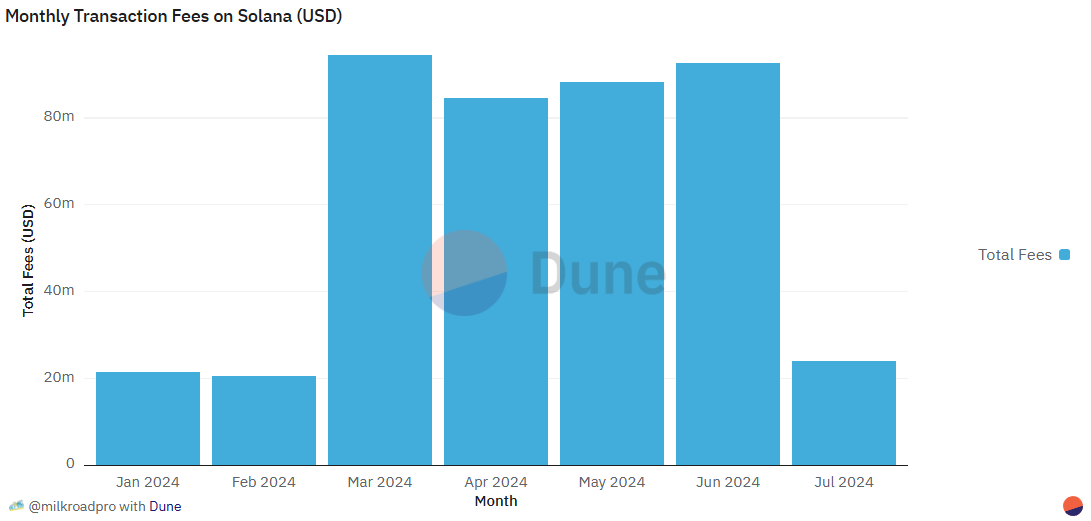
In short, the more fees generated, the better. So let's have a look at the fees on Solana overtime.
[
Source: Dune
Since March 2024, Solana's fees have remained high – around $80 million/month. Even though the market has cooled down, the fees have not decreased. 🔥
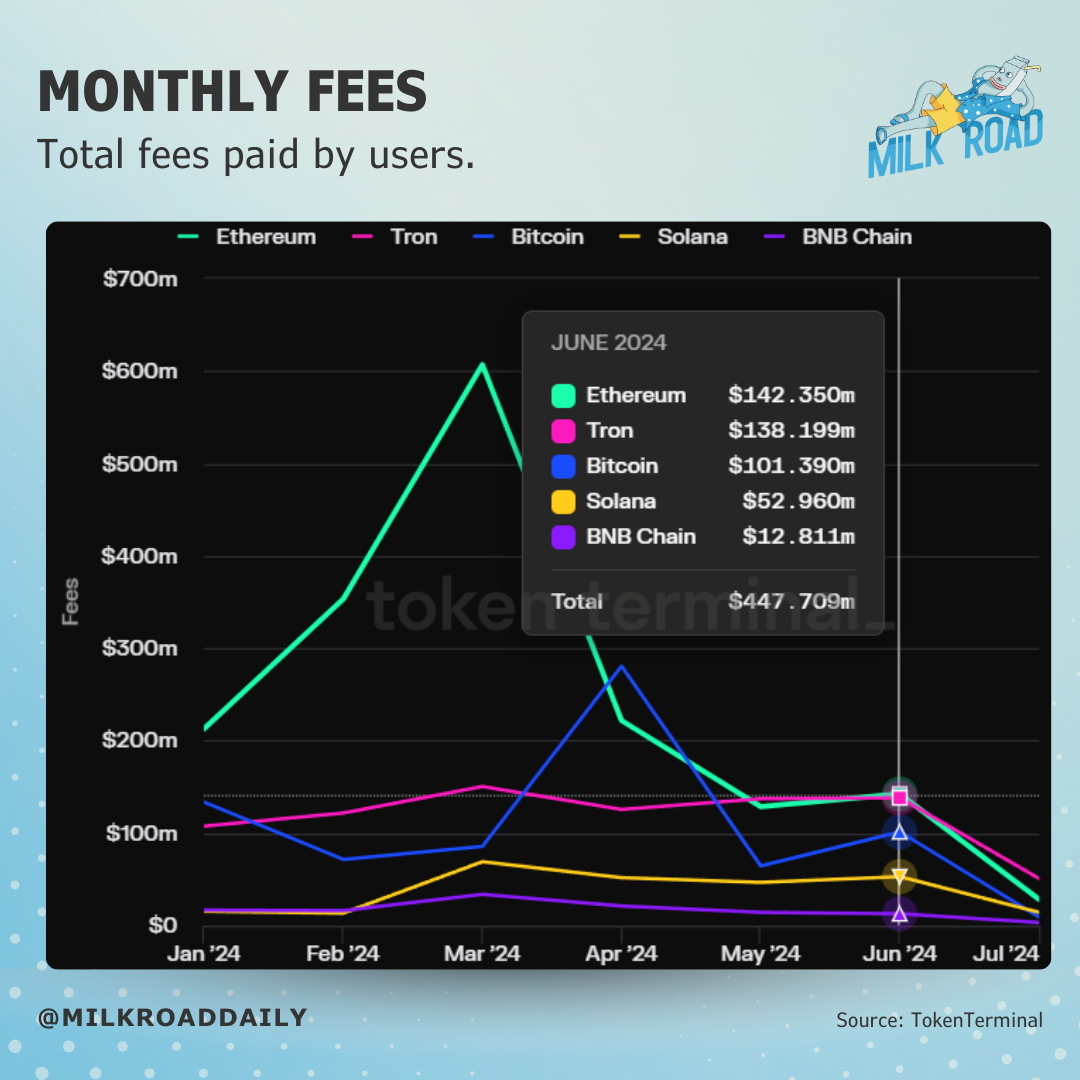
But these numbers themselves are really hard to interpret without knowing how much fees are paid on other blockchains. So let's compare fees on other blockchains.
[
Source: Token Terminal
Solana began the year 2024 with $11 million in fees and last month generated about $50 million (excluding MEV), marking a 5x increase.
Compared to other major blockchains, Solana ranks fourth in fee generation, behind Ethereum, Tron, and Bitcoin.
❗This is a very positive sign for the Solana blockchain, indicating sustained user activity and engagement.
2️⃣ Monthly active wallets (MAW).
We look at this because we want to see that there are still some active users on the blockchain and ideally more new users are coming.

[
Source: Dune
June was a landmark month with over 14 million active wallets. Notably, the number of new wallets (represented by the blue bar) surged from 6 million to over 10 million, indicating a significant influx of new wallets (users) to the Solana blockchain.
Seeing 14 million active wallets is exciting, but what does it really mean?
To find out, we need to compare it with other blockchains. Let’s dive into those comparisons and see how Solana stacks up.

[
Source: Token Terminal
Among the top five blockchains by monthly active wallets (MAW), Solana is competing fiercely for the #1 spot with Tron.
But beyond these impressive numbers, the chart reveals even more. Solana shows the strongest upward trend in MAWs (see purple line) over the last 6 months. 🔥
❗Solana boasts the most monthly active wallets (users) and shows the highest growth in this metric among the top five blockchains.
3️⃣ Trading volumes.
Trading volume reflects trading activity, which is a direct result of existing liquidity.
If a blockchain has a solid user base and decent liquidity, it will naturally result in strong trading volumes. A decent volume suggests a healthy, functioning market.

[
Source: DeFiLlama
Solana's trading volume ranges between $30-40 billion per month, which is impressive.
However, to truly understand its significance, let’s compare these volumes with other blockchains.

[
Source: DeFiLlama
Solana's DEX volume is pretty high, sitting second only to Ethereum.
But maybe even more impressive, Solana and Base are the only ones that have seen growth in DEX volume over the past three months.
❗ While other blockchains have seen declines, Solana's DEX volume has been growing steadily over the past three months.
4️⃣ Stablecoins in circulation.
This is the final metric we are going to analyze.
Looking at the number of stablecoins in circulation, we can gauge how many stablecoins are minted or bridged to this blockchain.
An increase in stablecoins signifies growing trust and usage of the blockchain. So we want to see stablecoins in circulation growing.

[
Source: DeFiLlama
Currently, $3.08 billion in stablecoins are circulating on Solana, which is down $170 million from its peak in April.
Although all other metrics are strong and provide promise, the circulating stablecoins haven't increased as expected. 🚧
To justify our concern let's look at the other blockchains.

[
Source: DeFiLlama
Ethereum and Tron are in a league of their own when it comes to stablecoins.
Solana, with only around $3 billion in stablecoins, falls short and isn't even in the top five blockchains for stablecoin in circulation.
Base (not on the chart) already surpasses Solana in this area. 🤔
❗Solana has fewer stablecoins than Ethereum L2s like Arbitrum or Base. We hope to see a significant increase in stablecoins on the Solana blockchain and will closely monitor this metric moving forward.
UPDATE: We got what we wished for. Since we finished writing this report, Solana has made a big jump in stablecoin supply. As of July 12th Solana now has $3.39B in stablecoins, surpassing Base.
We've covered all the key onchain metrics essential for analyzing blockchains. We will provide you with a summary at the end of this report.
Now, let's shift gears and explore the major developments related to Solana.
MAJOR SOLANA DEVELOPMENTS 🛠️
The price of $SOL has fallen by 45% over the last few months, but we've identified 9 key developments and upgrades that are pushing Solana's fundamentals forward.
Despite these improvements, the price has continued to diverge. Let's dive in!
Keep in mind that some of these updates can be quite technical. We'll simplify them as much as possible to ensure you understand them from an investor's perspective. 🤑
1/ Staked-weighted quality of service - sybil resistance layer.
👉 $SOL at $192 at launch, down 8.6% from local high
This update is a game-changer, especially after the congestion issues earlier this year.
It means that validators holding more staked $SOL (staked-weighted QoS) can now submit more transactions to the leader who constructs the block.
This prevents bottlenecks caused by spam attacks and bot activities, which previously led to many transactions dropping or failing.
❗This approach not only improves user experience but also strengthens the overall performance of Solana's blockchain. It increases the likelihood that transactions from real users will be successfully executed, reducing the impact of bots and malicious actors.
2/ SIMD 0096 - Solving bugs in the system.
👉 $SOL at $169 at launch, down 19.6% from local high
This proposal, known as SIMD-0096, passed to allocate 100% of priority fees to validators.
Currently, transaction submitters bribe block producers to include their transactions in the block.
However, only 50% of the bribe goes to the block producer, while the other 50% is burned.
This system encourages submitters to make side deals directly with block producers, bypassing validators to save money on priority fees.
Solana co-founder Anatoly Yakovenko addressed these concerns, calling the “priority fee burn” a bug in the system.
There was a need to solve this bug – and they did.
Though the vote has passed, implementation will take several months, allowing time for further discussion and development of additional proposals.
3/ Solayer - Restaking on Solana.
👉 $SOL at $135 at launch, down 35.9% from local high
Solayer, a startup building a restaking product similar to Ethereum’s EigenLayer, on Solana, has launched and opened restaking deposits.
If you are not familiar with staking, feel free to read our PRO Report about Restaking here.
❗Restaking is beneficial for Solana because it strengthens the usage of $SOL and Solana validators, while also creating new earning opportunities for users.
4/ Fuse - First smart wallet on Solana.
👉 $SOL at $159 at launch, down 24.3% from local high
Fuse by Squads Labs enhances Solana wallet security and usability with smart accounts, eliminating the need for seed phrases and centralized exchanges.
Think of it as bringing the web2 experience to crypto. This is exactly what we need for mass adoption.
After months of rigorous testing, Fuse is now available on iOS via Apple TestFlight only. An Android version is coming soon.
5/ Colosseum - Solana accelerator program.
👉 $SOL at $137 at launch, down 35% from local high
Colosseum has secured $60 million to accelerate the development of early-stage projects on Solana.
Think of Colosseum as the Y Combinator of the Solana ecosystem, where the best and brightest minds come together to build the next wave of groundbreaking applications on Solana.
It's like a digital boot camp for blockchain builders, where they can sharpen their skills, network with industry leaders, and potentially secure funding for their projects.
6/ Solana delegation program - Removing malicious validators.
👉 $SOL at $159 at launch, down 24.3% from local high
The Solana Foundation announced that it removed a group of validator operators from its delegation program due to their involvement in malicious activities on Solana users.
❗This step is crucial for enhancing the user experience and mitigating malicious behavior by some market participants on Solana.
7/ ZK Compression - Data layer natively on Solana
👉 $SOL at $135 at launch, down 35.9% from local high
We dare to spend a bit more time here, as this is the most important and impactful update for Solana this year.
ZK compression on Solana is a technique to reduce storage costs by compressing multiple accounts into a single account and storing the compressed data on the Solana ledger.
Today the data can be stored in accounts or in the ledger.
-
Accounts: Stores frequently accessed and modified data like account balances and token ownership. Storing costs are quite high due to the need for high performance and frequent updates.
-
Ledger: Stores less frequently accessed or larger data sets like historical data and logs. It is cheaper because it can handle slower access times and less frequent updates.
So it suggests that state data can be only stored in the ledger and only a proof of that state should be stored on the account storage.
Another way of explaining this is that Solana is using an alternative DA (data availability) layer and just posting proofs onchain, but the DA layer is still on Solana (on the ledger).
It helps with:
-
Efficiency: Storing and verifying only proofs is much cheaper and faster than storing and accessing large amounts of data.
-
Security: ZK-proofs provide strong cryptographic guarantees that the data is valid, helping to ensure the integrity and security of the blockchain.
-
Scalability: By reducing the amount of data stored and processed directly on the blockchain, proofs help make the system more scalable and efficient.
❗Overall, ZK compression helps make Solana faster, cheaper and more scalable, which is great news for developers and users alike! 🥳🥳
8/ Blinks - Connects Solana to the whole internet.
👉 $SOL at $137 at launch, down 35% from local high
Solana has introduced Blinks, a new feature that allows blockchain actions to be shared as links, embeds, and QR codes.
It's like turning any webpage into a portal to the Solana blockchain!
With Blinks, you can initiate Solana transactions directly from any platform, making it easier and more convenient to interact with the blockchain.
❗This development aims to simplify and expand the use of Solana's blockchain capabilities, potentially increasing its adoption and utility across various internet platforms.
9/ SOL ETF - First ETF application by VanEck.
👉 $SOL at $149 at launch, down 28.9% from local high
VanEck has filed for the first Solana ETF in the United States.
VanEck is a global investment management firm. As of March 31, 2024, VanEck manages $101.9 billion in assets across various sectors.
VanEck argues that $SOL functions similarly to digital commodities like Bitcoin and Ethereum, and it should be classified as a commodity, despite the SEC previously labeling it as a security.
“SOL’s decentralized nature, high utility, and economic feasibility align with the characteristics of other established digital commodities, reinforcing our belief that SOL may be a valuable commodity for investors, builders, and entrepreneurs seeking alternatives to the duopoly app stores,” said Matthew Sigel, Head of Digital Assets Research.
This move follows VanEck's previous successes with Bitcoin and Ethereum ETFs and aims to meet the increasing demand for secure and regulated digital asset investment products.
❗Although the SOL ETF is likely still over a year away, its introduction highlights strong demand and brings increased attention to Solana.
This was a recap of the key developments on Solana in the past few months, which we believe all $SOL investors should be aware of.
Now, let's try to put everything together.
KEY TAKEAWAYS ✍️
After reviewing the data and recent developments on Solana, we feel confident in saying that Solana’s price hasn't yet reflected all of the positive changes to Solana this year.
Solana reached $200 in March, but the price has been declining ever since. Solana isn’t alone here, in fact, the entire market is down 30% since March.
For this reason, we believe the sell-off in $SOL is not to do with Solana itself, but instead sentiment across the entire crypto market.
With fundamentals improving significantly during this time, we believe $SOL is ready to take off when market sentiment turns (which we think will happen sooner than later).
$SOL recently bounced back from strong support at $125. If the price breaks the trendline shown below and overall crypto sentiment shifts back to normal or bullish, we believe the market will start to price in all the changes and positive developments on Solana.

[
Source: TradingView
Based on this chart, we believe that $SOL will not only quickly surpass the local high from March, but likely move past all-time highs soon thereafter. 🚀
While the price has struggled recently, our thesis hasn't changed and we remain very bullish on $SOL.
That's also the reason why $SOL is the second biggest position in our portfolio (you can see our portfolio here).
Of course, even though everything looks very optimistic for Solana, we don't recommend putting all your eggs into one basket.
If you are not yet allocated to $SOL, we believe now is one of the best opportunities to do so.
If you already hold $SOL then it may be a great time to add to your position or simply hold onto your bag.
Whatever you decide, we think $SOL should be among the top three allocations in any portfolio at this point.
And that's it for today. We hope you've learned something new and feel more informed about Solana and all the recent developments.
Take care and good luck. ✌️
ACTION STEPS FOR PRO MEMBERS 🥛
Join the private PRO community now!
This is your all-access hub for engaging directly with the Milk Road PRO research crew and fellow PRO members, diving into live AMA sessions, digital events, and daily robust discussions on market trends, fundamentals, and industry insights.
🚨 Important: Upon joining the Discord, you’ll be asked to fill out a form. Please, please pay attention to 2 things:
-
Enter the exact email address you used to sign up to PRO with.
-
Enter your exact Discord username. To find your Discord username, click on your profile picture in Discord. Your username is the smaller text name under your profile picture.
Do this with bomb-defusing precision—a single typo might lock you out! 😬