DeFi will hit $700B market cap by EOY 2025
Will DeFi tokens grow more than blockchain tokens?
July 06, 2024

GM! Welcome to Milk Road PRO – your weekly crypto dose that’s hotter than a DeFi summer. 🥵
Today, we're diving into the world of Decentralized Finance (DeFi), a sector we predict will skyrocket to $700 billion by the end of 2025.
That’s an astounding 8x increase from where it stands now.
But here's the kicker: not all DeFi categories will rise equally.
So let’s discover which categories are primed to dominate and deliver the biggest gains.
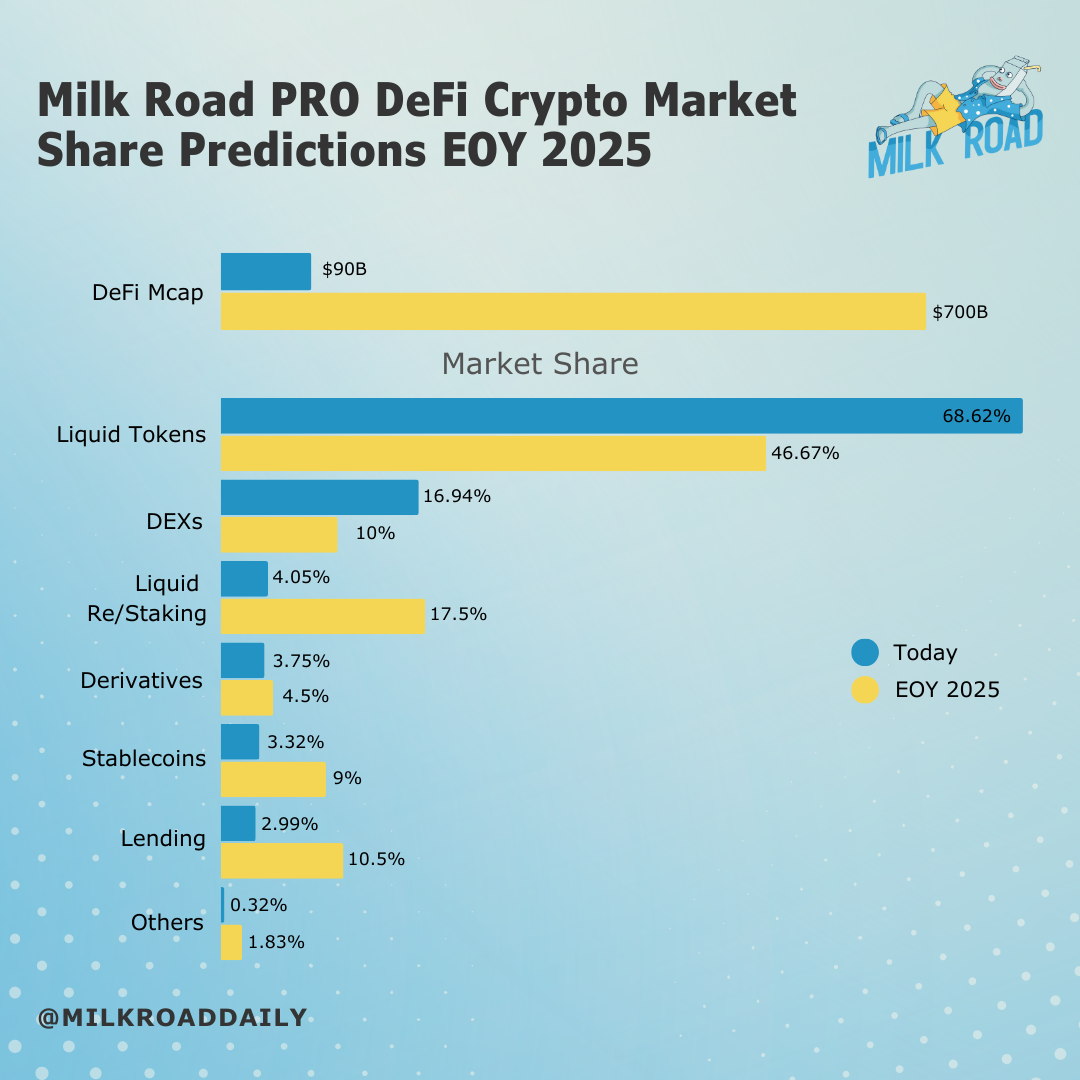
For example, the 'Liquid Re/Staking' market share is expected to grow more than 4x.
Consequently, the market cap for this category is anticipated to surge from the current $3.78 billion to $131 billion within just 18 months, marking an impressive 34x increase.
Now, you might be thinking… “That's a pretty astonishing growth projection for an industry that has been underperforming.”
Well, we believe DeFi's underperformance and waning investor interest stem from the DeFi summer 2020 bubble and current low prices.
However, the sector has made tremendous progress and now features many projects generating sustainable revenues.
If we take today's DeFi market cap and divide it by its current annualized revenues, we get a ratio of 26.
This means it would take 26 years for the revenue to equal the market cap. This is c****omparable to the technology index Nasdaq (NQ), which has a ratio of 32.
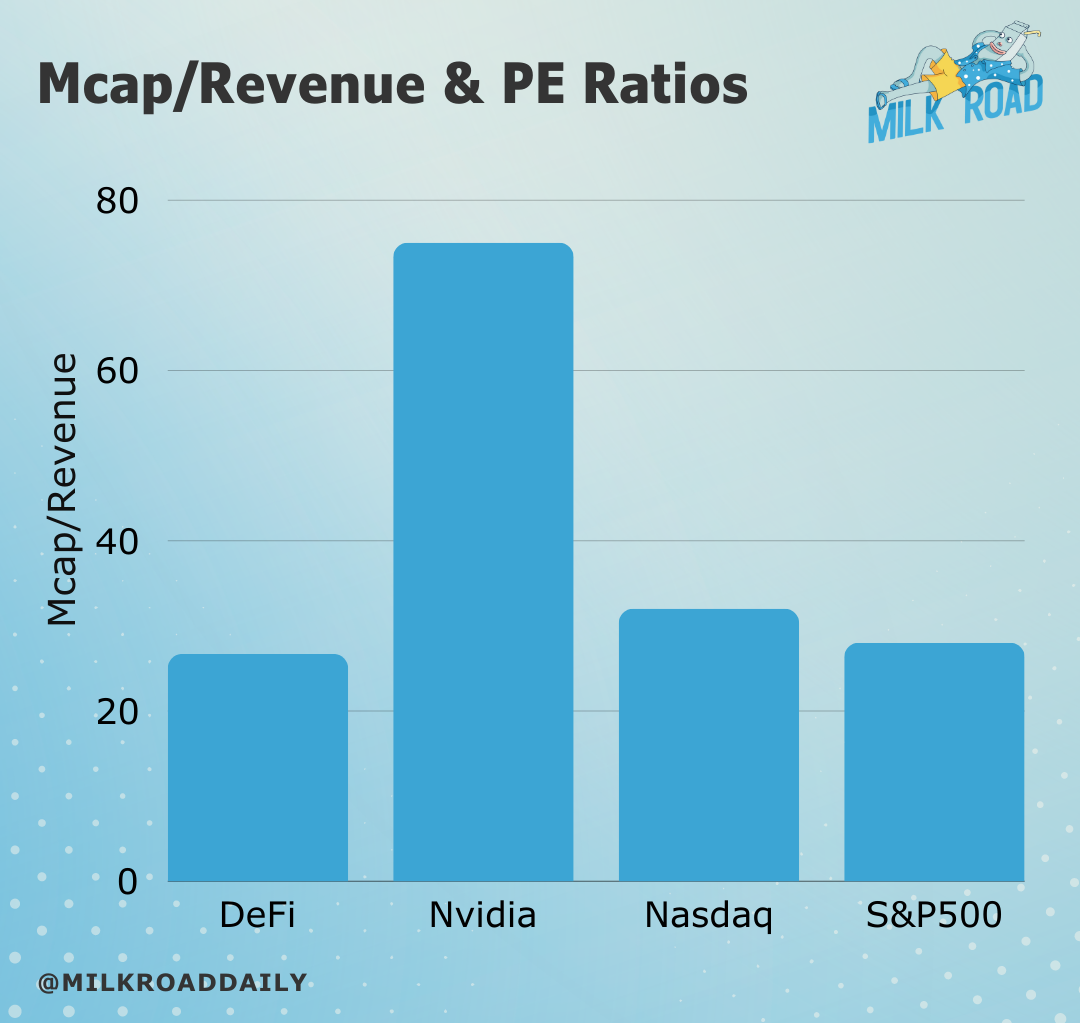
We use these ratios to determine if the sector or market is overvalued, fairly valued, or undervalued.
Moreover, we expect DeFi sector revenue to grow from the current revenue of $1 billion per year to more than $5 billion per year by the end of 2025.
❗So we're looking at a sector where revenues are expected to grow more than fivefold and its valuation remains below traditional benchmarks like the Nasdaq.
Isn’t that an outstanding investment opportunity? 👀
In today's report, we aim to understand how the DeFi market is poised to evolve.
We'll analyze the current valuations of each category, examine their business models, and identify which categories are likely to perform well.
This is what you can expect from today's report:
-
What is DeFi and why is it going to perform well? 🚀
-
Analysis of each DeFi category and our projections 📊
-
How to pick best performing DeFi projects 🎯
-
Portfolio Considerations 💼
P.S. This report builds on our previous report: Is your portfolio well-positioned for a $10 trillion market cap?
We recommend reading that report first before diving into this one.
Let's get into it. ⤵️
INTRODUCTION TO DEFI 💸
DeFi is one of the very first sectors to be built on the blockchain and thus, it’s one of the most robust.
It’s reached a stage where it’s ready for institutions to move their capital onchain and even Larry Fink, CEO of BlackRock says we are going to tokenize everything!
DeFi aims to bring the entire financial world onchain by offering a faster, cheaper, more transparent, and more secure way to move money and use financial products.
Here’s a quick look at the current size of global financial markets which is undoubtedly moving onchain over the coming decades.
Just a couple hundred trillion dollars worth of assets… no biggie. 🤷

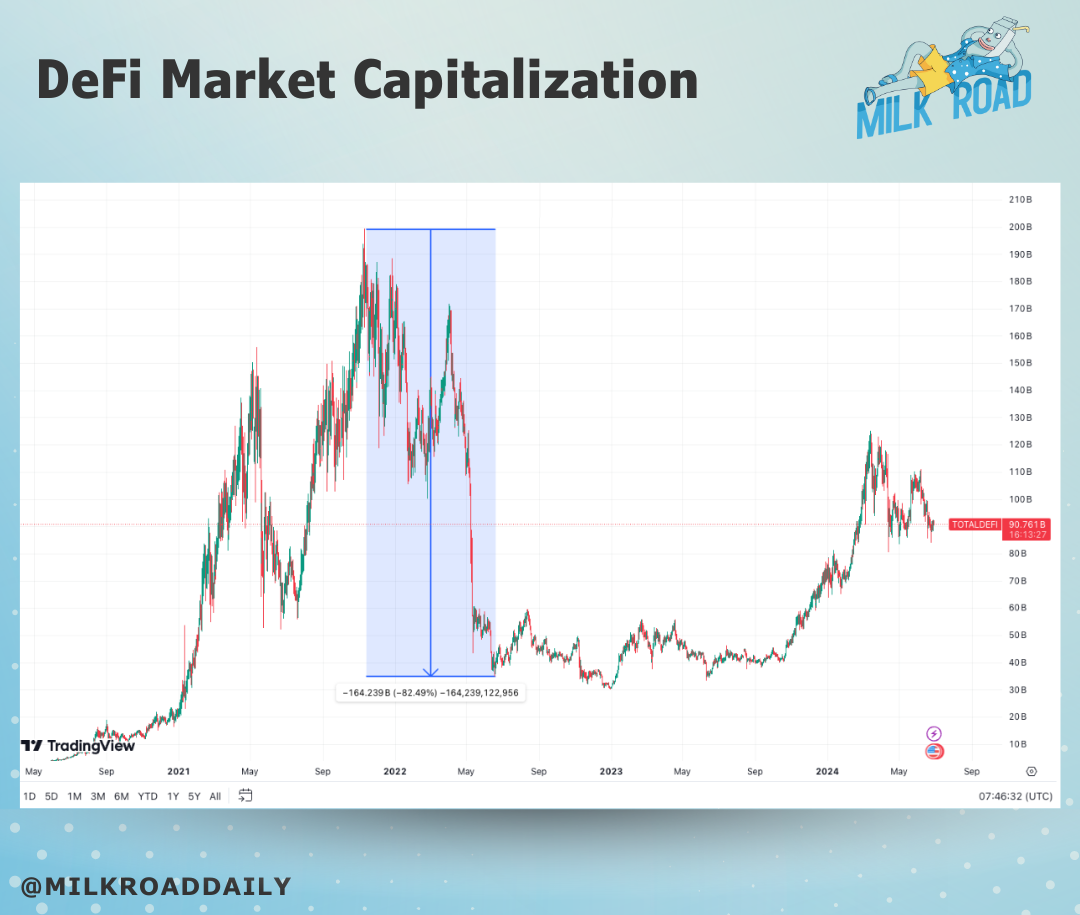
In 2020, DeFi experienced a significant boom during "DeFi Summer" when activity surged due to the emergence of liquidity mining and yield farming programs.
Here is the chart of the DeFi market cap.
[
Source: TradingView
Back in 2020 and 2021, users frequently hopped from one DeFi project to another, chasing higher incentives.
This frenzy created significant sell pressure, coupled with token unlocks for investors and team members, which ultimately led to price drops of over 80% from their all-time highs. 😪
Fast forward to today, there are DeFi projects that:
-
No longer rely on incentives
-
Have the majority of their tokens in circulation
-
Boast a decent user base
-
Generate significant revenue
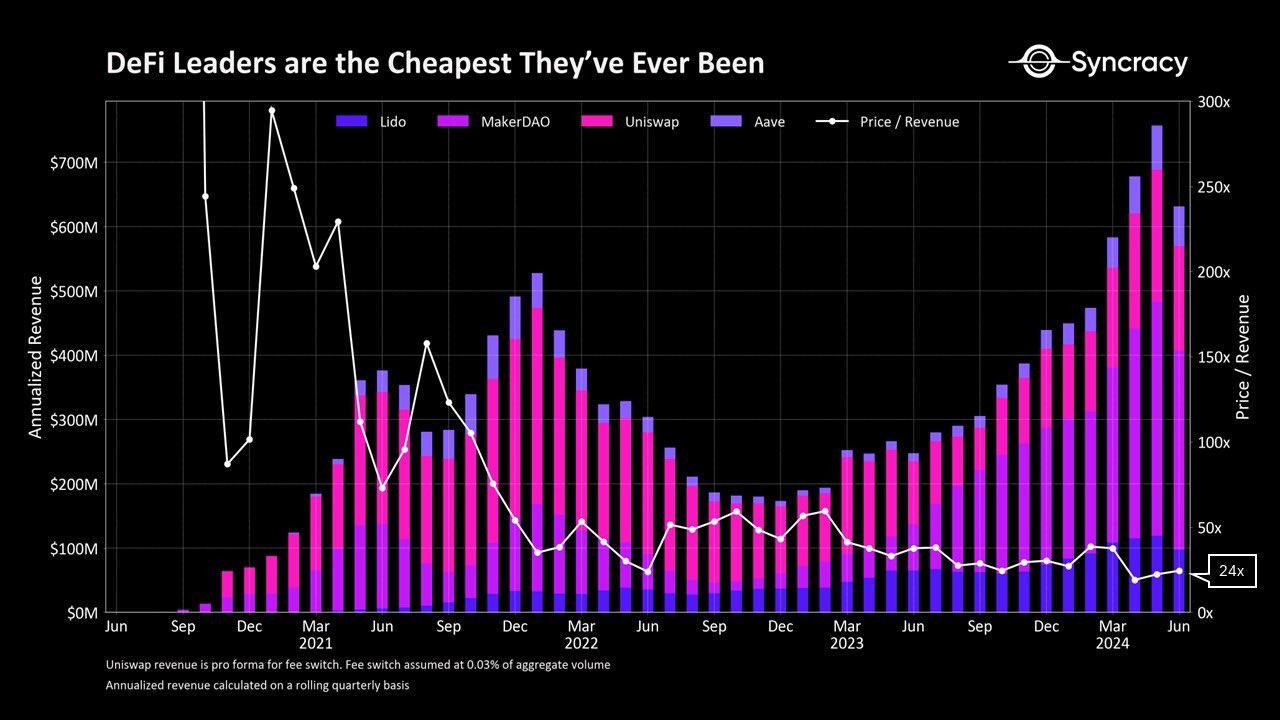
...and yet, they are the cheapest they have ever been. 💸
Today, the top 4 revenue generating DeFi applications are Lido, MakerDAO, Uniswap and Aave, having just a 24x price to revenue ratio.
[
Source: Ryan Watkins/X
Think of these as real businesses being built with substantial revenues and liquid tokens that enable people to invest in them.
This is a unique opportunity to invest in the next wave of high-growth startups, akin to buying Amazon shares back in 2002, after the dot com bubble crashed.
We believe now is the perfect time for this sector to outperform.
That's our mindset, and that's why we're incredibly bullish on DeFi. Let's walk you through each category.
LIQUID TOKENS 💵
This category includes all existing liquid staking and liquid restaking tokens. These tokens are the products of liquid staking or restaking protocols, which we will discuss in more detail in a second.
While this isn't a category we can invest in directly, these tokens and their market caps are considered part of the DeFi market cap, so we include them here. Some examples include:
-
stETH: staked ETH from Lido ($32.5B)
-
eETH: restaked ETH from Ether.fi ($6.5B)
P.S. Stablecoins are excluded.
Today, the entire DeFi sector is valued at $93 billion, with $64 billion (69%) represented by these liquid tokens.
However, we are mainly interested in the market cap of DeFi projects. And not the market cap of their products.
Thus, we could say the real DeFi market cap is just at $29 billion. What a low number. 🤯
Since we mentioned liquid tokens, let's introduce the liquid staking and restaking category next.
LIQUID RE/STAKING (e.g. Lido) 💧
Staking or restaking involves either:
-
Locking up your crypto assets.
-
Running a validator to help validate transactions or something else on a blockchain.
This process secures the network and earns you yield.
But many people want the yield without running their own validator (2).
So they lock up their crypto and outsource the validating service to liquid staking or restaking providers. These providers charge a small fee for their service.
For example, Ethereum's staking yield is 3%. Lido takes 10% of that yield. This results in a 0.3% protocol fee to Lido, while the remaining 2.7% goes to the staker.
Liquid (re)staking projects allow users to:
-
Stake or restake their crypto assets.
-
Earn yield.
-
Receive a liquid token representing their (re)staked assets.
This liquid token can then be traded or used in other DeFi applications, providing liquidity and flexibility while still earning staking rewards. 🤗
Let's have a look at some market data for this category.
Please be patient as there is a wealth of data to uncover. Once you grasp the logic and flow we use to determine future valuations, it will significantly enhance your investment decisions.
We start by examining current data and making reasonable estimates on how these figures might change.
Once we project the revenue, we can then calculate the anticipated market cap of the sector.

[
Source: TokenTerminal
Today, the market cap of liquid (re)staking projects stands at $3.7 billion, representing 4% of the DeFi market share.
Currently, about $64 billion is locked up in these projects, generating $1.4 billion in fees.
This translates to a 2.25% yield for staking or restaking assets. We expect this yield to increase to around 5%. This is due to several factors:
-
More blockchains will switch to PoS consensus.
-
Increased blockchain activity will boost yields.
-
New use cases for staking or restaking will emerge.
We also predict that the total value locked (TVL) in these projects will grow by 5.47x to $350 billion, driven by:
-
Rising prices of staked assets ($ETH, $SOL, etc.).
-
More people staking to earn yields, therefore more assets being staked.
Based on the data above, the projected revenue for this category is $1.75 billion.
By multiplying this revenue by 75, we estimate the future market cap for this sector to be $131.25 billion, representing a 34.72x increase from current levels.
Before we continue, you might wonder why we used a multiplier of 75. 🤔
We have projected the revenue for this category, but we need a way to estimate the market cap.
To do this, we borrow the famous Price-to-Earnings (P/E) ratio from the traditional finance world and apply NVDA's current P/E of 75 here.
Below is a chart to see P/E ratios from other big companies.

[
Source: Fool
Now you might wonder why we chose to use NVDA's P/E Ratio. There are several reasons why:
-
Market Perception: Nvidia's P/E ratio reflects how markets value revolutionary technologies like AI. Similarly, DeFi has the potential to disrupt the entire financial industry.
-
Revenue Growth: Nvidia's revenue grew 4x YoY, and we anticipate DeFi revenue to grow even faster.
-
Sustained Valuation: Nvidia has maintained these P/E levels for several years, indicating that such valuations can be sustained long-term, which we expect for DeFi as well.
➡️ Nvidia trading at a premium is a trend we foresee for DeFi.
If you don't share our optimism, feel free to use your own estimates and apply lower P/E ratios to determine the market share for each DeFi category.
Once you do, share them on X and tag us @MilkRoadDaily.
We will apply this same logic to each category to determine the projected market cap.
💡 We will also share our top picks for each category at the end of this report. So stay tuned!
Let's continue with another category.
LENDING (e.g. AAVE) 🏛️
Lending in DeFi involves depositing your crypto assets into a platform that lends it out to borrowers. In return, you earn interest on your deposited assets.
DeFi lending platforms match lenders and borrowers, automating the process and ensuring security through smart contracts. 🔒
For instance, by lending your crypto on a platform like Aave, you can earn a 5-10% yield on your assets.
If someone wants to borrow, they must deposit collateral that has a higher value than their debt.
If the value of the collateral falls below the required level, the borrower is liquidated, and their collateral is used to repay the bad debt.
This structure ensures a secure and efficient lending process, making DeFi lending a great way to earn interest on your crypto assets.
But how do lending projects make money? They charge borrowers a higher interest rate than what they pay lenders, keeping the difference as profit. 🤗
For example: You can lend $USDC for 7%, but you can borrow $USDC for 10%.
Now let's look at some data for the lending category and see our projections.

[
Source: TokenTerminal
Lending is currently the smallest category in DeFi, valued at $2.7 billion, which represents 2.9% of the DeFi market share.
Today, lending protocols generate fees averaging 5.1% of the total value locked (TVL). We anticipate growth in both TVL and the percentage of fees generated. Mainly because:
-
Rising prices of lended assets ($ETH, $SOL, etc.).
-
More people lend their assets as they seek ‘safe’ yields on their assets.
-
Optimism and demand for leverage increase which will drive the yields higher.
TVL on lending platforms is expected to grow 7x. Consequently, the fees generated could double to 10%.
Currently, most fees go to lenders, with protocols retaining only 17.6%. We predict that protocols will decrease their margins to 12.5% in order to be more competitive, leading to a projected revenue of around $1 billion—a 9.7x increase from today.
Applying a 75x multiplier to this revenue, we estimate the market cap for this category could reach $78 billion, representing 11.2% of the DeFi market share.
DECENTRALIZED EXCHANGES (e.g. UNISWAP) 🏟️
Decentralized exchanges (DEXs) are platforms that enable the trading of cryptocurrencies directly between users without the need for an intermediary.
When you trade on a DEX, you interact directly with a liquidity pool, which is funded by other users (liquidity providers) who provide their assets as liquidity to earn a share of the trading fees.
DEXs charge a small fee on each trade, which is distributed among liquidity providers and the protocol.
For example: When you trade $ETH for $USDC, you might pay a 0.1% fee. This fee is split, with a portion going to the liquidity providers and a portion going to the protocol.
This fee structure incentivizes users to provide liquidity to the pools, ensuring that there are always enough assets available for trading.
As a result, DEXs have become a cornerstone of the DeFi ecosystem, offering a decentralized, secure, and efficient way to trade cryptocurrencies.
Here are the numbers for this category and our projections:

[
Source: TokenTerminal
DEXs are currently the largest DeFi category, with a market share of 16.9% and a valuation of $15.8 billion.
The biggest player in this space is Uniswap, which accounts for 45% of the category. 🦄
Performance in this sector is determined by trading volume rather than TVL. Currently, the annualized DEX volume is $1.8 trillion, with an average trading fee of 0.1%, generating about $1.8 billion in fees.
We project that DEX volume will increase because:
-
Rising prices of traded assets ($ETH, $SOL, etc.).
-
Increased trading activity.
We anticipate the annualized volume could reach $10 trillion, a 5.5x increase from today's levels.
Applying the same 0.1% trading fee, this would generate $10 billion in fees. We expect projects to capture 10% of those fees as protocol revenue.
To estimate the category's market cap, we multiply the category revenue by 75, resulting in a projected market cap of $75 billion, representing a 10.7% market share.
Next category.
STABLECOINS (e.g. MAKER) 💲
Stablecoins in DeFi are cryptocurrencies designed to maintain a stable value, usually pegged to a fiat currency like the US dollar.
People use stablecoins like $USDC or $DAI to minimize exposure to price fluctuations.
In fact, we produced an entire report dedicated to stablecoins, explaining why they are popular and why we are very bullish on their future.
Where we expect this market to evolve is in the differentiation of stablecoin issuers based on the underlying strategies they apply to the total value locked (TVL).
Issuers will implement various strategies to generate yield on the assets backing their stablecoins. They will then charge a small percentage of the generated yield as a fee, distributing the remaining yield to stablecoin holders.
For example: Ethena deploys all their TVL into a delta-neutral strategy and generates a 20% yield. We expect them to implement a protocol fee, taking a cut of this generated yield.
We wrote an entire report on Ethena here.
Let's explore the current data as well as our projections by the end of the year 2025.

[
Source: TokenTerminal
Stablecoins represent 3.3% of the DeFi market today, with $9.3 billion in total value locked (TVL), using circulating stablecoins issued by decentralized projects (excluding Circle and Tether).
Currently, these issuers generate a yield of about 4.6%. Until recently, issuers captured all of these yields without distributing them to stablecoin holders.
However, the market is evolving, and issuers will need to distribute these yields to attract new demand. Thus, while stablecoin issuers currently have a 100% margin, this is expected to change.
The market cap/revenue ratio for stablecoins is the lowest among all DeFi categories, sitting at 7.2.
To estimate future revenue, we need to project the TVL or the amount of stablecoins in circulation.
We anticipate that by the end of 2025, there could be about $30 billion in circulation, which is slightly more than a 3x increase. Here are the reasons:
-
Increased demand for decentralized stablecoins.
-
Increased demand for stablecoins with juicy embedded yield.
We expect various strategies could yield around 15%, with projects keeping 20% and distributing the remaining 80% to stablecoin holders to boost demand and adoption.
If this scenario plays out, the stablecoin category could generate around $900 million in revenue.
Multiplying this by 75, we get a projected market cap of $67.5 billion.
Let's analyze the last category.
DERIVATIVES (e.g. GMX) 🌪️
Derivatives are financial instruments that enable various trading strategies. They allow people to long or short different assets and engage in leverage trading.
Imagine diving into a world where you can trade futures, options, and perpetual swaps directly with other users.
No banks, no brokers.
These platforms harness the power of smart contracts to automate and enforce every trade, ensuring seamless, trustless, and transparent execution.
They generate revenue in two main ways:
-
Trading Fees: Every time you buy or sell derivatives, the platform charges a small fee. This fee is then split between the liquidity providers, who supply the necessary assets, and the protocol itself.
-
Funding Rates: For open trades, platforms may charge a funding rate. This is a periodic fee paid by traders to hold their positions.
Let's have a look at the current data and our projections for the derivatives category.

[
Source: TokenTerminal
The derivatives market, valued at $3.5 billion, holds a 3.75% share of the market.
With $1.3 billion in Total Value Locked (TVL), it generates $144 million in annual fees, translating to an 11% yield on TVL.
These fees are either distributed to liquidity providers or retained by the project if it acts as the counterparty. This results in a significant 37.5% profit margin.
The market cap-to-revenue ratio stands at 64, the highest in the DeFi sector.
As blockchain adoption grows, we anticipate TVL on derivative platforms to reach $15 billion, driven by increased demand for leverage and hedging against crypto volatility.
This category is expected to capture 10% of the TVL and maintain a 30% margin, resulting in $450 million in revenue.
Applying a multiplier of 75, the category's market cap could rise to $33 billion, representing 4.82% of the DeFi sector's market share.
KEY TAKEAWAYS 💡
DeFi has evolved from the 2021 farming bubble into a thriving and innovative sector in the crypto space.
Today, it caters to millions of users daily, providing cutting-edge alternatives to traditional fintech.
With impressive revenue generation and immense potential, DeFi is still surprisingly undervalued.
Below, we can see some data showing DeFi evaluation compared to some tradfi benchmarks.

[
Source: TokenTerminal
DeFi is currently traded at a 26 Mcap/Revenue ratio.
When compared to traditional finance's Price/Earnings ratios, DeFi stands out as undervalued.
Moreover, we anticipate DeFi’s revenue to do 5x in the next 12-18 months, a factor that the market hasn’t yet priced in.
However, some categories within DeFi might offer better risk-reward profiles than others.
Let’s dive into these categories to identify the ones with the highest growth potential and the lowest valuations.

This chart highlights which DeFi categories are poised for the most growth and which may be currently undervalued.
The standout categories include Liquid Staking & Restaking, Lending, and Stablecoins.
For example, the Liquid Staking & Restaking market cap could grow 34x (blue bar), with its current valuation at around 26 (red bar) Mcap/Revenue.
This presents a compelling opportunity for investors. While this category is particularly promising, all DeFi categories are projected to see substantial growth.
Once we've identified a promising category, our focus shifts to selecting the best project within that category to invest in.
To select the best project, we recommend focusing on three key areas:
-
Product
-
Team and community
-
Emissions and unlocks
Product: The project must offer something that people want and are willing to pay for.
Ideally, they also have a competitive advantage, such as being a first mover, being live for some time, benefiting from network effects, or possessing unique technology.
Team and Community: Look for a team that consistently delivers new features, actively implements user feedback, works transparently, monitors competition, cares about the community, publishes research and so on.
Now a strong community is also essential, as these individuals defend the project on social media, provide feedback, assist newcomers on Discord, create online content, and participate in governance.
Emissions and Unlocks: Emissions and unlocks can be hidden pitfalls in the crypto world.
Some projects might appear to have product-market fit but are actually boosting numbers through incentives.
Also be cautious of projects with low circulating supply, as upcoming token unlocks can lead to significant sell pressure, which is often overlooked but critical for investors to consider.
We signal upcoming token unlocks very frequently in the free newsletter.
Now… We believe there are projects in each category that align with our recommendations:
-
Liquid Staking + Restaking: Lido ($LDO)
-
Lending: Aave ($AAVE)
-
Stablecoins: Maker ($MKR)
-
DEXs: Uniswap ($UNI)
-
Derivatives: GMX ($GMX)
Here are the reports where we cover these projects or categories in more detail:
SUMMARY 🧵
DeFi has evolved from the 2021 farming bubble into a thriving sector in the crypto space.
DeFi stands out as the most investable sector in the crypto space because DeFi projects function as businesses operating on the blockchain.
As more people and investors enter the space, this clarity will help them identify and understand projects with great investment potential.
Today, the market trades DeFi with a negative bias due to poor price performance in the last cycle.
In the previous cycle, we were exploring real use cases, providing significant incentives, and dealing with ongoing unlocks. However, this has since changed.
Now, DeFi projects are more established, and their true potential is more clear. And with impressive revenue generation and immense potential, DeFi is still surprisingly undervalued.
We believe that some DeFi projects will significantly outperform smart contract blockchains this cycle.
That's why we hold some DeFi gems in our Milk Road PRO Portfolio as well:
-
$MKR (3.62%)
-
$LDO (2.75%)
-
$JTO (1.19%)
-
$JUP (1.87%)
-
$ENA (0.9%)
You can always check our updated portfolio here.
With all of that said, we wouldn’t go all-in on DeFi.
Our strategy is to maintain the majority of our investments in major assets, allocating only around 10-20% to DeFi.
That's all for today. We hope we've provided valuable insights into the DeFi world and that you feel better equipped to make informed investment decisions.
Good luck out there. ✌️
ACTION STEPS FOR PRO MEMBERS 🥛
Join the private PRO community now!
This is your all-access hub for engaging directly with the Milk Road PRO research crew and fellow PRO members, diving into live AMA sessions, digital events, and daily robust discussions on market trends, fundamentals, and industry insights.
🚨 Important: Upon joining the Discord, you’ll be asked to fill out a form. Please, please pay attention to 2 things:
-
Enter the exact email address you used to sign up to PRO with.
-
Enter your exact Discord username. To find your Discord username, click on your profile picture in Discord. Your username is the smaller text name under your profile picture.
Do this with bomb-defusing precision—a single typo might lock you out! 😬