4 ways to capitalize on the restaking narrative
From Lido & Rocketpool to restaking tokens
April 27, 2024

GM! This is Milk Road PRO, lighting up your email inbox each Saturday with a report that helps you invest successfully in crypto. 💰
Today we’re diving into restaking – a sector we believe is the next big thing in crypto.
The Milk Man wants to make sure you're ready to make the most of this trend, so we’re breaking down 4 ways you can capitalize on this massive opportunity.
EigenLayer, the protocol who invented restaking, is one of the fastest growing protocols in crypto history, moving from <$1 billion to almost $15 billion in one quarter. 🤯
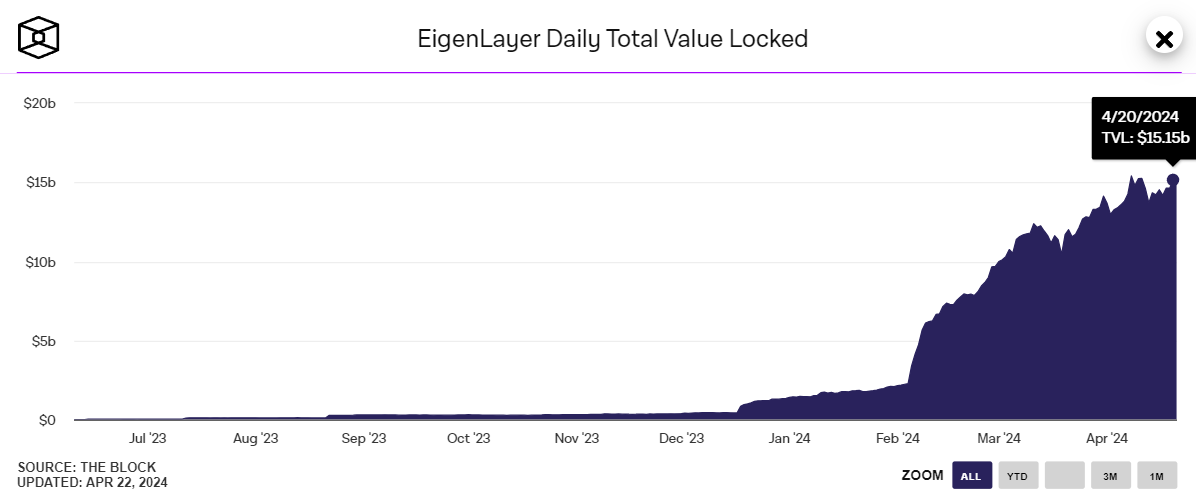
Source: TheBlock
Oh, and the craziest part is that it only went live on mainnet 2 weeks ago. 👀
Unbelievable growth, and we believe it’s well deserved. Restaking is one of the most exciting new use cases to exist in blockchain since Ethereum itself was invented.
We wrote a PRO report last year about staking becoming the next trillion dollar industry. We think restaking is the next big thing and where the opportunity to make serious cash is right now.
This could be another trillion-dollar industry built on blockchain, and it's still fresh and misunderstood by many—even in the crypto world.
We love nothing more than something with massive potential that isn’t well understood. That’s where the alpha exists and why today’s report is going to cover:
-
What is restaking and EigenLayer? 🌀
-
The bull case for restaking 🐂
-
Why liquid restaking tokens (LRTs) are going to eat the market share of liquid staking tokens (LSTs) 🌊
-
How to capitalize on the opportunity of restaking right now 💰
Ok let’s get into it, starting with a brief explanation of restaking and the protocol that invented it, EigenLayer. ⏬
WHAT IS RESTAKING? 🌀
Restaking is a complex topic, but the Milk Man will do his best to simplify it – just bare with him here…
Restaking allows validators on blockchains like Ethereum to redeploy their staked crypto assets across other proof-of-stake (PoS) based services to extend that asset’s security.
Think of restaking like repurposing the security of a staked asset. We’ll explain this more thoroughly soon…
When you stake $ETH, you are using your $ETH to help secure the Ethereum blockchain via running or delegating to a validator.
When you re-stake your $ETH, you’re extending the utility of that $ETH to not just secure Ethereum, but also other applications.
This concept is called actively validated services (AVSs) – and can consist of various applications like Rollups, bridges, oracles and more.
The advantages of restaking are simple:
1/ Think of this like Ethereum validators have excess bandwidth, so restaking allows them to put those excess resources to use.
As a result, validators and users earn additional yield outside of the yield earned from the Ethereum blockchain.
Staked ETH is ~4% APY + restaked ETH is X% APY = Total yield for restaked $ETH
FYI we don’t yet know the % APY for restaking as the protocol is still in its early days.
2/ For AVSs, bootstrapping decentralized security is extremely complex and expensive.
By using restaked security, decentralized applications save significant resources and achieve greater security than they could likely achieve on their own.
Restaking provides a clear solution to a problem for many applications on the internet.
What is EigenLayer?
EigenLayer is a protocol built on Ethereum that enables restaking.
In short, users can deposit their $ETH or staked $ETH in EigenLayer and the protocol will distribute that security to AVSs who choose to utilize EigenLayer’s restaking service.
The additional yield generated from restaking comes from the AVSs paying for this security service and then that payment is distributed back to the restakers via the EigenLayer protocol.
Is This Yield Risky?
The key thing to note here is that the yield coming from staking and restaking are both real yields, generated from sustainable and revenue generating sources.
1/ Staked $ETH earns yield from the issuance of the Ethereum blockchain (i.e. inflation) and gas fees.
In Ethereum's case, the inflation is sustainable because Ethereum is burning more $ETH than it is issuing due to its blockchain activity.
This yield is fluid and moves up and down based on gas fees as well as the number of staked $ETH – you can learn about Ethereum’s tokenomics design here.
2/ Restaked $ETH earns yield from the revenues of actively validated services (AVSs).
This yield can vary depending on how much revenue the AVSs generate and the amount of restaked $ETH.
While restaking carries some risks like any other protocol, it's not traditional rehypothecation where assets are reused in a risky manner that could create systemic risk to Ethereum. View the EigenLayer FAQ for more details on restaking risks.
Before we get into explaining the opportunities at hand with EigenLayer and restaking, there is one more layer that we need to explain: Liquid Restaking Tokens.
What Are Liquid Restaking Tokens?
Liquid Restaking Tokens (LRTs) are to restaking as Liquid Staking Tokens (LSTs) are to staking.
WTF is that? We bet you wanna punch the Milk Man in the face after he put together that sentence… Please don’t, yet! 🥺
If you've read our staking report, you know that staking your $ETH gives you a token representing your staked $ETH. This allows you to use that token in DeFi or other ways, while still earning staking rewards.
$stETH from Lido or $rETH from Rocketpool are common LSTs.
LRTs are the exact same concept, but instead for restaked $ETH.
$eETH from Ether.fi, $ezETH from Renzo and $rswETH from Swell are the most common LRTs currently. More on these in just a second…
Together, the various layers mentioned above create a new crypto ecosystem, called restaking. You can see this in a nice visual below.

Source: StakingRewards
THE BULL CASE FOR RESTAKING 🐂
We've talked extensively about the benefits of staking, and most of you get it by now. But if staking is good, why not restake to earn even more? This question makes the case for restaking pretty clear.
Restaking takes a crypto function that is already growing massively (staking) and adds additional rewards to it, with the exact same UX.
It’s one of those things that once you wrap your head around it, it's a complete no brainer. Let’s dive into the specifics to help you see just how big of an opportunity this is.
Currently, Ethereum has about 31.8 million $ETH ($99 billion) staked or about 26% of the entire $ETH supply. As you can see below, this is growing every day.

Source: BeaconChain
The bull case for the Ethereum staking ecosystem is that a 26% staking ratio is extremely low versus every other PoS blockchain.
Solana is 65.3%, Avalanche is 56% and chains like SUI and Aptos have over 80% of their token supply staked.

Source: StakingRewards
Ethereum is behind the others as it only recently transitioned to Proof-of-Stake in September 2022, from a Proof-of-Work blockchain.
It was (and still is) pretty obvious that after the merge, Ethereum’s staking ratio would sky rocket over the coming years.
This is bullish for $ETH as it means more demand for $ETH and more reason for people and institutions to hold $ETH without selling it. It’s also bullish for the protocols and tokens within the staking ecosystem who can capitalize on that growth.
That said, it’s not likely to get as high as some of the chains mentioned above, and that’s because Ethereum has a mechanism in its staking protocol which lowers the yield stakers receive with the more $ETH that is staked.
You can see this relationship below. As the $ETH stake rate increases, the yield you can generate decreases.

Source: GlassNode
With more than 26% of the $ETH supply staked, the yield for stakers currently sits just under 3%, excluding tips and MEV.

Source: UltraSound Money
As the stake rate increases, at some point the incentive to stake no longer becomes worth it. At what point that is, we don’t yet know, it could be 30%, 40% or 50%.
Regardless, this is where restaking changes the game for staking on Ethereum. If you hold $ETH or staked $ETH and you restake it, you not only access the staked ETH yield, but also the restaking yield.
This means that even if the return from staking $ETH decreases, the additional yield from restaking can keep people interested, as long as it proves successful and generates solid revenue. We believe it will.
This is undeniably positive for $ETH and could be another boost for the Ethereum staking ecosystem, but the real opportunity is within the newly emerging restaking ecosystem.
THE BULL CASE FOR LIQUID RESTAKING PROTOCOLS 🌊
In its current state, 26% of $ETH is staked and just 3.3% of $ETH is restaked. Both of those numbers will go up over the coming years, but which one do you think will go up more?

Source: Dune
Restaked, of course!
If someone is staking their $ETH to earn yield, they’ll naturally opt for the option that offers a higher return, provided it has the same user experience and similar risk characteristics. While this isn't entirely the case now, as restaking evolves, it’s likely to get there.
Currently, the total value locked in liquid staking tokens is $48 billion…

Source: DeFiLlama
In Liquid Restaking Tokens, it's just $10 billion, but look at the growth rate in LRTs vs LSTs. 🤯

Source: DeFiLlama
If that’s not clear enough, here are the absolute flows from top LSTs and LRTs for the last month.
Ether.Fi and Renzo (LRTs) are massively outperforming.
So much so that Lido (the largest LST) is actually negative on the month and has more outflows than Renzo’s inflows.

Source: Dune
Now to be fair, the LRTs aren’t currently adding any additional restaking rewards, since EigenLayer only just went live a couple weeks ago.
We still don’t know what additional yield these tokens will receive over the LSTs.
The reason these tokens are outperforming is because users are being incentivized to move from LSTs to LRTs through points programs and airdrops.
Hint: This is where a big part of the opportunity exists. 👀
Ether.Fi is the only liquid restaking protocol with a token ($ETHFI) to date, having airdropped its early users tokens worth around $450M when launched in March.
As of this writing, $ETHFI’s market cap stands at about $670M. The anticipation is now that other protocols like Renzo and Swell will do similar airdrops at similar valuations.
Even if the growth of Liquid Restaking Tokens (LRTs) is driven by token incentives, will the capital flow back to Liquid Staking Tokens (LSTs) after the airdrops, or will it stay in the restaking ecosystem? Our view is that it stays in LRTs due to the extra yield.
The key question is, will Liquid Restaking Tokens (LRTs) eat into the market share of Liquid Staking Tokens (LSTs), or could they even surpass them to become the leading Ethereum derivatives?
The answer will give us clues about the potential value of upcoming LRT governance tokens, along with the likely launch of Eigenlayer's token in the future. 👀
RESTAKING TOKENS: THE OPPORTUNITY AWAITS 🚀
There are 4 ways to capitalize on restaking. The first 3 offer short-term gains and require immediate action, while the 4th is a long-term investment strategy.
Let’s start with the short-term, since we’ve been babbling long enough in this report so far.
Opportunity #1: Earn Liquid Restaking Protocol Tokens
This one is very straightforward. No investment analysis required, just take action. Stake your $ETH in liquid restaking protocols and start earning points to earn their airdrops.
-
The more $ETH you stake, the more points you’ll earn
-
The more you use your LRTs in DeFi, generally the more points you’ll earn too (...but also the more risk you take)
-
The faster you take action, the more points you’ll earn too
Here’s a list of the top Liquid Restaking Protocols providing points programs:
- Renzo
- Ether.Fi
- Swell
- Kelp
Check out last Friday's newsletter for a guide on farming these tokens along with 5 other protocols simultaneously.
Opportunity #2: Earn EigenLayer Points
By holding the LRTs above, you automatically farm EigenLayer points for the upcoming airdrop. You can also provide liquidity into EigenLayer directly with your LSTs or native $ETH.
Doesn’t matter how you do it, the point system is the same. Though, you can likely earn boosted or bonus points by providing liquidity within the LRT ecosystem.
There is still no confirmed date on the EigenLayer airdrop, but we believe it will come at some point in 2024 and it will likely be one of the biggest to ever happen in the crypto industry.
Opportunity #3: Earn Karak Points
A new restaking platform emerged just this month called Karak. It’s similar to EigenLayer, however it provides the ability to restake more than just $ETH.
We think competition is always a good thing, and while Eigenlayer has a first mover advantage, it’s still very early to consider a winner.
While this platform is extremely new, Karak has a high quality team and we think it’s worth participating in as well.
You will need an access code to use Karak, you can use this: X1qXg
You can actually deposit your LRT tokens into Karak and earn points from the Liquid Restaking Protocol, Eigenlayer and Kark all at the same time!
One More Way to Capitalize on Restaking ☝️
Outside of earning tokens from airdrops, let’s talk about investing in restaking long-term.
The first and most simple way to capitalize on restaking is by holding $ETH.
While Karak is adding functionality for other tokens to be restaked, we believe that $ETH will be the dominant asset used for this.
$ETH is building network effects around its asset as a decentralized, deflationary, store of value with yield-bearing properties. Not many other assets in the world can claim this.
For this reason, we believe that $ETH continues to see the most benefit from the restaking demand.
The other opportunity to invest in restaking would be to buy (or hold your airdrop) tokens from the restaking protocols and/or the liquid restaking protocols.
Currently, the only token that exists in the restaking world today is $ETHFI, the governance token of EtherFi.
On a market cap basis, it looks like it could be undervalued to $LDO, if we consider that it has the potential to eat into Lido’s market share.

Source: CoinGecko
However, when we do a full analysis comparing fully diluted valuations, we can see that $ETHFI is already valued at more than Lido and Rocketpool combined!
In terms of TVL and users, this doesn’t make a lot of sense. Although, if we look at future potential, EtherFi has a leg up, considering everything explained above.

Source: CoinGecko
Regardless, we do think there is plenty of growth to be seen in these restaking tokens, however before we can make any investment decisions, we need to first see many of these tokens launch and see what sort of values they do so at.
With this in mind, we see a better opportunity in putting your $ETH to work to earn these tokens rather than purchasing them after launch.
Once they all launch and we can compare the valuations as well as further understand the revenue potential of restaking and the value accrual of these tokens, we can make more informed investment decisions.
Until then, the best move is to accumulate $ETH and use it to earn more rewards.
Stay safe and good luck out there! ✌️
Action Step For PRO Members 🥛
Join the private PRO community now!
This is your all-access hub for engaging directly with the Milk Road PRO research crew and fellow PRO members, diving into live AMA sessions, digital events, and daily robust discussions on market trends, fundamentals, and industry insights.
🚨 Important: Upon joining the Discord, you’ll be asked to fill out a form. Please, please pay attention to 2 things:
-
Enter the exact email address you used to sign up to PRO with.
-
Enter your exact Discord username. To find your Discord username, click on your profile picture in Discord. Your username is the smaller text name under your profile picture.
Do this with bomb-defusing precision—a single typo might lock you out! 😬