Is your $ETH and $SOL working for you? ⚙️
Learn where and how we earn yield on our crypto 💡
September 14, 2024

GM! Welcome to Milk Road PRO — the reason for your growing neck pain.
(That brain of yours is getting too big).
The crypto market never sleeps.
Which means leaving your holdings stagnant could mean missing out on significant opportunities.
So it’s time to ask yourself:
Are your assets maximizing their potential, or are they just gathering virtual dust?? 🫣
(You wouldn’t leave all your money in a low interest savings account – so why do it with your crypto?)
👉 The idea is to put your investments to work, so they keep earning returns without you lifting a finger.
To help you do just that, we’ve launched Milk Road PRO Portfolio V2, which now includes a brand-new page: Yield Strategies.
It shows our playbook on how we power up our major assets, $ETH and $SOL, in order to squeeze as much juicy yield from them as we know how. 🤑

If that table looks confusing, don’t worry—we’ll walk you through exactly how to read it and use it to your advantage.
But that’s just the beginning – we’ll also be covering:
-
Yield strategies: A breakdown of the strategies we use to generate yield.
-
Pros and cons: The advantages and drawbacks of each strategy.
-
Finding the best protocols: A guide on how to choose the right protocols.
-
Our allocations: Where we’ve put our major assets to work.
Are you letting your capital sit idle? Worried about security risks? Not sure what options are best for you?
This report is about to change that. 💡
We’ll show you how to maximize your returns and crush those security fears, so you can confidently put your assets to work.
Let's dive right in and kick things off with the ‘crowd favorite’ of yield strategies: staking.
THE BEST EXPOSURE TO STAKING YIELD
P.S: We cover staking in crazy detail in this report.
But if you already understand the basic gist, we'll save you a click and give you a brief summary here...
Staking is exclusive to Proof-of-Stake (PoS) blockchains and their associated tokens.
Meaning you cannot gain staking yield from Bitcoin, for example, because it is a Proof-of-Work (PoW) blockchain.
By staking your tokens like $ETH or $SOL, you receive a portion of newly minted tokens, effectively earning yield while playing a vital role in securing the network.
If you’re not staking, you could be missing out on significant gains, with potential returns ranging from 3% to 18% APY.
That’s why many investors choose to stake their assets rather than let them sit idle. 😴
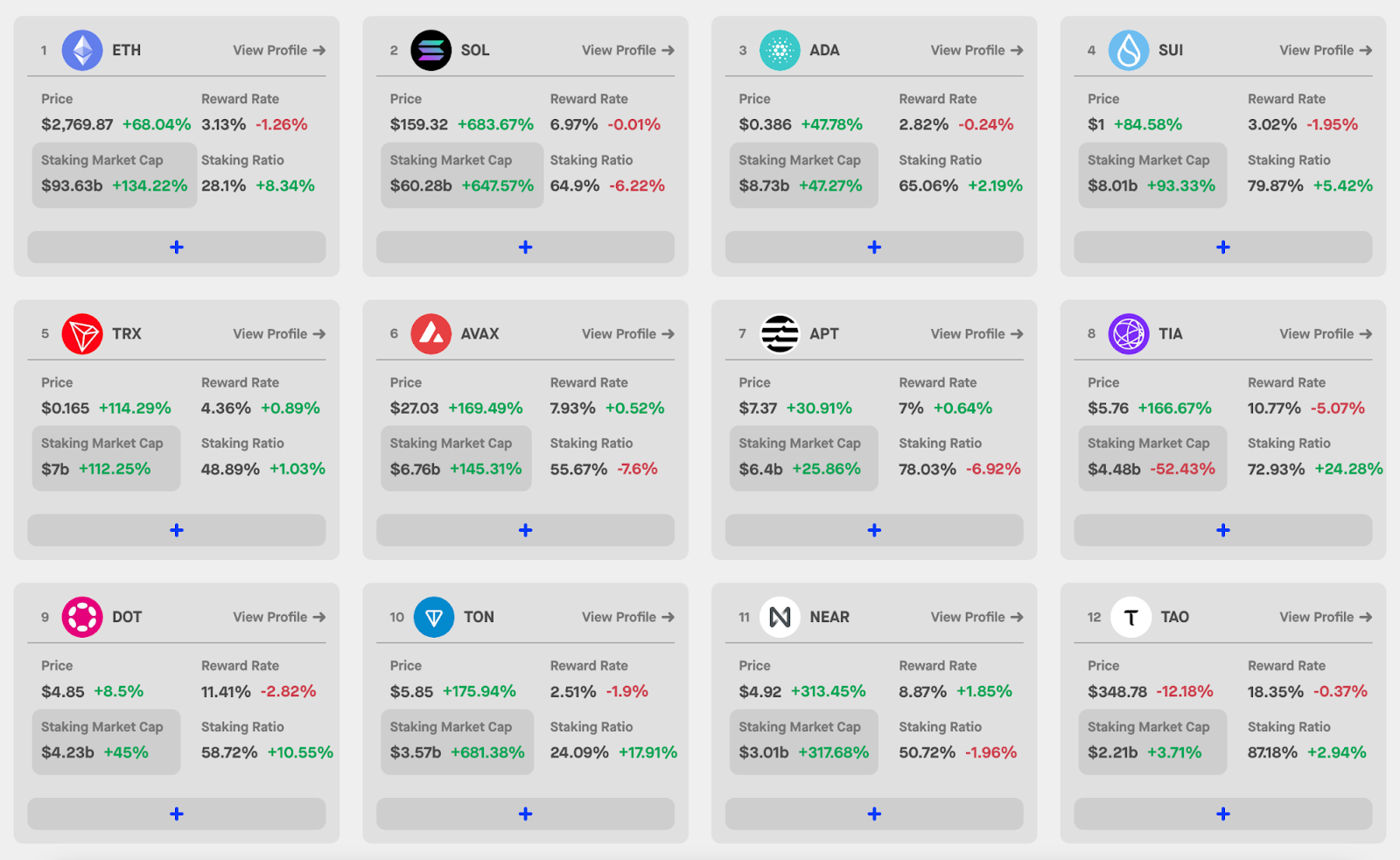
Here are the basic stats for a range of popular PoS blockchains:
[
Source: StakingRewards
Staking has become a widely adopted strategy, with staking ratios (amount staked vs. unstaked) sitting between 20% and 80% on most POS blockchains.
In fact, a staggering $520 billion is currently staked across the top PoS blockchains, underscoring its popularity as a method for generating additional income.
Assuming an average 5% reward rate, that equates to $25 billion in staking rewards. That’s massive! 💰️
Despite the appeal of earning extra income through staking, becoming a solo staker can be technically challenging – which is why staking providers like Lido, Rocket Pool, and Jito have emerged.
They handle network validation for the rest of us, while maximizing our staking yield.
Let’s break down the pros and cons of using a staking provider:
Pros:
✅ Security and efficiency: Our tokens are put to work securely and efficiently, contributing to the network’s security without us having to manage it all ourselves.
✅ Maximized rewards: We earn the majority of staking rewards without needing to handle the technical complexities, making it a hassle-free way to generate income.
✅ Liquidity retention: We receive liquid tokens as proof of our staked assets, allowing us to stay flexible and use them in other DeFi opportunities.
Cons:
❌ Fees: These providers typically charge a fee ranging from 8% to 25% for their validation services, which can slightly reduce your overall yield.
❌ Smart contract risks: There are inherent risks associated with smart contracts, such as bugs and/or vulnerabilities, that could potentially impact your staked assets.
By weighing these pros and cons, you can decide whether outsourcing your staking through liquid staking providers is the right strategy for you.
Ok, so if that’s the case – how do we go about choosing the right liquid staking provider?
Here are some key factors to consider when selecting a provider:
1/ Reputation and security
-
Track record: Look for providers with a solid track record and a strong reputation in the DeFi space.
-
Security measures: Ensure the provider employs robust security measures, such as smart contract audits.
2/ Total volume locked
-
TVL: Check how much liquidity your chosen provider has attracted.
TVL is a quick and effective measure of the broader market's trust in a provider, as it reflects the total amount of assets currently staked or locked in their protocol, valued in dollars.
Feel free to use DefiLlama, which ranks all liquid staking providers by TVL.
Simply select the blockchain you’re interested in, and you’ll see the top players in the space, giving you a clear view of where the most assets are being staked and which providers are leading the market.
3/ Yield rates
-
Competitive yields: Compare the staking yields offered by different providers. While higher yields are attractive, they should not come at the expense of security or reliability.
-
Fee structure: Be aware of the fee structure. Liquid staking providers typically charge a small fee for their services, which can impact your overall returns.
4/ Liquidity and flexibility
-
Liquid staking tokens (LSTs): Check if the liquid tokens issued by the provider are widely accepted across DeFi platforms and have enough liquidity. The more integration and liquidity these tokens have, the better.
-
Redemption options: Some providers offer instant or flexible redemption options for your staked tokens, which can be crucial if you need quick access to your assets.
5/ Decentralization and governance
-
Decentralization: Providers that are more decentralized tend to be more resilient to risks such as regulatory actions or central points of failure.
-
Governance participation: Some providers offer governance rights with their tokens, allowing you to have a say in the protocol’s future direction. This can be an added benefit for those interested in being more involved in the ecosystem.
6/ Community and support
- Active Community: A strong, active community can be a good indicator of a provider’s health and future prospects. Engage with the community to gauge the level of transparency and support.
🔥 If you’d like to skip this process, we’ve got you covered—we’ve done the work for you and will share our top picks with you at the end.
Now that we’ve covered the pros and cons and selection process, it’s important to explain the different types of liquid staking tokens (LSTs) you might receive.
This is also true for liquid restaking tokens (LRTs).
There are two main types, and understanding the difference is important – so let’s break them down:
1/ Rebasing tokens: The price of the token is equivalent to the underlying asset (e.g., 1 $stETH = 1 $ETH).
Yield is earned through an increase in the token balance—your holding of $stETH grows over time as rewards accumulate.
2/ Repricing tokens: The price of the token differs from the underlying asset (e.g., 1 $wstETH ≠ 1 $ETH).
In this case, yield is reflected in the rising value of the token itself, so as rewards are earned, the price of $wstETH increases.
See the diagram below.

In this scenario, we start the year with 10 $ETH, an ETH price of $1,000 and 10% staking yield.
By the end of the year, assuming the price remains $1,000 for simplicity, the dollar value will be the same for both token types at $11,000.
However, pay attention to the red rectangles—they highlight what sets them apart.
✍️ Rebasing tokens increase by token balance, while repricing token increase by token price.
Some investors prefer repricing tokens because they can be more appealing for tax purposes, potentially turning what would be considered income into capital gains, which may have different tax implications.
However it may vary depending on the country you have tax obligations in.
The final step is to acquire some liquid staking tokens (LSTs). Here’s how you can do it:
1/ Stake directly with native tokens:
If you already hold the native token (e.g., $ETH), the most efficient way to get LSTs is to stake directly through the liquidity provider’s website.
This method allows you to convert your tokens into LSTs without intermediaries. Just make sure you’re using the official website to avoid scams.
For example, if you have $ETH and want to get staked $ETH ($stETH), you can easily do so by visiting Lido's official website and staking your Ethereum directly through their platform.
2/ Swap for LSTs:
If you don’t have the native token but still want to acquire LSTs, you can buy or swap your available assets for LSTs on an exchange.
This method is convenient but may result in some slippage – plus you’ll need to pay a trading fee.
For example, if you have something other than $ETH, like $USDC, you can use a service like Cowswap to swap it for $stETH. Alternatively, you can use a centralized exchange if that's your preference.
Basically, if you already have the underlying tokens, it's best to use direct staking through the liquidity provider to get your liquid staking tokens (LSTs).
If you don’t have the native tokens, you can opt for the second option: Buy or swap your available assets like $USDC for LSTs on an exchange.
If you're accustomed to using a centralized exchange (CEX), go ahead. But if you prefer a decentralized option, consider using a DEX aggregator like Cowswap or 1inch.
Before we share where/how we deploy our assets we want to talk a little bit about restaking and lending – starting with restaking.
THE BEST EXPOSURE TO RESTAKING
P.S: We have a PRO report on restaking, so we won’t go into too much detail here.
In short, restaking allows stakers to reuse their staked tokens to provide additional validation services and earn rewards.
Again you won’t need to handle the validation yourself—you can outsource that part and simply contribute by restaking your assets.
But there is the key difference between staking and restaking:
-
When you stake L1 tokens, you know you’re validating that specific blockchain and earning yield from it.
-
With restaking, you don’t necessarily know which projects or services you’re validating—and often, you don’t have to.
Projects like EigenLayer and Symbiotic serve as restaking marketplaces, connecting the supply side (operators/validators) with the demand side (actively validating services, or AVSs).
To simplify and broaden access to restaking, liquid restaking providers like Ether.fi and Renzo have emerged.
These providers collect assets like $ETH from users and delegate them to trusted operators.
The assets ($ values delegated) serve as guarantees, ensuring that the operators deliver high-quality and reliable validation services while adhering to the rules set by AVS.
But here’s the catch: The demand from AVS for restaking isn’t very high.
For example, there's about $11 billion in TVL on EigenLayer, representing the supply for restaking.
Which means this $11 billion is waiting to earn some juicy yield – but to achieve a 10% restaking yield, projects or AVSs would need to be demanding restaking services worth $1.1 billion, which isn’t happening at the moment.
And we believe it will take some time before we see any significant demand for restaking.
👉 This indicates that the real yield from restaking isn’t driven by genuine demand yet—it's mostly fueled by incentives and airdrops.
We should also note that restaking is still a relatively new concept, with the first restaking protocol, EigenLayer, launching earlier this year.
As such, it remains quite risky – and we wouldn’t recommend deploying all of your assets into restaking protocols (unless you’re prepared to lose it all). 😄
With that in mind, choosing your liquid restaking provider will be quite similar to selecting a liquid staking provider.
However, here are a few additional factors to consider beyond the previous guide:
-
Delegating process: Once the provider accumulates a significant amount of restaked capital, consider how they select operators to run the validation services. A transparent and thorough selection process is crucial for minimizing risks.
-
Operator diversification: Ideally, operators should provide validation services for multiple independent AVSs. This diversification can spread risk and potentially enhance returns.
-
Slashing risks: Be aware that operators might validate AVSs with varying slashing policies. Some AVSs may have more aggressive slashing rules, which increases the overall risk of slashing and potential loss of assets.
P.S: You can find a list of liquid restaking providers ranked by TVL here. This ranking can serve as a useful filter to help you choose a provider based on market trust and liquidity.
🔥 But once again, we’ve handled the selection process for you and will share the top restaking protocols that are worth your attention below.
Here’s the main takeaway: We use restaking not because we anticipate high yields, but because we’re aiming for juicy airdrops from new projects trying to establish themselves in this market. 😉
To gain exposure to potential airdrops and possibly earn a small restaking yield, you have two options, similar to staking:
1/ Direct restaking:
If you hold assets accepted by the provider, you can restake them through the provider’s official website to receive liquid restaking tokens (LRTs).
2/ Buying or swapping:
If you hold other assets, you can convert them into LRTs by buying or swapping on supported exchanges.
Great! Now that we’re familiar with staking and restaking, including their pros and cons, how to choose providers, and how to access the yield – it’s time to talk lending.
THE BEST EXPOSURE TO LENDING
Lending is the second most significant source of real yield in DeFi today, after staking.
PS: We’ve already covered lending in our previous reports as well:
🥛 PRO | Is $AAVE the next big DeFi token in crypto? 📈
🥛 PRO | DeFi will hit $700B market cap by EOY 2025
Here's a quick recap: Lenders deposit their assets, which are then borrowed by others. Borrowers pay interest on these loans, and that interest is passed on to the lenders.
(Bada-bing, bada-boom!).
Let’s take a look at the size of this market…

[
Source: TokenTerminal
Over the past year, the five largest protocols have paid out nearly $350M to lenders.
That’s something, ain’t it? But before we get too excited, let’s review some pros and cons of lending.
Pros:
✅ Yield generation: We earn yield on our assets.
✅ Liquidity retention: Some protocols issue liquid tokens as proof of our lent assets, allowing us to stay flexible and use them in other DeFi opportunities.
(For example: You lend $USDC on Aave, and you receive $aUSDC in return.)
Cons:
❌ Protocol risks: Some lending protocols may lack robust risk management measures, potentially leading to bad debt.
Borrowers can use lower-quality “shitcoins” as collateral, which could put my assets (which they borrow) at risk if the collateral value drops significantly.
❌ Smart contract risks: Smart contracts carry inherent risks, such as bugs or vulnerabilities that could be exploited.
Alright, so how do you choose the best lending provider?
Our initial guide for selecting liquid staking providers also applies to lending protocols. 😂
(Scroll back up if you’d like to review the guide again).
But we know that most users often base their choice on just one factor: TVL.
(In that case, you can use DefiLlama again).
And quite frankly, if a project manages to attract hundreds of millions or even billions of dollars, it sends a clear message of trust and credibility.
👉 Bigger players with the resources to do their own due diligence and audits trust these high TVL protocols with their bags – so it should be relatively safe to send a chunk of our money there too.
However, a reminder:
❗Even high TVL isn’t 100% foolproof. Remember, Terra Luna had $20 billion in TVL before it all came crashing down.❗
With staking, restaking, and/or lending, we know exactly where the yield is coming from, making it a more transparent and sustainable design.
We’ve covered how to earn staking or restaking yield, either by directly staking/restaking through the protocol or by swapping/buying liquid tokens on exchanges.
Now, let’s dive into how you can access lending yield.
Deposit:
Simply deposit your assets into the protocol using their official app. Make sure to double-check the link to avoid scams!
(For example, if you want to lend your money on Aave, you simply go to their official app, find the asset you want to lend, and then deposit it. That’s it!)
Great! Now that you're familiar with all the strategies we use for our assets, let’s finally reveal our exact allocations and the projects we’re invested in…
WHERE WE GENERATE YIELD TODAY
We want to show you how we put our capital to work in the Milk Road PRO portfolio, along with some insights on our approach and reasoning behind these investments.
Keep in mind that we hold 11 tokens, but we’re primarily focused on deploying $ETH and $SOL, which make up 74% of our portfolio!
Simply because there are great, relatively safe yield opportunities for these assets as we discussed above.

So how do we go about reading this table?
If you’re wondering where to deploy your $ETH, focus on the rows where the ‘Asset’ column reads ‘$ETH’ (e.g. the first 2 rows).
PS: You can find this table on the 'Yield Strategies' page here.
You’ll notice that:
-
We converted 70% of our $ETH into $wstETH from Lido, earning a staking yield (3.2%)
-
While the remaining 30% we swapped into $weETH from Ether.fi to earn restaking yield (including staking yield) and qualify for future airdrops.
The table also highlights different risk levels for each allocation, and the last column provides guidance on how you can achieve the same position for yourself.
We’ve previously discussed the options of direct staking/restaking and swapping earlier – and the same logic applies to $SOL.
We’ve allocated our $SOL across three different liquid staking providers, with the majority (60%) in $jitoSOL (see rows where ‘Asset’ column reads $SOL).
✍️ Notice that all our $ETH and $SOL are fully allocated, meaning we’re generating yield on our entire holdings!
Let’s quickly take a look at how much we earn per year (using current yields):
-
ETH: 0.52 $ETH/year → today valued at $1,210
-
SOL: 16.20 $SOL/year → today valued at $2,140
Remember, we’re investors, not traders, so we plan to hold these assets long-term.
Earning 0.5 $ETH per year might be worth “just” $1,210 at today’s prices, but who knows what $ETH will be worth in 5 years to 10 years?
We might look back one day and say, "Hey, we were earning $10K per year—that’s insane!" 🤑
And even if we were to sell immediately, that would still result in an annualized yield of $3,680, translating to a 4% return on our total portfolio value of $90K.
But wait, there’s more!
We can take our yielding assets and put them into another protocol to generate even more yield—what we call “boosted” yield.
Crazy, right? But rest assured, security is still our top priority.

For example, say we take 30% of our $wstETH and deposit it into Symbiotic to earn restaking yield and qualify for a future airdrop, which is expected to be substantial (potentially as big as EigenLayer).
Similarly, we could allocate 50% of our $jitoSOL into Kamino, the largest lending protocol on Solana.
And with Kamino's ongoing second points season, we could earn lending yield and qualify for a future airdrop too. 🪂
Our overall yield would be even higher once we factored in the boosted yield and the value of tokens we expect to receive from airdrops!
But remember: Always make sure to pay attention to the risk levels in our tables and act accordingly.
While we're confident in the protocols we use, we would never allocate a majority of our assets into anything marked red!
We have solid confidence in the protocols we use, as they’re often market leaders with strong teams and respected backers.
These protocols typically undergo multiple audits and strive for maximum decentralization, further reducing the risks of legal actions or central points of failure.
Alright, that’s it for today!
We hope this report helps you better understand the yield opportunities in front of you. 🤗
And don't worry, If we make any changes to our allocations, we’ll share the signals on our Discord, so be sure to join us there!
Take care and good luck!
ACTION STEPS FOR PRO MEMBERS 🥛
Join the private PRO community now!
This is your all-access hub for engaging directly with the Milk Road PRO research crew and fellow PRO members, diving into live AMA sessions, digital events, and daily robust discussions on market trends, fundamentals, and industry insights.
🚨 Important: Upon joining the Discord, you’ll be asked to fill out a form. Please, please pay attention to 2 things:
-
Enter the exact email address you used to sign up to PRO with.
-
Enter your exact Discord username. To find your Discord username, click on your profile picture in Discord. Your username is the smaller text name under your profile picture.
Do this with bomb-defusing precision—a single typo might lock you out! 😬
Join the PRO Discord Community Here
See you on the inside! 🥛
Start the Crypto Investing Masterclass (50% off just for you)
If you want to supercharge your portfolio and capture a piece of crypto's growth to a $100T market cap, then you need to understand these 4 basic concepts:
-
The fundamentals of crypto cycles
-
Liquidity flow in crypto
-
How to pick the right coins for your strategy
-
Building a portfolio that outsmarts 99% of crypto investors
You can learn all of the above (and more) inside the Milk Man’s Crypto Investing Masterclass — your ultimate cheat code to become a successful crypto investor.
This masterclass lays the foundation of investing in crypto, so you can maximize the value of the Milk Road PRO reports and build a portfolio that brings you generational wealth by the end of the next bull cycle.
The best part? Milk Road PRO members like you 🫵 get a 50% discount for lifetime. 🥳